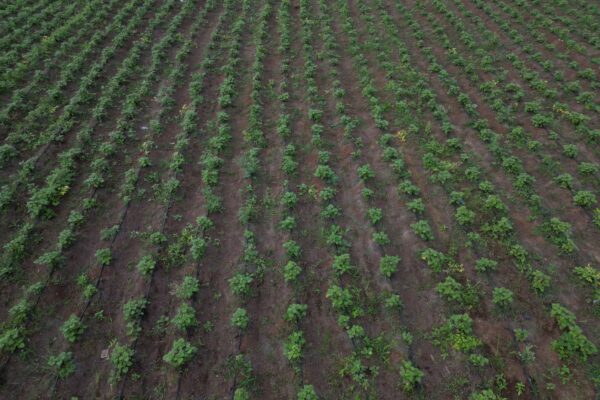
The ₹81,000 crore project requires flattening 130 square kilometres of ancient rainforest, and the government cleared the path by quietly wiping Category IA reefs off official charts.
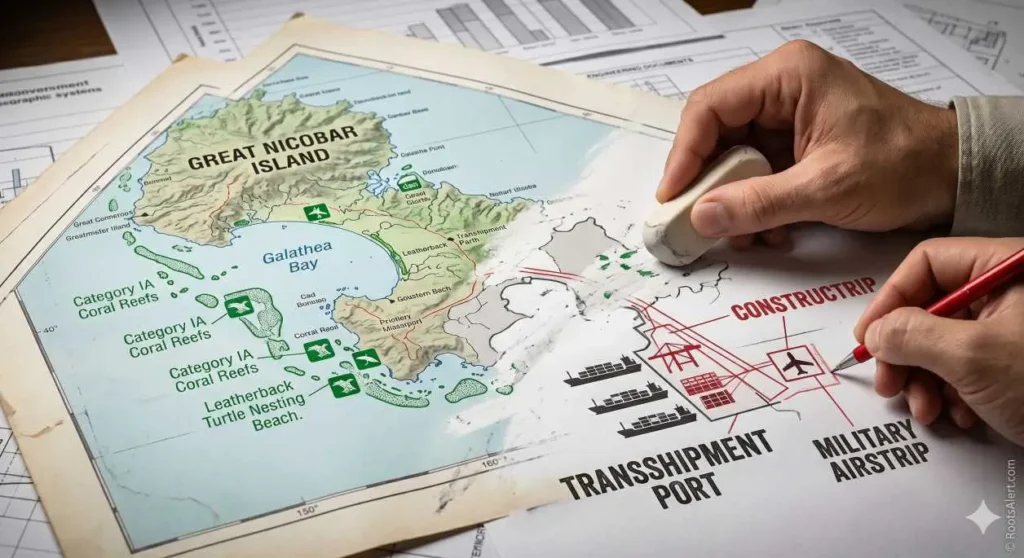
Whole coral reef ecosystems simply vanished from official Indian government maps between 2020 and 2021. The cartographic sleight of hand cleared the legal runway for an ₹81,000 crore mega-infrastructure project on Great Nicobar Island. It’s a move that ensures concrete will replace the corals.
The National Centre for Sustainable Coastal Management (NCSCM), a Chennai-based institute operating under the Ministry of Environment, Forest and Climate Change, drew the original maps. They accurately depicted lush coral reefs hugging the shores of Galathea Bay in the south of the island. The agency classified this coastal stretch as Category IA under the Integrated Coastal Regulation Zone Notification of 2019. That specific designation provides the absolute highest level of environmental protection in India. It explicitly outlaws major ports, harbours, and industrial setups so they don’t destroy sensitive ecologies.
But a massive geopolitical vision demanded a different reality on the ground. The NITI Aayog’s master blueprint for the Great Nicobar Island Development Project hinges entirely on building a massive International Container Transshipment Terminal right inside Galathea Bay. Planners couldn’t legally dredge the bay if the Category IA classification remained intact.
So, they’ve just changed the maps.
The 2021 revised NCSCM documents erased the protective green band from the coastline entirely and depicted the coral reefs floating out in the middle of the ocean, safely away from the proposed port’s footprint. Environmental researchers analyzing the Andaman and Nicobar forest department’s website quickly caught the discrepancy. The updated documents stripped Galathea Bay of its IA status, effectively downgrading the ecological value of the land on paper. You can’t pave over a legally protected reef, but you can definitely build a shipping terminal if the government officially pretends the coastal corals don’t exist.
And the stakes here extend far beyond a few altered nautical charts. The Great Nicobar project represents one of the most aggressive territorial re-engineerings in modern Indian history. The Andaman and Nicobar Islands Integrated Development Corporation (ANIIDC) plans to construct a dual-use military and civil airport, a 450 MVA gas and solar power plant, a free trade zone, and a sprawling greenfield township. This isn’t just a logistics hub. It’s an entirely new economy stamped onto a severely fragile and isolated ecosystem.
The biological toll looks catastrophic. Official environmental impact assessments admit the project requires diverting 130 square kilometres of primary tropical rainforest, which equals roughly 15 percent of the island’s total landmass. The government’s own annexures state this translates to felling at least 8,52,245 trees. Independent ecologists analyzing the island’s dense, multi-tiered canopy warn the actual number of destroyed trees won’t stop at official estimates, but will easily exceed one million.
The Nicobar archipelago forms a critical part of the Sundaland Biodiversity Hotspot, hosting endemic species found nowhere else on earth. Galathea Bay itself served as the globally crucial nesting ground for giant leatherback turtles until the government abruptly denotified the Galathea Bay Wildlife Sanctuary in 2021. The chainsaws won’t just threaten the turtles, but also the Nicobar megapode, the salt water crocodile, the Nicobar crab-eating macaque, and newly discovered species like the Great Nicobar crake and the Lycodon irwini wolf snake.
The destruction cuts straight into human sanctuaries as well. Under the Andaman and Nicobar Protection of Aboriginal Tribes Regulation of 1956, roughly 92 percent of Great Nicobar is designated as a tribal reserve. The mega-project will absorb around 10 percent of this highly restricted territory. The Shompen, a Particularly Vulnerable Tribal Group, rely entirely on these untouched rainforests for their survival. The Tribal Council initially protested the development, but the government proceeded anyway. Can you replace a million-year-old ecosystem and a tribe’s ancestral home by planting commercial saplings in Haryana? The environment ministry insists it isn’t a problem, offering compensatory afforestation thousands of miles away on the mainland to offset the devastation in the Bay of Bengal.
In February 2026, the National Green Tribunal (NGT) effectively sealed the island’s fate. The tribunal cleared the project, stating they couldn’t find good ground to intervene. They cited the overriding strategic necessity of establishing a deep-water port near the Malacca Strait, a vital maritime chokepoint handling a third of global shipping. The NGT approved the environmental clearances but attached a highly controversial condition regarding the surviving marine life. They ordered the Zoological Survey of India to translocate any existing scattered corals, claiming they’d use proven scientific methods.
Marine biologists across the country dismiss coral translocation on this industrial scale as an expensive fantasy. Corals aren’t furniture you can just drag to a new room. They are highly complex organisms that require specific currents, temperatures, and symbiotic relationships built over centuries. Dragging them away from the dredging zones of an international shipping terminal guarantees a massive mortality rate, and scientists aren’t pretending otherwise.
The local administration and defence ministries argue the country can’t afford to leave Great Nicobar pristine and undeveloped. China’s naval presence in the Indian Ocean Region continues to expand, and India needs a fortified vantage point. Currently, foreign ports like Colombo and Singapore handle 75 percent of India’s transshipment cargo, driving up domestic logistics costs. Planners view the ₹81,000 crore investment as a necessary geopolitical anchor, leveraging proximity to Indonesia’s Sabang port and the proposed Kra Canal in Thailand. They’re betting the entire island’s future on it.
They also routinely ignore the island’s volatile geology. The proposed port sits directly in a highly active seismic zone. During the devastating 2004 Indian Ocean earthquake and tsunami, Great Nicobar experienced a permanent tectonic subsidence of around 15 feet. Building massive concrete infrastructure on sinking, earthquake-prone shores carries immense physical and financial risks that the project reports largely gloss over, because they’d rather not discuss it.
But geopolitical anchors demand a heavy price from the ground they sink into. The central government circumvented its own environmental protection laws by simply redrawing the boundaries of reality. They’ve traded ancient reefs, primary rainforests, and isolated tribal reserves for shipping lanes and military airstrips.
The map changed first, and they’ll ensure the island inevitably follows.