The President has eliminated Iran’s Supreme Leader and called for a revolution, but as the dust settles over Tehran, the White House admits there is no plan for what comes next.
By Rootsalert Global Desk
The smoke rising over Tehran on Monday was not just the physical remains of the Islamic Republic’s command centers; it was the signal of a radical, perhaps reckless, new era in American foreign policy. In a series of surgical strikes that have effectively “decapitated” the Iranian leadership including the confirmed death of Supreme Leader Ayatollah Ali Khamenei President Donald Trump has achieved in forty-eight hours what decades of diplomacy and “maximum pressure” could not. But as the Washington Post reports, this military triumph has left a vacuum so vast it threatens to pull the entire Middle East into a generational quagmire.
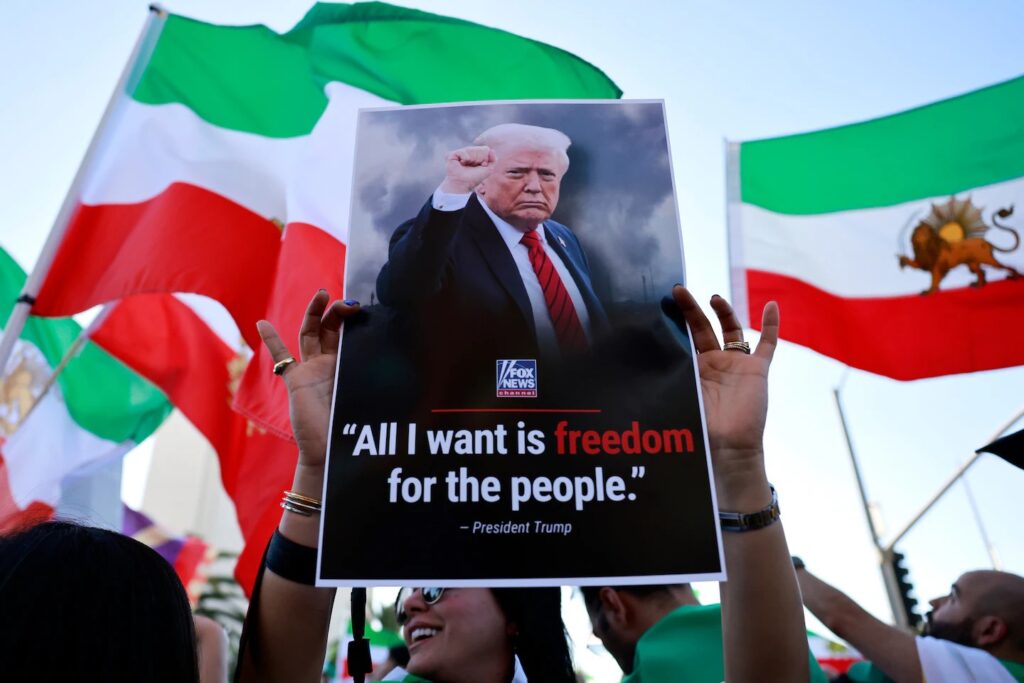
President Trump, speaking from the familiar gold-leafed backdrop of Mar-a-Lago, was blunt in his weekend address: “When we are finished, take over your government. It will be yours to take.” It was a call to arms for the Iranian people, framed as a “now or never” opportunity for freedom. Yet, behind the scenes, the administration’s strategy appears to be defined more by what it won’t do than what it will.
Unlike the nation-building projects of the Bush era or the messy interventionism of the Obama years, the Trump administration has made one thing clear: no American boots will hit the ground to help manage the fallout. This is “regime change” on a budget a decapitation strategy that leaves the body of the state to twitch and reorganize itself, for better or worse.
Sources within the administration describe the current operation, dubbed “Operation Epic Fury,” as a manifestation of “escalation dominance.” The logic is simple: hit the enemy so hard and so high up the chain of command that they are too paralyzed to retaliate effectively. By taking out Khamenei and a significant portion of the inner circle, Trump has banked on the idea that the Iranian Revolutionary Guard Corps (IRGC) will be too busy fighting over the throne to launch a coherent counter-attack.
However, Western security officials are already sounding the alarm. Iran is not a small, isolated actor; it is a nation the size of Western Europe with a population of 90 million. The Washington Post notes that security experts in both Europe and the Middle East fear the U.S. is unleashing “forces that could spill across borders,” disrupting global trade and inviting asymmetric terrorist reprisals.
Senator Lindsey Graham, a frequent confidant of the President, echoed this hands-off approach on NBC’s Meet the Press, stating, “It’s not my job, it’s not the president’s job” to pick the next Iranian government. The goal, Graham insisted, is simply to ensure that whoever emerges—be it a new cleric or a representative democracy is no longer a state sponsor of terrorism.
The shadow of the 2003 Iraq invasion looms large over these events. Critics point out that the Trump administration’s perceived lack of post-conflict planning stands in stark contrast to the detailed—if ultimately flawed—blueprints used in Iraq and Afghanistan. Trump, who rose to power partly by lambasting “stupid” foreign wars, seems determined to avoid the “Pottery Barn rule” (you break it, you bought it).
By refusing to commit troops or a reconstruction budget, Trump is attempting to claim the glory of a “win” without the liability of the aftermath. “He is calling for regime change, but is not assuming the responsibility for it,” said Richard Haass, former director of policy planning. “It gives him an off-ramp.”
But off-ramps are hard to find when global markets are in a tailspin. Oil prices have surged as the IRGC declared the Strait of Hormuz effectively closed. For an American public already sensitive to inflation, the “freedom” of the Iranian people may soon be measured at the gas pump.
Inside Iran, the situation is a powderkeg. While the President urges “patriots” to seize the moment, the streets remain a chaotic mix of celebration, mourning, and abject terror. The regime’s repressive apparatus, though headless, is far from dead. The Basij and remnants of the IRGC still hold the keys to the armories, and history suggests that when a vacuum appears in Tehran, it is rarely filled by liberals with Jeffersonian ideals.
Trump has expressed a vague willingness to deal with an “interim ruling council” announced in Tehran, provided they abandon all nuclear ambitions. “They want to talk, and I have agreed to talk,” he told The Atlantic. But when asked if he would support a grassroots democratic movement, his answer was non-committal: “I’d have to look at the situation.”
As the third day of the war escalates, with U.S. fighter jets reportedly downed by regional tensions and Hezbollah launching retaliatory strikes on Israel, the “Epic Fury” shows no signs of abating. The President has made his move, successfully “decapitating” a long-time foe. Now, the world waits to see if the head grows back or if the body simply collapses into a fire that no one, not even Donald Trump, can put out.