
The $3.5 billion facility at Jewar aims to become India’s largest aviation gateway, connecting Western Uttar Pradesh to global markets while relieving Delhi’s crowded skies.
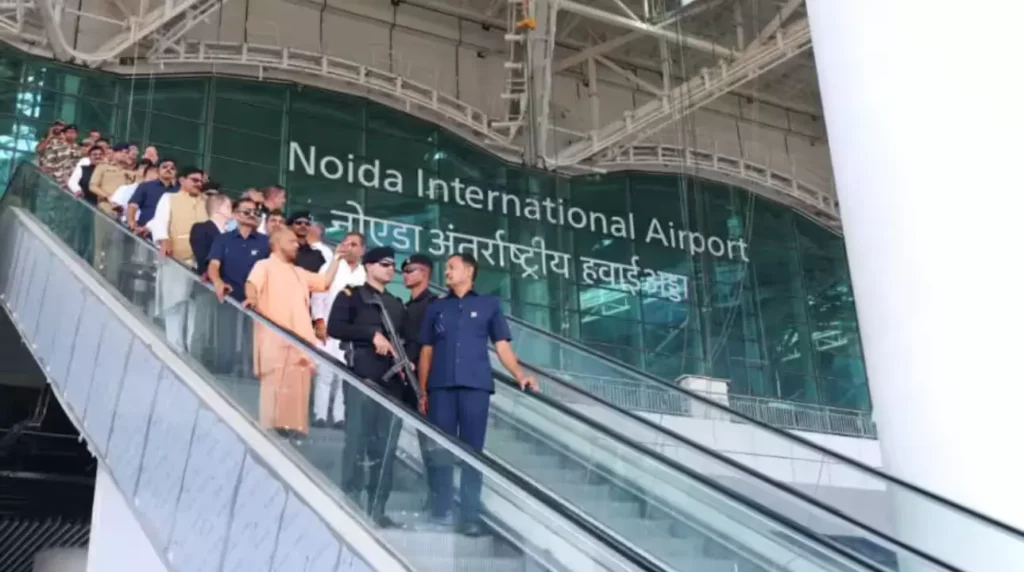
RAIPUR, March 28, 2026 – Prime Minister Narendra Modi officially opened the Noida International Airport (NIA) today, marking the completion of a decade-long ambition to build a second major aviation hub for the National Capital Region. The first flight, a commercial domestic arrival, touched down on the runway at 10:30 AM local time. It signaled the start of operations for a facility designed to eventually handle 70 million passengers annually.
The project sits on 1,334 hectares of land in the Gautam Buddha Nagar district. It isn’t just an airport. It is a calculated bet on the industrial future of Uttar Pradesh. Standing before a crowd of officials and construction partners, Modi described the site as a “gateway to international logistics” for Northern India. He noted that the region, once defined by agrarian land, now houses a digital-ready infrastructure capable of competing with global transit points like Dubai or Singapore.
Money tells the real story here. The initial phase cost approximately 10,056 crore rupees ($1.2 billion), part of a total projected investment exceeding 29,000 crore rupees. Zurich Airport International AG, the concessionaire for the project, holds a 40-year lease to operate the site. They’ve built a terminal that leans heavily on Swiss efficiency and carbon-neutral technology.
The location is strategic. Jewar sits roughly 72 kilometers from Indira Gandhi International (IGI) Airport in Delhi. For years, IGI has operated near its ceiling, causing delays and limiting new slots for international carriers. By opening NIA, the government has effectively doubled the capacity of the capital’s airspace.
And the timing matters.
India’s aviation market is currently the fastest-growing in the world. Domestic carriers like Air India and Indigo have placed record-breaking aircraft orders totaling hundreds of planes. They need somewhere to park them. They need runways that don’t have 20-minute taxiing queues.
“This is about more than just travel; it’s about the ‘Gati Shakti’ vision of integrated multi-modal connectivity,” said Civil Aviation Minister Kinjarapu Rammohan Naidu during the ceremony. He pointed to the planned link between the airport and the Delhi-Varanasi High-Speed Rail, which will allow passengers to move from the terminal to the heart of Delhi in 21 minutes.
Local impact is already visible. Real estate prices in the Yamuna Expressway Industrial Development Authority (YEIDA) sectors have surged by over 40% in the last 24 months. Over 500 industrial units, including mobile manufacturing plants and apparel exporters, have secured plots nearby. They aren’t there for the scenery. They’re there for the cargo terminal.
The airport’s cargo capacity is a centerpiece of the design. The first phase includes a dedicated cargo terminal with a capacity of 250,000 tonnes per year. Officials from the Ministry of Commerce expect this to slash transit times for electronics manufactured in the Noida-Greater Noida belt. Previously, goods had to be trucked to Delhi or even Mumbai for international export. Now, they go straight from the factory floor to the Jewar tarmac.
Construction didn’t happen without friction. The land acquisition process in Jewar became a case study for large-scale infrastructure in India. While the state government claims a smooth transition, some local farmer collectives have continued to petition for higher compensation and guaranteed employment for displaced families. The administration has responded by establishing a skill development center in the district to train locals for airport ground roles.
Environmental critics have also kept a close eye on the site. To counter these concerns, NIA is marketed as India’s first net-zero emissions airport. It uses a 100% digital “paperless” processing system and a massive solar power farm to offset its energy consumption.
But will it be enough to shift the gravity of North Indian aviation?
Aviation analyst Kapil Kaul of CAPA India suggests that the success of Jewar depends entirely on the “last-mile” connectivity. If the road and rail links aren’t seamless, the distance from central Delhi might remain a deterrent for premium travelers. However, for the millions of residents in Agra, Mathura, and Aligarh, Jewar is now their primary international port.
It changes the map of the state.
The Uttar Pradesh government, led by Chief Minister Yogi Adityanath, has positioned this as the crown jewel of their “Trillion Dollar Economy” roadmap. With five international airports now operational or nearing completion in the state, the message is clear: UP is open for business.
Looking ahead, the second phase of expansion is scheduled to begin within the next 18 months. This will add a second runway and a larger terminal building. The ultimate goal is a four-runway system that rivals the world’s largest hubs.
As the sun set over the new control tower today, the first departing flight cleared the runway, headed for Mumbai. It wasn’t just a flight; it was the launch of a new economic engine for the country.
The era of the single-airport capital is over.