
Four astronauts speed toward the Moon aboard the Orion capsule after years of technical delays, budget overruns, and mounting geopolitical pressure.
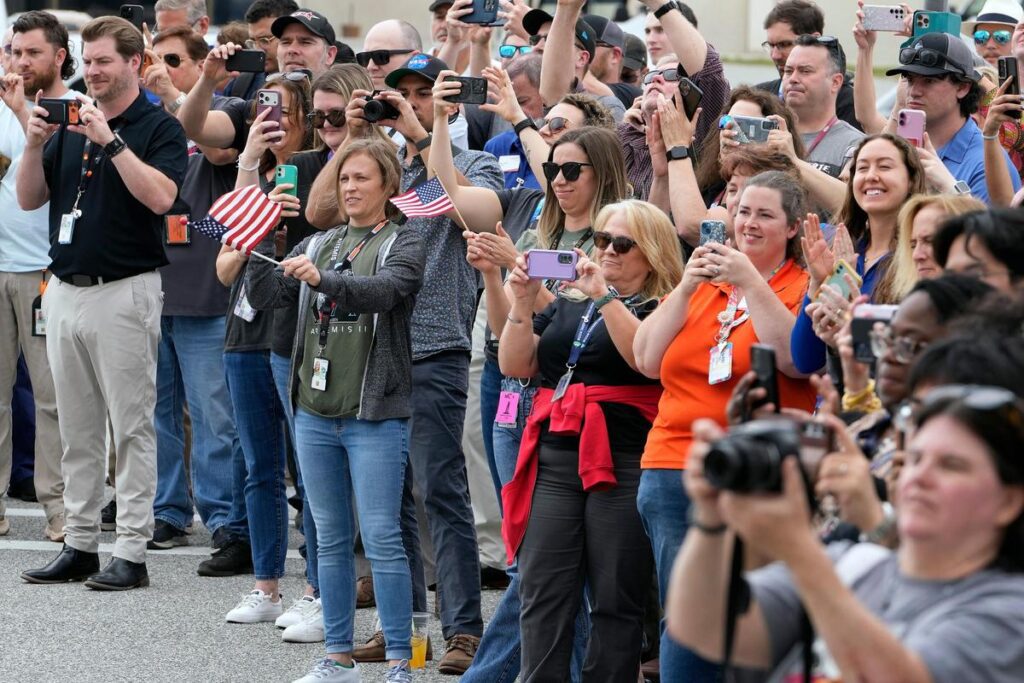
April 2 — Two minutes into flight, the twin solid rocket boosters peeled away from the core stage. They had done their job. Each stood 177 feet tall. Each generated 3.6 million pounds of thrust to drag NASA’s Artemis 2 mission off Launch Pad 39B.
Now, the Space Launch System core stage pushes the Orion capsule—christened Integrity—toward orbit. Four astronauts sit strapped inside. They are flying to the Moon.
Nobody has done this since Apollo 17 in 1972.
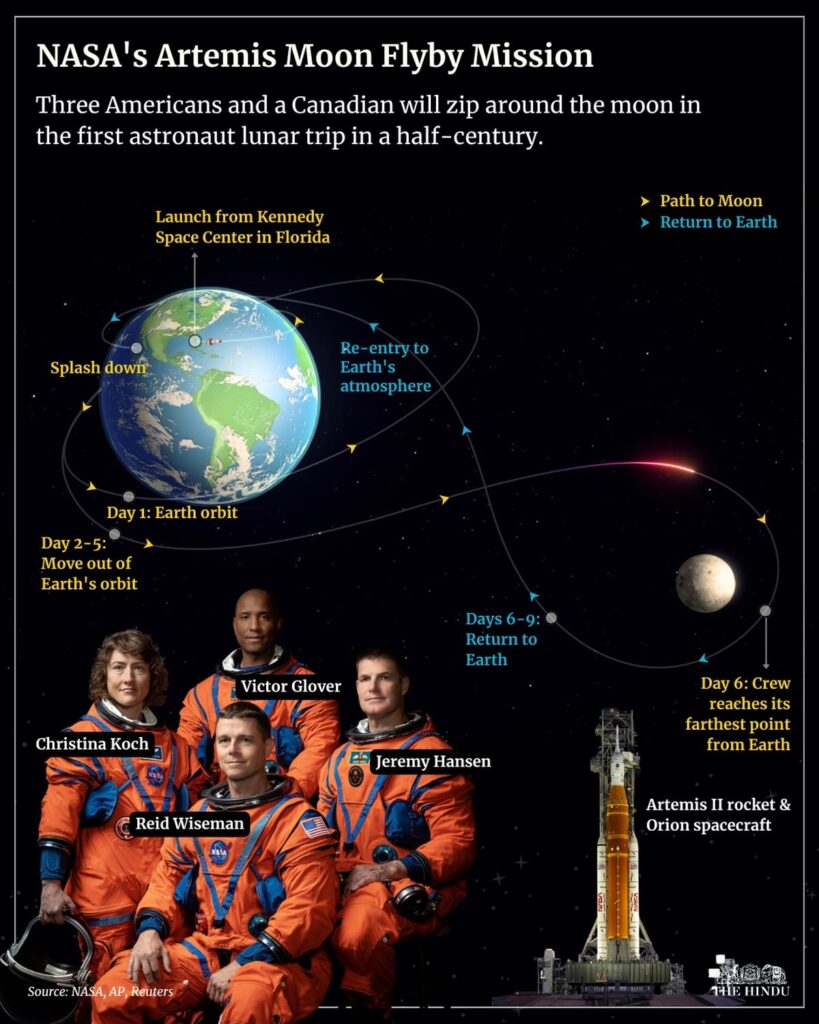
The rocket cleared the Florida coast at 6:24 p.m. Wednesday. Inside the capsule, Commander Reid Wiseman, Pilot Victor Glover, and Mission Specialists Christina Koch and Jeremy Hansen felt the crushing weight of liftoff. They embarked on a 10-day circumlunar flight. They won’t land on the lunar surface. Instead, they will slingshot around the Moon and test the deep-space life-support systems required to keep humans alive that far from Earth.
But getting off the pad took more than engineering. It took surviving a gauntlet of blown budgets and busted timelines.
The Artemis program carries a staggering price tag. NASA plans to spend roughly $93 billion over ten years to build this architecture. Taxpayers absorbed massive cost overruns. Critics spent years questioning the agency’s reliance on legacy contractors. Yet, the sheer violence of the SLS lifting off the pad silences those debates, at least for the ten days this crew remains in the vacuum of space.
And the stakes extend far beyond the capsule.
Washington feels the heat of a new space race. The Trump administration pushed NASA to accelerate the timeline. They want to beat China’s aggressively expanding Chang’e lunar program to the punch. Beijing plans its own crewed landings. The geopolitical rivalry that fueled the Apollo era returned, trading the Soviet Union for the Chinese Communist Party.
But space doesn’t care about politics. Physics dictates the schedule.
Before liftoff, launch teams monitored every sensor on the pad. The weather update provided the crew with the latest conditions at Launch Pad 39B, the surrounding recovery zones, and potential abort sites along the flight path. The margin for error sits at zero. A stray cloud or a sudden wind shear could scrub a mission.
The timeline demands perfection. NASA scheduled this crewed flight years ago, but reality kept getting in the way. Between supply chain failures, software glitches, and the sheer complexity of integrating millions of parts, the launch date kept slipping right. Just weeks ago, NASA Administrator Jared Isaacman had to stand before cameras and scrap a planned March launch. A liquid hydrogen leak cut short a critical wet dress rehearsal in early February. Engineers couldn’t finish testing the fueling procedures.
Isaacman didn’t mince words. He cited technical issues and refused to risk the crew for a schedule.
“During the 1960s, when NASA achieved what most thought was impossible, and what has never been repeated since, there were many setbacks,” Isaacman told reporters in February. He grounded the rocket until his teams could run the wet dress rehearsal flawlessly. They finally completed that test earlier this week, loading the cryogenic tanks under real conditions.
So, they got the green light.
Once the solid rocket boosters fell away, the SLS relied entirely on its four RS-25 engines. These are the same engines that once powered the Space Shuttle, refurbished and repurposed for deep space. They burn liquid hydrogen and liquid oxygen. They drain the massive core stage in minutes. After the core stage empties, it detaches and falls back toward Earth.
Then, the Orion capsule flies alone.
Actually, it flies attached to the European Service Module. The European Space Agency built this critical piece of hardware. It provides power, propulsion, and thermal control. It holds the air the astronauts breathe and the water they drink. If the service module fails, the crew can’t survive.
In about one minute after booster separation, the spacecraft adapter jettison fairings broke apart. These panels enclosed Orion’s service module and the launch abort system. Shedding them reduced the vehicle’s mass. Every ounce matters when you need to break Earth’s gravitational grip.
Will this hardware hold up in the deep freeze of lunar orbit?
That is the entire point of Artemis 2. The uncrewed Artemis 1 mission flew in 2022. It proved the rocket could fly and the heat shield could survive reentry. But a dummy in a seat doesn’t breathe. It doesn’t sweat. It doesn’t consume water. Artemis 2 forces NASA to test the environmental controls with real human lives on the line.
The crew represents a shift in how humanity explores space. Koch holds the record for the longest single spaceflight by a woman. Glover is the first Black astronaut to fly a lunar mission. Hansen, representing the Canadian Space Agency, proves this isn’t a solo American endeavor. Canada built the robotic arms that will eventually service the Lunar Gateway. Wiseman commands the flight, bringing years of test pilot discipline to a vehicle that has never carried humans.
They aren’t flying alone. The Apollo program saw America stand largely alone against the Soviets. Artemis functions as a global coalition. The Japanese Aerospace Exploration Agency builds modules for the Gateway. India’s ISRO maps the lunar surface with its Chandrayaan program, sharing data that helps target future landing zones.
They will travel a quarter-million miles. They will fly around the dark side of the Moon. They will see Earth rise over the barren, cratered horizon.
Then, they have to come back.
Reentry presents the ultimate test. The Orion capsule will hit the Earth’s atmosphere at nearly 25,000 miles per hour. That generates temperatures approaching 5,000 degrees Fahrenheit. The heat shield must absorb that punishment. If it cracks, the capsule burns. If the parachutes fail, the capsule shatters against the Pacific Ocean.
NASA calls this an incremental approach. They refuse to rush a landing. They need to prove they can operate in deep space before they send astronauts down to the lunar dust.
The Artemis program envisions a permanent human presence. NASA wants to build the Lunar Gateway—a small space station orbiting the Moon. Astronauts will dock there. They will transfer to commercial landers built by private spaceflight companies. SpaceX designed Starship to serve as the human landing system for Artemis 3.
We watch the foundation of a new off-world economy.
But critical technology gaps remain. Engineers haven’t solved sustainable in-situ resource utilization. That means NASA can’t yet extract lunar water ice to make rocket fuel. Until they crack that problem, every mission must carry its own fuel from Earth. That severely limits how long humans can stay.
The Outer Space Treaty complicates matters. It prevents any sovereign nation from claiming lunar territory. But it doesn’t clearly regulate resource extraction. As the U.S. and China race to the lunar south pole—where the water ice hides—lawyers will scramble to prevent a new kind of resource war.
For now, the focus stays locked on the four people in the Orion capsule. The immediate goal is survival and data collection. Mission control in Houston will monitor every heartbeat, every valve, and every thruster firing over the next ten days.
NASA bet its legacy on this rocket.
If Artemis 2 succeeds, it sets the stage for Artemis 3. It puts boots back on the Moon. It builds the operational muscle memory NASA needs before taking aim at Mars.
They burn for the Moon, carrying the weight of a $93 billion gamble.