The Right to Information Act guarantees transparency for ten rupees, but severe commission backlogs and empty offices mean citizens are waiting decades for
Raipur, April 6 — The law fits in your pocket. For a ₹10 fee, the Right to Information (RTI) Act of 2005 hands any Indian citizen the power to open government files, track tax rupees, and pull public officials into the light.
But knowing your rights isn’t the same as getting answers.
Twenty years after it passed, the machinery built to enforce transparency is grinding to a halt. While filing an application remains straightforward, the appeals system designed to protect citizens from stonewalling bureaucrats is buckling under the weight of over 400,000 pending cases across the country.
If you want to pull records from a state or central department today, you need to know exactly how to file. You also need to know what happens when they say no.
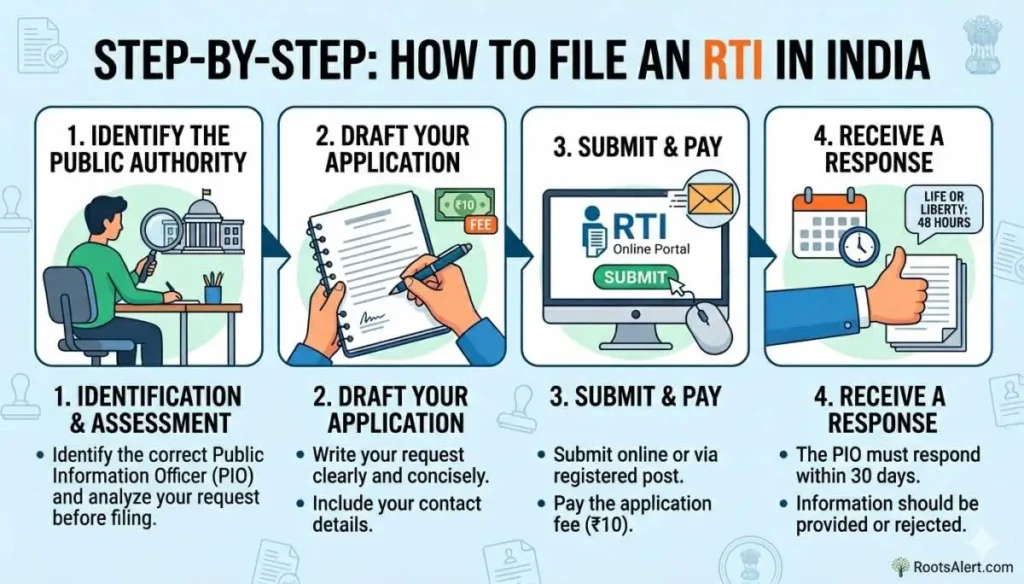
How to File Your Application
The law covers the central government, state governments, panchayats, and any entity substantially funded by public money. Private companies are exempt unless their data is legally controlled by a regulatory public authority.
First, pinpoint your target. Every government body has a designated Public Information Officer (PIO). Finding the right department cuts your wait time in half.
For central government requests, the process is digitized. You log onto the RTI Online portal, click “Submit Request,” select the specific ministry, and fill out a single-page form.
Keep your questions surgical. You have a 3,000-character limit online, but transparency experts suggest keeping your core request under 150 words. Don’t ask why a decision was made. Ask for the document where the decision was recorded.
Offline applications still work. You can draft a handwritten letter. Slap a ₹10 court fee stamp in the top right corner. Mail it via Speed Post or drop it at the department’s office yourself.
By law, the PIO has 30 days to hand over the documents. If the request involves a citizen’s life or liberty, the clock drops to 48 hours.
When the System Stalls
What happens when the 30 days expire, or the officer hands you heavily redacted pages?
You file a First Appeal to an officer senior to the PIO. If that fails, you escalate to a Second Appeal with the Central Information Commission (CIC) or your State Information Commission (SIC).
That’s where the gridlock begins.
A 2024–25 performance report from the Satark Nagrik Sangathan (SNS) paints a bleak picture of the final line of defense. Across 29 state and central commissions, over 4.1 lakh appeals and complaints are currently stuck in bureaucratic limbo.
And the delays aren’t measured in months. They’re measured in lifetimes.
Based on current disposal rates, a citizen filing an appeal in Telangana today will wait an estimated 29 years and two months for a hearing. The Tripura commission will take 23 years to clear its backlog. Chhattisgarh will take 11.
Some states simply stopped picking up the phone. Between July 2024 and October 2025, six state commissions sat defunct for varying stretches. Jharkhand’s commission operated with empty chairs for an entire year.
“In many cases appeals and complaints were returned without even being registered by Information Commissions, and often on flimsy grounds like the pagination being incorrect,” noted Anjali Bharadwaj, a transparency activist and founding member of SNS.
The CIC itself returned 40 percent of the appeals it received.
No Consequences for Officers
The original 2005 Act gave commissions teeth. If a PIO deliberately buried information, the commission could slap them with a penalty of up to ₹25,000.
They aren’t using it.
According to the SNS analysis, information commissions failed to impose penalties in 98 percent of cases where they were legally justified. Out of thousands of show-cause notices issued to erring officers, only a fraction resulted in fines.
So, why file at all?
Because the law still works at the ground level. Millions of routine RTI applications are resolved by PIOs every year without ever hitting the appeals backlog. Citizens use it daily to force municipal corporations to fix roads, to uncover subsidized ration theft, and to retrieve delayed pension records.
The initial ₹10 application remains a potent, highly visible demand for accountability. But if a public authority decides to pull the shutters down, the wait for a crowbar is getting longer.
Democracy thrives on daylight. Right now, the government holds the flashlight, and they’re taking their time turning it on.
Discover more from Rootsalert
Subscribe to get the latest posts sent to your email.