The central government controls a massive welfare budget, but millions of eligible citizens across India leave their guaranteed housing, health, and pension funds unclaimed.
Raipur, April 10, 2026 — The Union Finance Ministry controls a welfare budget exceeding ₹40 lakh crore. Yet millions of eligible Indians pay out of pocket for emergency healthcare, borrow at extortionate rates to launch small businesses, and fund their daughters’ education through predatory personal loans.
They simply don’t know what the state owes them.
India runs hundreds of central and state-level programmes. Most drown in bureaucratic red tape. A citizen can spend months chasing signatures from indifferent local officials. But ten core schemes possess the financial gravity to completely rewrite a family’s economic trajectory. They don’t require political connections. They require a PAN card, an Aadhaar number, and the basic knowledge to apply.
You just have to know where to look.
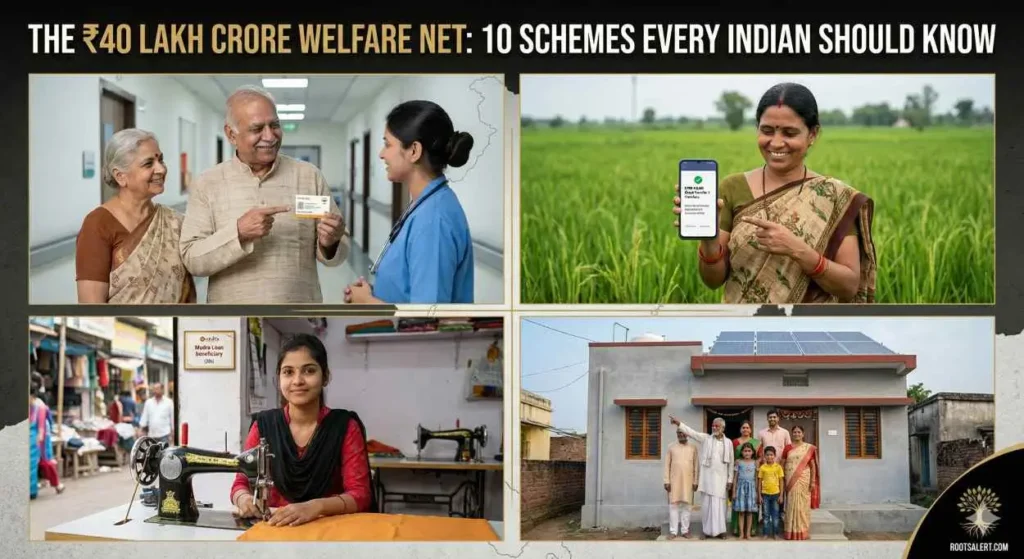
The flagship remains Ayushman Bharat, officially the Pradhan Mantri Jan Arogya Yojana (PM-JAY). It represents the largest publicly funded health insurance programme on the planet. The scheme provides ₹5 lakh in cashless health coverage per family, per year. The government initially designed the programme exclusively for the poorest households. But the Health Ministry recently expanded the safety net. Today, every Indian citizen aged 70 and above qualifies for the ₹5 lakh cover, regardless of their bank balance or past medical history. It effectively shields families from the sudden, devastating hospital bills that traditionally force the middle class into generational debt.
And then you have the roof over your head. The Pradhan Mantri Awas Yojana (PMAY) subsidises home loans and construction costs. The Ministry of Housing and Urban Affairs drives this initiative to replace makeshift rural dwellings and urban slums with permanent concrete structures. The state has already sanctioned over four crore houses. If you earn less than ₹18 lakh a year and want to buy your first home, PMAY slashes your interest rate. The government credits the subsidy directly to your loan account, erasing lakhs of rupees from your principal overnight.
But a house means little without power. Early this year, the Ministry of New and Renewable Energy aggressively pushed the PM Surya Ghar Muft Bijli Yojana. Backed by a ₹75,000 crore outlay, the pitch relies on raw economic incentive. The government heavily subsidises the installation of rooftop solar panels. Families generate their own power, eliminate their monthly electricity bills up to 300 units, and legally sell surplus energy back to the national grid. It turns a standard middle-class rooftop into a revenue-generating asset.
For the agricultural backbone of the country, the Agriculture Ministry operates PM-KISAN. It bypassed the notorious local middlemen entirely. The government sends ₹6,000 every year directly into the bank accounts of landholding farmers. Three equal instalments of ₹2,000 hit the accounts automatically. It doesn’t sound like much in a Mumbai corporate boardroom. But in rural Vidarbha or the plains of Bihar, that cash buys the seeds for the next harvest. It prevents farmers from taking high-interest loans from local moneylenders before the monsoon hits.
Who banks the unbanked? The Pradhan Mantri Jan Dhan Yojana (PMJDY) does.
This is the financial plumbing of modern India. The Finance Ministry mandated zero-balance accounts for every citizen. Over 50 crore accounts exist today, holding more than ₹2 lakh crore in collective deposits. These aren’t just vaults for loose cash. A Jan Dhan account comes with a free RuPay debit card and an automatic ₹2 lakh accident insurance cover. It functions as the crucial receiving end for every other direct benefit transfer the government issues. Without it, the rest of the welfare state collapses.
If you have a daughter, the Sukanya Samriddhi Yojana (SSY) outpaces nearly every conservative market investment available today. You open the account before she turns ten. The government guarantees an interest rate that currently hovers around 8.2 percent, and the returns remain entirely tax-free. The corpus locks until she turns 18 for higher education, or 21 for marriage. It forces disciplined saving and shields the girl child’s financial future from unpredictable stock market crashes and inflation.
When it comes to building a business, banks despise risk. They demand hard collateral that a street vendor, a freelance mechanic, or an independent weaver simply doesn’t own. The Pradhan Mantri Mudra Yojana (PMMY) forces lenders to back the little guy. The scheme offers micro-loans starting from ₹50,000 all the way up to ₹20 lakh without asking for a single piece of collateral. The Ministry of Micro, Small and Medium Enterprises engineered this to formalise the street-corner economy. It transforms daily wage earners into independent proprietors.
So what happens when these workers grow old?
The vast unorganised sector holds no pension plans. No corporate human resources department matches their provident fund contributions. The Atal Pension Yojana (APY) fixes this gaping hole in the social safety net. A 25-year-old daily wage worker contributes a few hundred rupees a month. The government steps in, manages the fund, and guarantees a fixed monthly pension of up to ₹5,000 when the worker hits 60.
We also see a quiet revolution in the traditional trades. The PM Vishwakarma Scheme targets the carpenters, the goldsmiths, the boat makers, and the blacksmiths. For generations, these eighteen specific trades relied on inherited tools and exploitative loan sharks. Now, the Ministry of Skill Development offers them official certification, a ₹15,000 grant for modern toolkits, and collateral-free credit at a flat 5 percent interest rate. It turns inherited survival skills into scalable, bankable micro-enterprises.
Finally, the Mahatma Gandhi National Rural Employment Guarantee Act (MGNREGA) remains the ultimate fallback line for rural India. The Ministry of Rural Development guarantees 100 days of paid wage employment to any rural household that demands it. When crops fail or private construction slows down, MGNREGA absorbs the economic shock. It pays the bills when the private market stops hiring.
These ten schemes represent trillions of rupees in active, budgeted deployment. They exist specifically to distribute the nation’s tax revenue back to its citizens. The funds sit waiting. The administrative machinery works. The only variable left is the citizen stepping forward to claim their exact share.