From dry taps in 19 states to fake job cards in West Bengal, official audits reveal a nationwide trail of ghost beneficiaries and squandered public funds.
Raipur, April 11 — The official ledgers in the capital say the water is flowing, the jobs are working, and the sick are healing. The ground tells a different story.
India’s rural development machinery is haemorrhaging billions. Official documents and the latest 2025 reports from the Comptroller and Auditor General (CAG) expose a staggering disconnect between what gets funded in Parliament and what actually survives in the dirt. We aren’t talking about slow implementation. We’re looking at outright data fraud, ghost payments, and systemic mismanagement across the country’s biggest welfare initiatives.
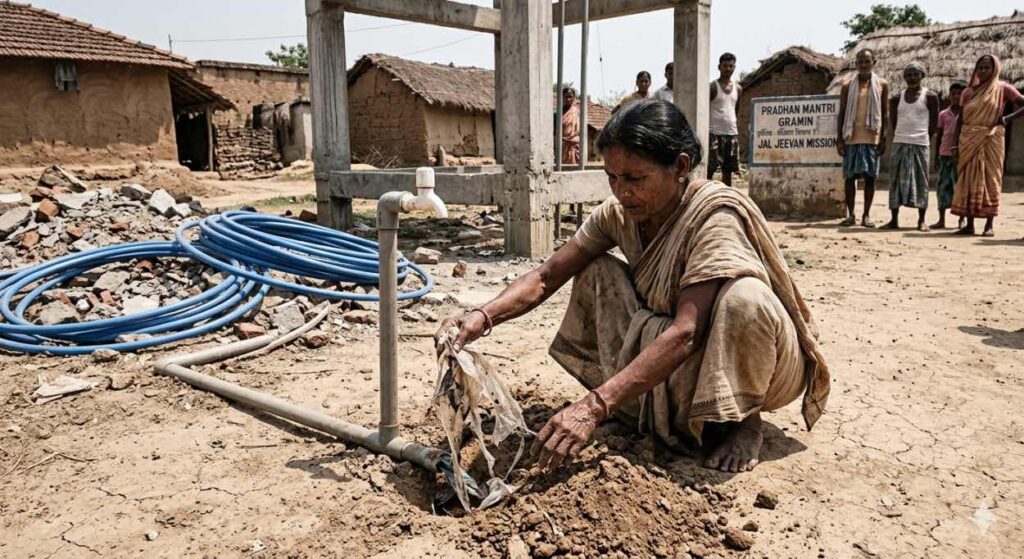
Start with the water. The Jal Jeevan Mission launched in 2019 with a bold mandate: a functional tap in every rural household. The government poured massive capital into the project, recently raising the Jal Shakti Ministry’s budget by 93 percent to ₹99,503 crore for 2025-26.
But auditors walking the pipeline routes found a mirage.
In 19 states, contractors abandoned 2,371 water schemes midway. They burned through nearly ₹200 crore before walking away, citing poor planning and unscientific source identification. The money is gone. The pipes are dry. And where the hardware actually exists, it’s often broken. Auditors logged 3.85 lakh hand pumps lying dead across the country out of 37.57 lakh installed, simply because nobody bothered to fund maintenance.
It gets worse. Water treatment plants built to filter out fluorosis, excess iron, and salinity—costing ₹16 crore—sit completely non-functional in nine states. The human cost of this administrative failure is immediate. Eighteen states recently reported a surge in water-borne diseases, including cholera, typhoid, and gastroenteritis. You can’t drink a budget allocation.
Then you have the rural jobs guarantee. For years, the Mahatma Gandhi National Rural Employment Guarantee Act (MGNREGA) stood as the ultimate safety net for India’s poorest citizens. Recently rebranded by the Union government as the VB-G RAM G Act (Viksit Bharat-Guarantee for Rozgar and Ajeevika Mission Gramin), the scheme promises 100 days of paid work. Union Rural Development Minister Shivraj Singh Chouhan recently defended the rollout, pointing to a massive ₹95,692 crore allocation and a proposal to bump the guarantee to 125 days.
The reality in the villages doesn’t match the math.
CAG auditors reviewing the social sector found that workers received an average of just 66 days of employment. The funds rarely arrived on time. But the deeper rot lies in who actually gets paid. In West Bengal alone, social audit findings flagged nearly 11 lakh irregularities. Local bosses fabricated job cards. They forged muster rolls. They brought in heavy machinery to dig ponds and lay roads, then billed the government for human sweat that was never expended.
So where is the oversight? It barely exists. The law mandates social audits by the Gram Sabha every six months to keep local officials honest. The CAG found a 54 percent shortfall in these audits nationwide. When no one checks the books, the books lie.
This culture of phantom welfare extends directly into healthcare. By January 2024, investigators uncovered what they bluntly called a “murder for money” racket under the PMJAY health insurance scheme. In Gujarat, authorities arrested a doctor for performing entirely unnecessary heart surgeries on healthy villagers just to siphon off government insurance payouts. That wasn’t an isolated grift. The government has de-empanelled over 1,000 hospitals and levied ₹231 crore in penalties for similar frauds.
Private hospitals that actually do the work are increasingly refusing free treatments because the state won’t reimburse them on time. The poorest Indians are handed a health card that looks good on a billboard but holds no currency at the clinic door.
Even the push for rural youth employment has devolved into a paperwork fiction. Early in 2025, the government approved an extra ₹8,800 crore to restructure the PM Kaushal Vikas Yojana, aiming to train and place rural youth. Yet auditors found 94 percent of bank details missing for enrolled candidates. Training centres certified underage kids. They reported job placements that investigators couldn’t verify. Hundreds of thousands of rural youth never saw their promised incentives.
Why does this keep happening?
The fundamental flaw isn’t a lack of cash. It’s a refusal to build local capacity. The Jal Jeevan Mission set aside ₹473 crore specifically to institutionalise community participation—training locals to manage their own water systems. The government spent exactly ₹6 crore of it. They trust contractors to lay the pipes, but they don’t trust the villagers to own them.
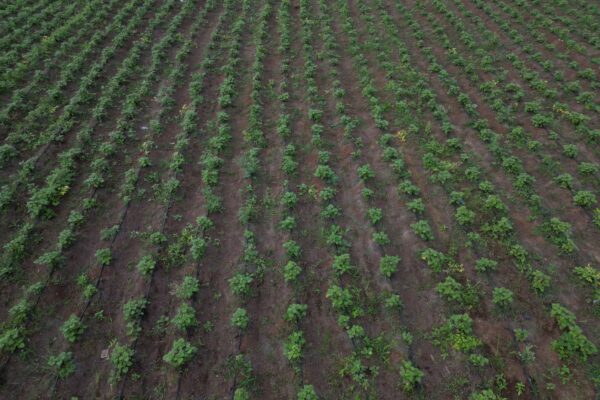
Agriculture faces the exact same top-down failure. During the pandemic, agriculture was the only cushion for the Indian economy, growing at 3.6 percent while other sectors collapsed. It remains the primary livelihood for 49 percent of households. Recognising this, the state launched a ₹3,000 crore mission to forge 10,000 Farmer Producer Organisations (FPOs), aiming to turn marginal farmers into collectives that can bypass middlemen. But registering thousands of producer companies on the Ministry of Corporate Affairs portal means nothing without ground-level training. Handing a legal charter to a collective of smallholder farmers without teaching them corporate governance or supply chain logistics just creates thousands of dormant companies.
We are witnessing the industrialisation of rural aid. Mega-projects are designed in Delhi, tendered to massive firms, and measured by dashboards that track money spent rather than utility delivered. The government builds the shell of a welfare state, but the machinery inside is hollow.
Millions of rural Indians don’t need another rebranded scheme or a bigger budget announcement. They need the tap to work, the clinic to heal, and the wage to arrive. Until the state stops paying for ghosts, the ground reality will remain broken.