
A peaceful sit-in over stagnant wages detonated into violent clashes across Noida’s industrial hub Monday, leaving vehicles torched and transit routes completely paralyzed.
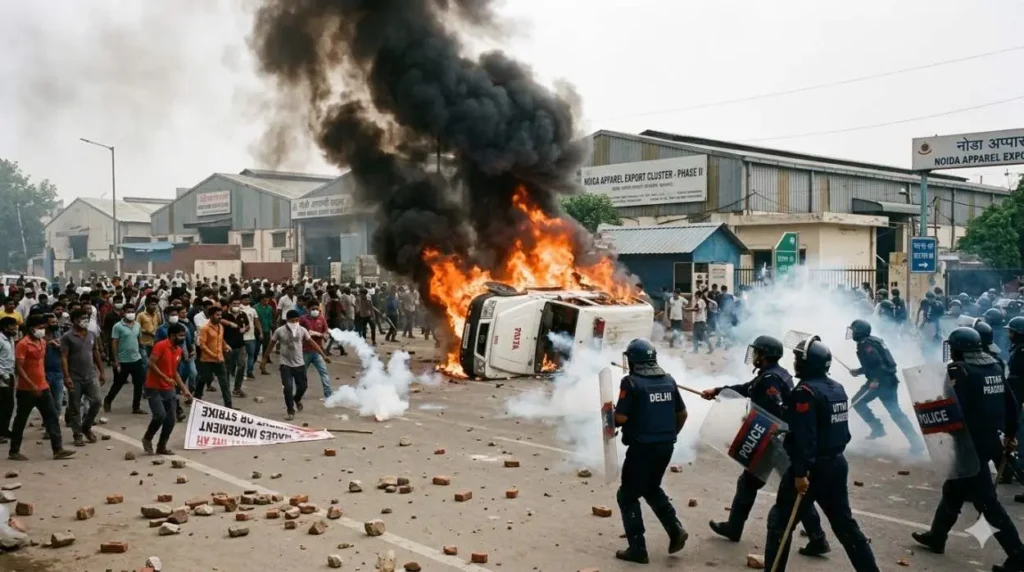
INDIA, April 13, 2026 — They waited three days for an answer. When the factory bosses gave them nothing, thousands of industrial workers took to the streets of Noida’s Phase-2 and set them ablaze.
What began as a quiet, desperate sit-in over stagnant wages detonated Monday morning into outright rioting. By noon, the sky over Sector 60 and the Hosiery Complex was thick with black smoke. Workers hurled stones. They smashed factory windows. They dragged police vehicles into the road and torched them.
This wasn’t a sudden flare-up. It was a pressure cooker blowing its lid.
For a week, blue-collar workers across Noida’s manufacturing backbone have pleaded for a basic survival wage. They stitch garments, assemble components, and pack boxes for a flat ₹13,000 to ₹14,000 a month. That’s for 26 days of back-breaking labor. While inflation eats their paychecks, they look across the border to Haryana, where the state government just bumped the minimum wage for unskilled workers by 35 percent. Over there, the floor is now ₹15,220. Here in Uttar Pradesh, they get ignored. The contrast is sharp, and the resentment has been building for months.
So Monday morning, the patience ran out.
More than a thousand employees poured out of the manufacturing units. They marched through the industrial sectors, and the crowd didn’t just walk—it surged. When police intercepted them, the dialogue collapsed immediately. Stones flew. A police interceptor van was flipped and set on fire.
Heavy reinforcements flooded the zone. Personnel from multiple stations brought riot gear. When the stone-pelting intensified, police fired tear gas shells directly into the mob. It didn’t stop the rage. It just scattered it.
The violence spilled outward. In Sector 63, a massive mob armed with sticks and clubs descended on Vipul Motors, an authorized Maruti Suzuki service center. Eyewitnesses watched them smash the windows of two dozen parked cars. They set four or five vehicles completely ablaze. The workers weren’t just angry at their employers anymore. They were angry at the machinery of wealth that excludes them.
By early afternoon, the industrial hub looked like a war zone. Two motorcycles were reduced to melted plastic and blackened steel frames in Sector 59. The smoke plumes served as a brutal beacon to any commuter trapped on the highways. For the thousands stranded in their air-conditioned cars on the DND Flyway, the riot was a massive inconvenience. For the men and women throwing the stones, it was the only way to be seen.
The disparity isn’t just a talking point. It’s a daily indignity. A worker in Noida looks at a counterpart in Gurugram doing the exact same repetitive labor and realizes their sweat is valued a third less purely because of geography. Rent is climbing. Commute costs are climbing. The only thing frozen in place is the wage.
Management in the Hosiery Complex spent the last week ignoring the rumblings. They assumed the workers would complain, hold a peaceful sit-in, and eventually go back to the assembly line because hunger is a highly effective strike-breaker. They miscalculated. What happens when hunger meets a dead end? It turns to fury.
The immediate fallout choked the entire National Capital Region.
The Chilla Border, the vital artery connecting Delhi to Noida, was entirely locked down. Delhi Traffic Police issued emergency alerts as the Noida Link Road became impassable. Commuters on the DND Flyway sat parked for hours in absolute gridlock. Anyone trying to catch a cab or auto-rickshaw from Ghaziabad into Noida found drivers demanding three times the normal fare—if they were willing to drive into a riot zone at all. Delhi Police threw up heavy barricades at their checkpoints, terrified the unrest would bleed into the capital.
It’s the rawest display of class friction India’s industrial corridors have seen in years.
Uttar Pradesh Chief Minister Yogi Adityanath reacted with a blunt directive. He ordered the state administration to take the strictest possible action against those instigating the violence. But he also told factory owners they had better comply with labor laws and ensure timely payment of wages. The state government immediately established a probe panel to investigate the unrest, pointing fingers at vested interests stoking the fire.
The police insist they held the line without deadly force. Senior officials on the ground confirmed they used minimal force and fired no live ammunition. They filed First Information Reports against social media accounts spreading rumors of police brutality. But workers on the street tell a different story. “Why are the policemen beating girls with sticks?” one protester demanded of a local reporter. “What is the need for a lathi charge?”
The disconnect is staggering.
On one side, you have district administrators scrambling to push mandatory labor guidelines, promising double pay for overtime and better grievance mechanisms. On the other, you have workers who can’t buy groceries on promises. They see Haryana’s wage hike and wonder why the border dictates whether they can feed their kids. Some manufacturing firms claim the workers are driven by misinformation about how wages are calculated. The soot on the roads says the workers don’t care about corporate math. They care about survival.
Senior police officers, including the Additional DCP, spent the afternoon alongside the Deputy Labour Commissioner trying to establish a dialogue. The talks went nowhere. The streets remain tense. The police have flooded the affected sectors with heavy deployment, trying to put a lid back on the very pressure cooker that just exploded.
It won’t hold forever.
This riot isn’t just about a few factories in Noida. It’s a violently visible symptom of a nationwide cost-of-living crisis hitting the lowest rungs of the ladder. Unskilled labor is the engine of the Indian economy. And when the engine realizes it can’t afford the fuel to keep running, it stops. When it stops, it breaks things.
The embers are still smoking in Phase-2. The borders are heavily guarded. The state has promised crackdowns and committees. But until the numbers on those paychecks match the price of living, the fire isn’t really out. It’s just waiting for the next spark.