With Nitish Kumar exiting for the Rajya Sabha after two decades in power, the BJP finally claims Bihar’s top office alongside two JD(U) deputies.
The Nitish Kumar era in Bihar is officially over.
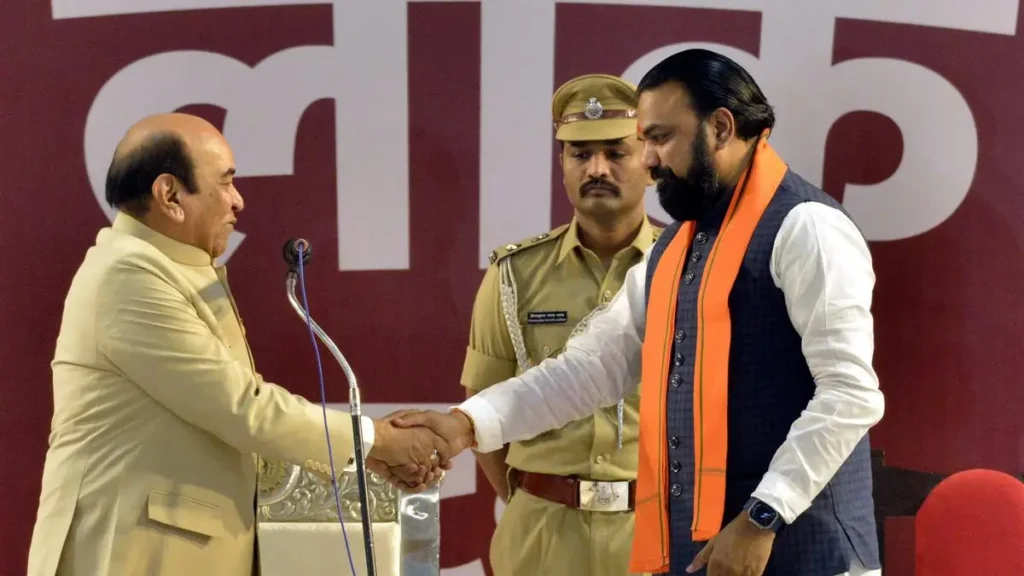
Samrat Choudhary took the oath of office at the Lok Bhawan on Wednesday morning, becoming the state’s 24th chief minister and the first to emerge from the Bharatiya Janata Party. The swearing-in dismantles a two-decade political structure where Kumar dictated the terms of every state government, regardless of his alliance partners. Kumar resigned on Tuesday after securing a seat in the Rajya Sabha. His exit cleared the path for his former deputy to claim the state’s highest office after days of intense speculation.
Governor Syed Ata Hasnain administered the oath in a packed hall echoing with slogans of “Samrat Choudhary zindabad” from BJP workers. Prime Minister Narendra Modi was slated to attend the event, underscoring the national significance of the power shift in Patna.
Choudhary didn’t take the stage alone. Two veteran leaders from Kumar’s Janata Dal (United) — Bijendra Prasad Yadav and Vijay Kumar Choudhary — took their oaths immediately after, assuming roles as deputy chief ministers. This arrangement cements the National Democratic Alliance’s grip on the state following the 2025 assembly elections. In that contest, the BJP outpaced its rivals to finish as the single largest party, securing exactly 89 seats based on Election Commission data.
But the backroom negotiations that shaped Wednesday’s lineup reveal a coalition still managing a sensitive internal transition.
JD(U) leadership initially pushed for Nishant Kumar, Nitish Kumar’s son, to take one of the deputy slots. The younger Kumar only recently joined the party, and strategists viewed the deputy chief minister post as a rapid launching pad. Nishant refused. He explicitly cited his lack of political experience and rejected the sudden elevation, according to internal party accounts.
That refusal forced the party to pivot back to its older loyalists.
They tapped Yadav, a 79-year-old political heavyweight who has won the Supaul assembly seat in nine consecutive elections since 1990. Yadav previously stated he wouldn’t serve as a minister if Kumar stepped down from the top job. Party pressure, combined with the vacuum left by Nishant Kumar’s refusal, reversed that stance. Yadav brings extensive administrative baggage to the role. In Kumar’s previous cabinet, he managed the finance, planning, and development portfolios. His failing health remains an open concern among party ranks, yet his historical weight within the JD(U) made him indispensable for the transition. When the original Janata Dal split in 1997 and Lalu Prasad formed the Rashtriya Janata Dal, Yadav stuck with the Sharad Yadav faction. That group eventually evolved into the modern JD(U).
Vijay Kumar Choudhary, 69, fills the second deputy position. He operates with an entirely different political pedigree. He began his career in the Congress Party, winning the Dalsinghsarai constituency in 1985 and 1990. He served as the general secretary of the Bihar Pradesh Congress Committee from 2000 to 2005 and acted as the chief whip for the Congress Legislature Party. He jumped to the JD(U) in 2005.
His initial run under the JD(U) banner ended in a loss from the Sarairanjan constituency in October 2005. But he rebounded aggressively. By 2010, the party named him state president. He led the JD(U) to victory in the assembly elections that year, capturing the Sarairanjan seat with a margin exceeding 17,000 votes. Kumar subsequently brought him into the cabinet as water resources and parliamentary affairs minister. Later, he served as Speaker of the Bihar Legislative Assembly from December 2015 until November 2020, before handing the gavel to BJP leader Vijay Kumar Sinha.
Both deputies remain deeply connected to the outgoing chief minister.
And that leaves Samrat Choudhary managing a cabinet anchored by his predecessor’s closest allies.
The BJP laid the groundwork for this transition days in advance. On Sunday, April 12, the party dispatched Union Minister Shivraj Singh Chouhan to Patna. He operated as a central observer, accompanied by BJP state chief Nitin Nabin, whom Choudhary received personally at Jay Prakash Narayan Airport. Their mandate was to ensure the legislature party elected Choudhary without friction. By Tuesday afternoon, the BJP MLAs formally selected him as the leader of both the BJP and NDA legislature parties.
The opposition watched closely, but allies fell in line. Rashtriya Lok Morcha chief Upendra Kushwaha quickly issued a public statement congratulating Choudhary on his elevation.
Hours later, Kumar convened his final state cabinet meeting. He informed his colleagues of his decision to dissolve the council of ministers — a constitutional prerequisite before resigning. He then traveled to the Lok Bhawan with Choudhary and other senior leaders to hand his resignation to Governor Hasnain.
Prior to that, Choudhary held a strategic meeting at Kumar’s official residence alongside key JD(U) figures, including Sanjay Jha and Rajiv Ranjan Singh. The delegation then visited the Patna High Court to pay their respects at the statue of B.R. Ambedkar, signaling unity before the formal transition of power.
Will this structural shift translate to a radically different style of governance?
The BJP now controls the chief minister’s office, but JD(U) veterans hold the vital deputy roles. The exact balance of power remains obscured. Right now, the swearing-in only covers the top three positions. The broader cabinet expansion is strictly on hold until the Election Commission declares results for the ongoing assembly polls in West Bengal, Assam, Kerala, and Puducherry.
This calculated delay buys both parties time to negotiate the remaining ministries without triggering a public feud.
Nitish Kumar attended the Wednesday ceremony, sitting near the front. He greeted his successor warmly. The optics were striking. On Friday, April 10, Kumar took his oath as a member of the Rajya Sabha in New Delhi. Just months prior, he had taken the oath for his record tenth term as chief minister in November 2025. That final term lasted less than six months. He concluded his tenure on April 14, deliberately timing his exit with the end of Kharmas, an inauspicious month in the Hindu calendar.
Now, the political math in Bihar changes completely.
For years, the BJP operated as a junior partner or the primary opposition, perpetually reacting to Kumar’s shifting alliances. Now they own the state apparatus. They inherit a deeply agrarian state attempting to pivot toward a technology-driven economy, and they must govern alongside the very JD(U) leaders who authored the previous two decades of policy.
They campaigned for the wheel, and now they have to drive.