A suspected valve leak in the crude distillation unit halted Tuesday’s massive launch, forcing investigators to assess structural damage before resetting the timeline.
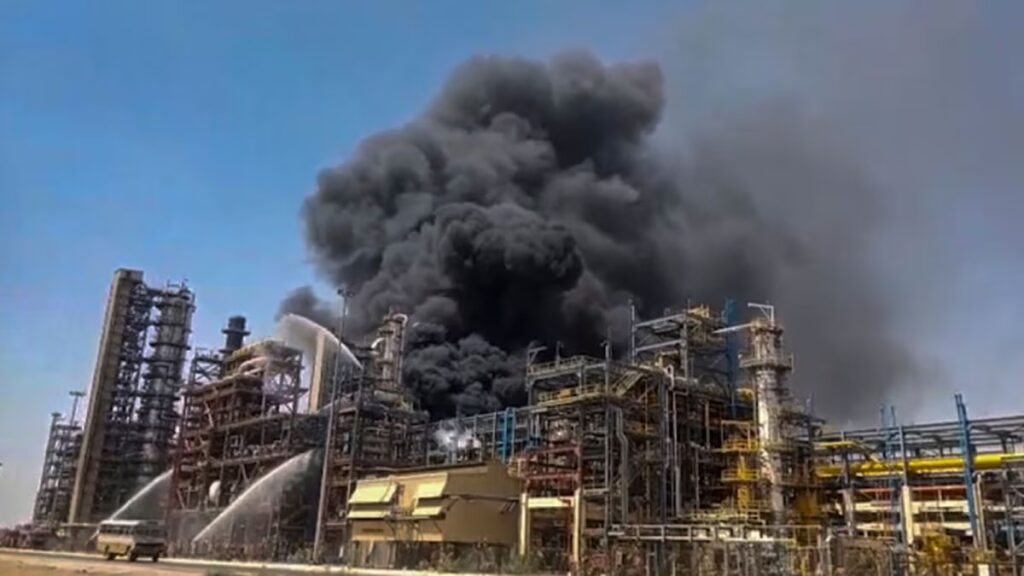
The 80,000-crore rupee HPCL Rajasthan Refinery won’t be opening this week. A hydrocarbon fire struck the facility’s core crude distillation unit Monday afternoon, forcing the sudden cancellation of Prime Minister Narendra Modi’s scheduled Tuesday inauguration.
Flames broke out inside the heat exchanger circuit. Hindustan Petroleum Corporation Limited, the state-run energy giant holding a 74 percent equity stake in the project, points to a suspected valve or flange leak as the trigger. Local emergency responders and refinery safety teams rushed the site. They contained the blaze before it could tear through the wider complex.
Not a single casualty or injury occurred.
But the damage to a highly choreographed national launch is already done. The smoke hadn’t fully cleared before government officials scrambled to secure the site and control the narrative around India’s most expensive new energy asset.
A four-member investigation team instituted by the Ministry of Petroleum and Natural Gas landed in Rajasthan today. Former Mangalore Refinery and Petrochemicals managing director M Venkatesh leads the probe. They aren’t just looking for a failed flange. They’re assessing whether the July 1 target for full commercial operations can survive this setback.
Can a massive petrochemical plant recover its launch timeline after a blowout in its primary processing unit?
The crude distillation unit operates as the absolute heart of any modern oil refinery. It functions as the crucial first stage of the manufacturing process. Raw crude feeds directly into the massive towers, where extreme heat separates the oil into distinct, usable fractions. Naphtha, kerosene, diesel, gas oil, and heavy residue boil off at varying, precise temperatures. Those separated streams then route outward. They move into secondary processing facilities, cracking units, and treatment plants across the sprawling complex. That downstream journey is what ultimately transforms raw sludge into refined aviation turbine fuel, high-grade petrol, and industrial heating oil.
A fire here threatens the entire downstream production chain. It stops the heartbeat of the plant before the other organs can even function.
HPCL isolated the crude distillation unit immediately after the alarms triggered. They locked down the adjacent vacuum distillation unit and swiftly severed the feeds connecting the damaged section to the rest of the plant. That rapid isolation protocol prevented a localized equipment failure from escalating into a site-wide catastrophe. The company released a tight, controlled statement Tuesday confirming all other sections of the refinery remain structurally safe and untouched by the intense heat.
“The fire was localized in the heat exchangers stack,” HPCL stated. The company insists the financial and operational impact isn’t expected to be material.
Yet the central government isn’t taking chances with an 80,000-crore rupee investment. Ministry of Petroleum Joint Secretary Sujata Sharma confirmed Tuesday that any new timeline waits entirely on Venkatesh’s team. The revised inauguration date won’t be announced until the investigators finish walking the site, reviewing the metallurgy, and running their final safety assessments.
This isn’t just another industrial ribbon-cutting. The Rajasthan site represents India’s first greenfield oil refinery launch since Indian Oil Corporation commissioned its massive Paradip facility on the eastern coast in 2016.
Pre-commissioning a massive oil processing facility carries built-in, unavoidable volatility. Engineers introduce highly combustible hydrocarbons into fresh piping, untested valves, and unseasoned equipment for the very first time. The risks are inherent to the physics of refining. The Paradip refinery experienced a strikingly similar event. A fire broke out at that facility in February 2016, just days before its own grand inauguration.
The stakes in Balotra are monumental.
When fully operational, the HRRL complex will process nine million tonnes of crude annually. That massive footprint includes 2.4 million tonnes dedicated exclusively to petrochemical production. The supply chain relies on a deliberate, split feed. The plant will intake 7.5 million tonnes of imported crude oil from global markets, while pulling 1.5 million tonnes directly from Rajasthan’s domestic onshore fields.
The government of Rajasthan holds the remaining 26 percent stake in the joint venture. They’ve waited a very long time for this specific payoff.
Planners first announced the mega-project back in 2008. It sat paralyzed on paper for a full decade. Deep political differences over fiscal incentives and state tax breaks between the Rajasthan government and central operators stalled the blueprints. Those bitter disputes finally cleared, allowing construction crews to break ground in the desert in 2018.
They built an absolute beast.
The Balotra facility boasts a Nelson Complexity Index of 17. That industry metric dictates a refinery’s ability to upgrade low-quality, heavy crude into high-value, refined products. A score of 17 makes the Rajasthan plant the most advanced public sector refinery in India. It outpaces Indian Oil’s Paradip plant, which sits at an index of 12.2. Only massive private operations, like Reliance Industries’ mega-complex in Gujarat, run at higher complexity levels.
This specific capability matters immensely on the global energy market. Complex refineries buy the world’s cheapest, dirtiest crude oil and crack it into premium Bharat Stage VI grade petrol and diesel. The financial margins depend entirely on that volatile chemistry.
And beyond standard fuels, the Balotra plant targets a massive, glaring gap in the Indian economy: petrochemicals.
Despite supporting a population of 1.4 billion people, India’s per-capita petrochemical consumption lags far behind developed Western economies. As domestic manufacturing scales up and consumer goods markets expand, that specific demand is slated for aggressive, exponential growth over the next decade. The Rajasthan refinery aims to capture a massive share of that domestic market the moment its gates open.
India currently depends on foreign markets to meet over 88 percent of its daily crude oil requirements. Yet it operates as an absolute processing powerhouse. The country stands as the world’s third-largest consumer of crude oil and the fourth-largest refiner on the planet.
The activation of the HPCL Rajasthan Refinery will push India’s total national refining capacity close to a staggering 270 million tonnes per annum.
International energy think tanks are watching this math closely. Forecasters project India is positioned to overtake China as the single largest driver of global oil demand within the next few years. Infrastructure like the Balotra complex isn’t just about domestic fuel supply. It’s about cementing hard geopolitical leverage in the shifting global energy trade.
So the pressure to launch is immense. But that economic engine requires a spark in the right place. On Monday afternoon, it caught in the wrong one.
Modi’s cancelled inauguration leaves a massive political and industrial milestone hanging in temporary limbo. The ambitious project that took sixteen years to build now waits on the findings of four investigators walking through the soot of a heat exchanger stack.
Every day of delay burns potential revenue. Now, the state waits to find out exactly how much that single leaking valve will cost.