With answer sheet evaluations wrapping up and digital platforms showing “coming soon,” the Chhattisgarh Board of Secondary Education prepares to release critical exam scores.
RAIPUR, April 22 — The waiting game is almost over for more than half a million students across Chhattisgarh.
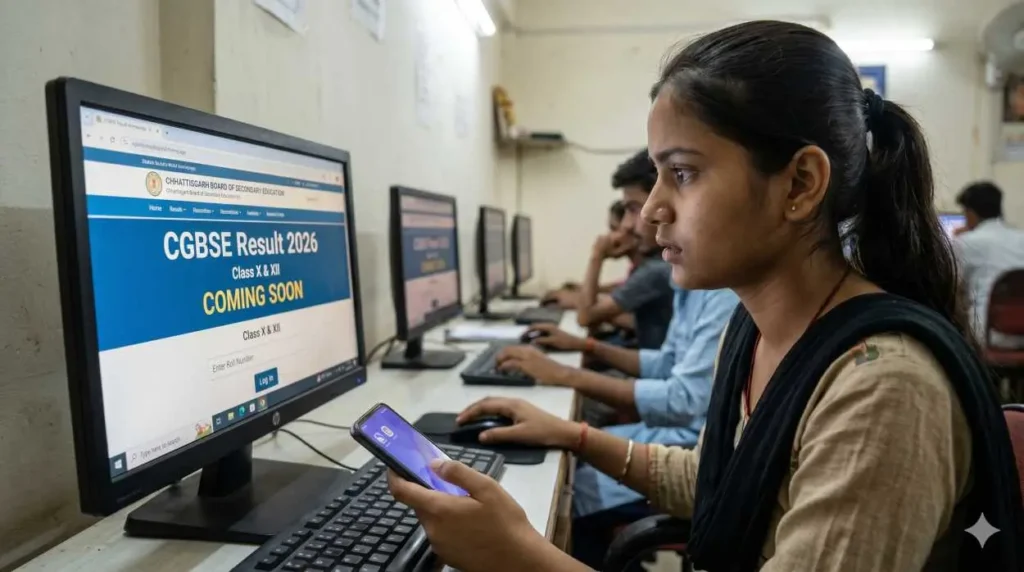
The state’s Board of Secondary Education is finalising the scores for the 2026 Class 10 and 12 examinations, and the signs point to an imminent release. Evaluators have essentially finished checking the massive volume of answer sheets. The government’s document repository, DigiLocker, has already flipped its status for the CGBSE mark sheets to a flashing “coming soon.”
But exactly when will the link go live?
Board officials haven’t pinned down a specific hour in their public statements, though historical patterns offer a tight window. Last year, the board dropped both sets of results on May 7. If they stick to the same operational rhythm, students should expect the official press conference in the first week of May, or possibly earlier if the data tabulation wraps ahead of schedule.
It’s a high-stakes moment for the state. These specific numbers dictate college admissions, stream selections for high schoolers, and immediate career trajectories for those entering the workforce.
The exams themselves wrapped up weeks ago. Class 12 students sat for their final papers between February 20 and March 18. Class 10 students finished slightly earlier, running the gauntlet from February 21 to March 13.
But the 2026 exam cycle didn’t pass without significant friction.
A widely circulated paper leak on social media forced the board’s hand midway through the schedule. Allegations surrounding the Class 12 Hindi exam surfaced on March 15 and 16, prompting immediate police complaints and widespread anxiety among candidates. After an internal committee reviewed the digital evidence and confirmed the breach, the CGBSE cancelled the March 14 paper entirely to protect the integrity of the board.
Students were forced to return to their examination centres on April 10 for a mandatory re-test. The board mandated a 9:00 a.m. start time, handing out fresh question papers at 9:05 a.m. to give students time to read before the three-hour writing period began.
That operational hiccup could easily have derailed the evaluation timeline. Coordinating a statewide re-test requires securing new venues, printing hundreds of thousands of new papers, and deploying fresh invigilators. Yet, the board pushed through the logistical nightmare, keeping the broader grading schedule largely on track.
Now, the focus shifts entirely to the results portals.
When the announcement hits, traffic will instantly choke the state’s internet infrastructure. Students relying exclusively on the official websites—cgbse.nic.in and results.cg.nic.in—should anticipate slow load times, timeout errors, and crashing pages.
The board knows this. They’ve built necessary redundancies into the system.
For those who can’t get the primary websites to load, SMS remains the most reliable fallback. It doesn’t require broadband or a smartphone. Class 10 students just need to text ‘CG10’ followed by a space and their exact roll number to 56263. Class 12 students follow the exact same format using ‘CG12’. The automated system pings back the subject-wise breakdown and overall pass status in seconds.
And then there’s the digital vault.
DigiLocker has quietly become the standard for securing verified academic records in India. Students no longer need to wait weeks for physical mark sheets to arrive at their local schools. By registering with an Aadhaar-linked mobile number and navigating to the CGBSE section, they can pull a legally valid digital scorecard the moment results are declared.
That digital document isn’t just a placeholder. It serves as official proof for university applications, Class 11 admissions, and even government job verifications while the physical copies make their slow way through the postal system.
Let’s look at the sheer numbers involved here. The volume of students waiting for these results requires massive logistical coordination.
In 2025, 3,23,094 candidates sat for the Class 10 exams. Another 2,38,624 appeared for the Class 12 finals. While the exact enrollment figures for 2026 haven’t been published in the preliminary press releases, the demographic trend suggests a similar, if not slightly larger, cohort this year.
The benchmarks for academic success remain rigidly unchanged. Students must hit a hard floor of 33 percent in every single enrolled subject—combining their theory marks and practical assessments—to officially clear the boards.
Falling short in one or two subjects doesn’t mean the end of the road. It triggers the supplementary exam process, a secondary safety net that the board typically schedules later in the summer. For students who fail three or more subjects, the rules are unforgiving. They must repeat the entire academic year.
Last year’s performance sets the baseline for the current cohort. The overall pass rate for Class 12 sat at 81.87 percent. Girls thoroughly dominated that statistic, passing at an 83.72 percent clip compared to a sluggish 76.91 percent for boys.
Class 10 saw a slightly tougher landscape. The overall pass rate landed at 76.53 percent. Again, girls outperformed the boys across the state—80.70 percent to 71.39 percent.
Will the 2026 batch break those existing records? That depends entirely on how they navigated a slightly disrupted exam season, the pressure of the testing halls, and the fallout from the Hindi paper leak.
The physical mark sheets, once they finally reach the local schools and are distributed by headmasters, will detail much more than just the final grade. They carry the candidate’s full legal name, parents’ names, specific centre codes, and a granular breakdown of theory versus practical marks. It’s a comprehensive academic footprint that follows a student for decades. Errors in these documents require an arduous bureaucratic process to correct, meaning students must check the digital versions meticulously for spelling mistakes the moment they download them.
For now, the standing advice to students from school administrators is simple. Keep your admit cards close. Memorise your specific roll number. Don’t fall for fake links circulating on WhatsApp or Telegram claiming early or paid access to the board results. Scammers frequently exploit this high-anxiety window. The only verified, legitimate channels are the state’s official platforms, the central government’s DigiLocker app, and the official 56263 SMS gateway.
The tension across the state is palpable.
Every household with a teenager in Chhattisgarh is currently watching the calendar. The results don’t just measure academic retention; they serve as a hard pivot into the next phase of a student’s life. A strong showing opens doors to premier coaching institutes in Bhilai and Raipur, while a weak result limits options in an increasingly competitive educational market.
As the state board finalises the last batches of data and stress-tests the servers, the narrative shifts from preparation to outcome. The next move belongs to the CGBSE, and half a million students are waiting for the board to hit publish.