State complicity in corporate coal extraction is wiping out central India’s oldest forest, violently displacing indigenous tribes, and triggering an unstoppable climate catastrophe.
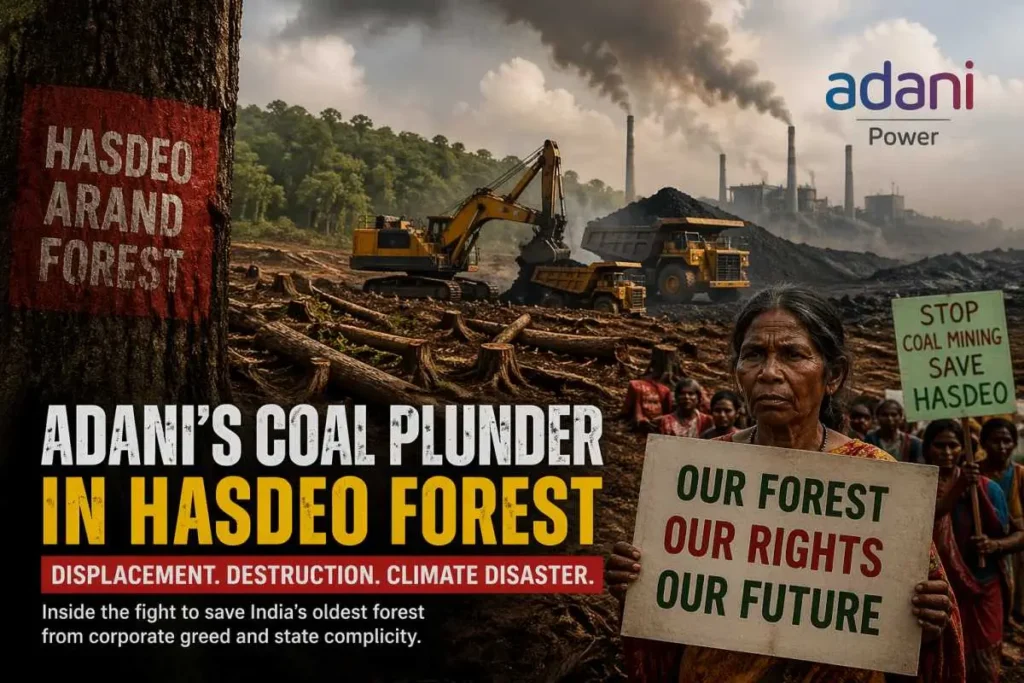
RAIPUR, April 22 — Police units with riot gear stood by while contractors dragged chainsaws through 15,000 ancient sal trees in central India’s oldest forest. State authorities under the BJP government greenlit this brutal felling in Chhattisgarh’s Hasdeo Arand, handing over an irreplaceable ecosystem to expand an Adani Group coal mine. It’s an extraction zone built directly on top of five billion tonnes of coal. And it’s obliterating a massive carbon sink just as the planet chokes on its own emissions.
State officials push a hollow narrative framing this destruction as necessary domestic energy development. They’re dead wrong. Hasdeo Arand isn’t just a patch of harvestable timber; it’s the life-giving catchment area for the Hasdeo River and the Minimata Bango Dam. That water irrigates over 300,000 hectares of India’s agricultural heartland. When excavators rip out the complex root systems holding this ecosystem together, they annihilate the region’s primary water sponge. This violent disruption instantly ripples outward, guaranteeing water scarcity and threatening food security for millions far beyond the mine’s immediate perimeter.
The global fallout is purely catastrophic. Hasdeo locks millions of tonnes of sequestered carbon in its soil and canopy, acting as a critical atmospheric regulator that we simply can’t afford to lose. “You can’t offset the destruction of an ancient, contiguous forest ecosystem by simply planting saplings elsewhere,” warns Ashish Kothari, a prominent Indian environmentalist and founder of the Kalpavriksh action group. “This specific mining expansion acts as a massive carbon bomb. We’re looking at a release of emissions that directly sabotages international climate agreements and accelerates extreme weather events worldwide.”
We know exactly what the wreckage looks like, and the clock is already ticking. In the first year following this clearance, the immediate canopy collapse triggers rapid, unstoppable topsoil erosion. Without the sal trees to anchor the earth, monsoon rains will wash thousands of tonnes of barren silt directly into the Hasdeo River. Local surface temperatures will violently spike by up to three degrees Celsius during the dry season. But the most immediate bloodshed won’t just be climatic. Stripped of their ancestral migratory corridors, panicked elephant herds will inevitably crash into surrounding human settlements, driving a brutal, deadly surge in human-animal casualties across the state.
By the second year, the ecological fracture turns permanent and global. The Bango Dam’s holding capacity will plummet due to advanced siltation, slashing crop yields across central India’s plains and devastating rural economies. Simultaneously, the heavy extraction phase kicks in. The first massive waves of coal from the Parsa East and Kente Extension blocks will hit the power plants. It’s a toxic process pumping millions of tonnes of greenhouse gases into the atmosphere, shoving the planet past the irreversible 1.5-degree warming threshold. They’ve essentially armed a climate time bomb that guarantees erratic, destructive weather patterns for the global south.
Adani Enterprises manages the joint venture running the Parsa East Kete Basan (PEKB) coal block on behalf of a Rajasthan state utility. For a decade, the Adivasi tribal communities living in these forests fought the corporate expansion through desperate mass protests, including a grueling 300-kilometre trek to the state capital. They’ve relied on this land for shelter, medicine, and livelihoods for generations. The political calculus turned lethal when the BJP assumed control of the state government late last year. They rushed contractors back into the forest, resuming massive logging operations under heavy police protection and violently erasing indigenous land rights.
So why doesn’t the law protect these ancestral lands anymore? The answer lies in compliant courts and corporate influence. In a devastating decision last October, the Chhattisgarh High Court dismissed a petition challenging the cancellation of community forest rights for Ghatbarra village, which sits directly inside the mining kill zone. The court ruled the state made a mistake granting these rights in 2013 because officials had already marked the land for coal diversion. It’s a legal precedent that strips forest-dwelling tribes of the bare-minimum protections the 2006 Forest Rights Act guarantees.
Goldman Environmental Prize winner Alok Shukla, convenor of the Hasdeo Aranya Bachao Sangharsh Samiti, spent over a decade fighting this exact nightmare. “We continue to claim leadership on climate change, but then allocate more coal mines than ever before,” Shukla stated following the recent clearances. He argues the state consistently rubber-stamps approvals based on completely forged Gram Sabha consents. Shukla highlights a grim local saying that drives the desperate indigenous resistance: “If you sell your land, you will be reborn as a jackal.” To the Adivasi, the state isn’t just stealing real estate; it’s murdering their identity.
The government’s push to clear Hasdeo’s timber directly violates the Panchayats Act of 1996, a law designed to ensure self-governance in tribal regions. The legislation grants Gram Sabhas absolute authority over natural resources. Yet state authorities blatantly bypassed these mandatory consultations for villages like Salhi and Hariharpur. The Chhattisgarh State Scheduled Tribes Commission previously uncovered deep, systemic fraud in the clearance process, documenting forged consent documents and explicit coercion against tribal leaders. The legal shield that tribal communities desperately built simply couldn’t withstand the state’s crushing pressure.
The human devastation multiplies daily. Activists estimate contractors have slaughtered over 81,000 trees since mining began in 2012, with hundreds of thousands more facing the blade. Bulldozers have already displaced hundreds of families, flattening their homes to expose the black seams below. Thousands more now face imminent, forced eviction, and they won’t survive the transition. Up to 90 percent of the indigenous population depends entirely on agriculture and forest produce for survival. When the excavators tear through the canopy, they condemn the communities living beneath it to absolute poverty.
Activists on the ground know the fight is slipping away. The new administration scrapped the state assembly’s prior resolutions to cancel the coal blocks. Police detentions of protest leaders haven’t stopped, becoming a brutal standard practice ahead of any logging phase. Authorities locked up prominent organisers for days without charge during the latest wave of deforestation.
There’s nothing left to negotiate when the forest is already dead.