Finance Minister Nirmala Sitharaman claims the state is bleeding revenue, but the ₹117 price tag at the pump proves who’s actually paying the price.
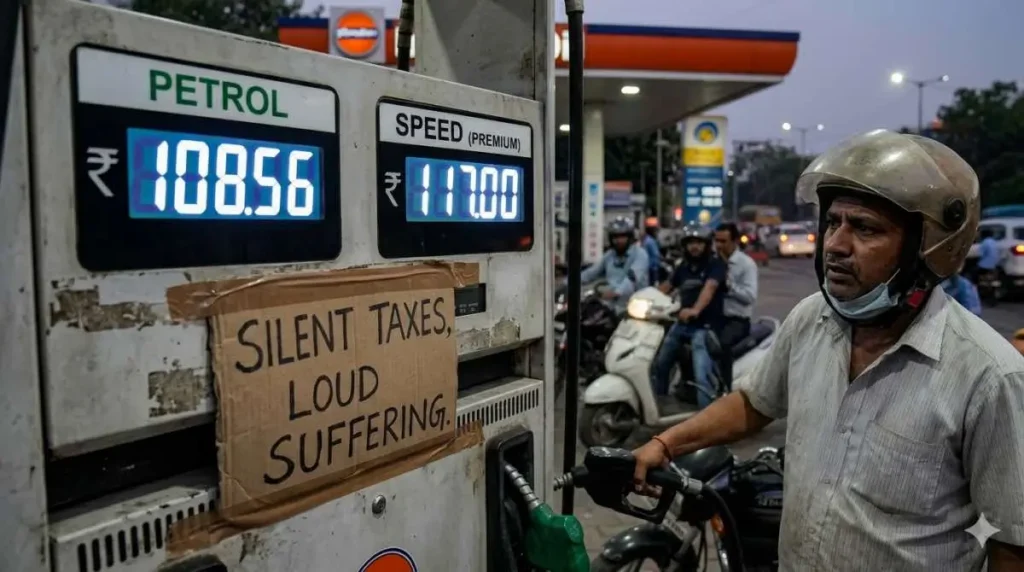
Raipur, May 26 — The digital meters at your local fuel pump aren’t malfunctioning, even as they demand ₹108.56 for a standard litre of petrol and a blistering ₹117 if your engine requires premium ‘Speed’. State-run oil marketing companies just slammed consumers with their fourth consecutive price hike in eleven days. They’ve drained an extra ₹8 per litre from drivers nationwide since the middle of May. And while the middle class scrambles to balance household budgets against soaring transit costs, the central government expects you to stay quiet. Finance Minister Nirmala Sitharaman stood before a Mumbai audience on Monday and dismissed the ensuing public frustration as mere “fear mongering.”
They don’t want you looking too closely at the math behind that ₹117 premium tag. The government insists it’s heavily shielding citizens from global energy shocks. Sitharaman loudly pointed out that a recent ₹10 cut to central excise duties will cost the exchequer roughly ₹1 lakh crore in foregone revenue. But she conveniently ignored a glaring historical precedent. When global crude oil crashed a few years ago, the Centre didn’t pass those savings down to the street. They aggressively hiked excise duties, maintaining massive financial buffers for themselves while ordinary commuters paid a premium for cheap global oil. So why does the government suddenly cry poverty only when international margins tighten?
You can’t call a daily tax squeeze a global inevitability. Even with the Centre’s highly publicised duty cuts, the base cost of crude makes up less than half of what you’re handing over to the cashier. Central excise duties and state-level Value Added Taxes still consume a massive chunk of that ₹108.56 per litre. Ministry of Petroleum Joint Secretary Sujata Sharma claims the domestic price jump is much lower than the 22 percent spikes seen globally. That’s a clever way to dress up an unbearable local reality. They’ve maintained an artificially high floor price for years, meaning any percentage increase hits an already exhausted consumer base much harder.
And the market definitely knows who stands to benefit from this setup. Every time the government unchains the state-run retailers to aggressively hike prices, OMC stocks surge. They’re explicitly prioritising corporate balance sheets and state coffers over the financial survival of the working class.
You can’t fake a crisis when your oil companies are flashing green on the stock exchange.
You don’t just hike the core cost of logistics by ₹8 in ten days without driving up the price of every single vegetable, brick, and pharmaceutical drug transported across state lines. The government demands confidence from the public, yet it routinely demonstrates zero empathy for the immediate financial ruin happening at the petrol pump. They’re extracting maximum revenue while demanding maximum gratitude.
The state isn’t subsidising your commute; it’s aggressively taxing your right to move.