As New Delhi deploys forensic and tunnel rescue units to the disaster zone, families in Bilaspur and Surguja wait desperately for word on two missing doctors.
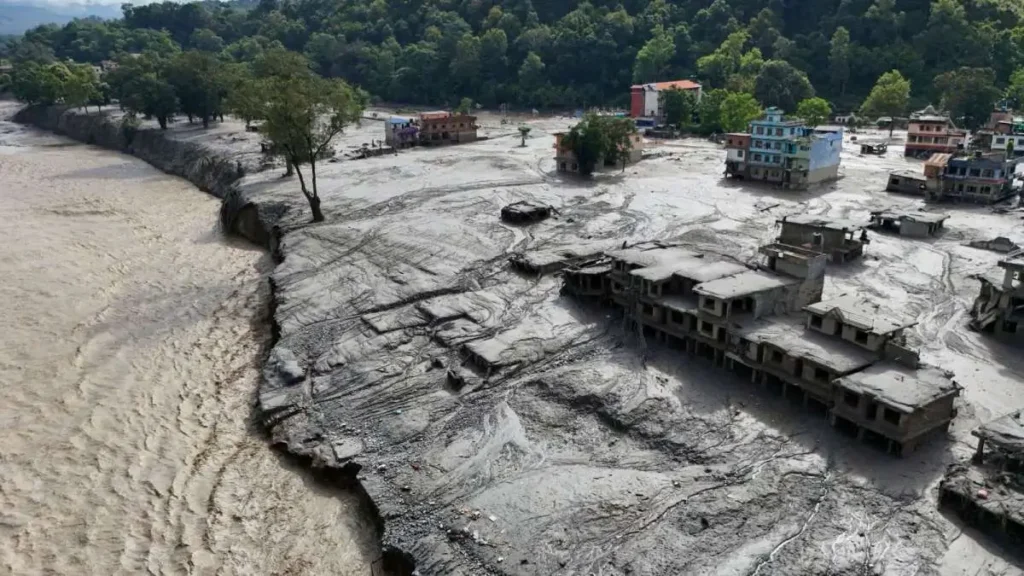
KATHMANDU, Sept. 3 — The death toll from the catastrophic glacier-triggered flash floods across the Nepal-Tibet border has surpassed 1,250, with nearly 4,000 people still missing nine days after a Himalayan avalanche obliterated entire villages and hydropower projects.
Among the thousands unaccounted for are two Non-Resident Indian doctors originally from Chhattisgarh — Dr. Priyanka Choudhary of Bilaspur and Dr. Meena Gupta of Surguja — who vanished when a wall of water and debris slammed into the Rasuwagadhi immigration centre on the morning of August 25.
As families in India face an agonising wait, New Delhi has rapidly escalated its emergency footprint in the disaster zone. On Wednesday, a fifth Indian Air Force flight landed in Kathmandu, bringing India’s total relief delivery to 74 tonnes. Simultaneously, a specialised Indian tunnel rescue team is battling deep slush to reach hundreds of workers trapped inside subterranean hydropower facilities in Chilime.
The catastrophe, which Nepal’s Prime Minister Balendra Shah explicitly blamed on climate change, has laid bare the fragile geography of the Himalayas. Entire transit checkpoints and border towns were wiped clean away by the raging Bhotekoshi and Trishuli rivers. In the district of Rasuwa, on the border with Tibet, the scale of destruction is nearly absolute. Villages like Syabru Besi have been reduced to muddy riverbeds, leaving just a single building standing, and are now accessible only by army helicopters evacuating survivors.
In Nuwakot’s Bidur area, desperate residents have resorted to pulling themselves across the treacherous Trishuli river using the steel wire of a newly installed zipline. The sheer kinetic force of the August 25 floodwaters was so severe that some victims’ bodies were carried up to 240 kilometres downstream, crossing the border into neighbouring India.
A Desperate Wait in Chhattisgarh
For the families of the two Chhattisgarh doctors, the disaster struck just minutes after their last contact. Both women were part of a 77-member pilgrimage group associated with the Isha Foundation that had just completed the Kailash Mansarovar Yatra.
They reached the Rasuwagadhi immigration centre on the Nepal-Tibet border for customs formalities on the morning of August 25. Dr. Choudhary, 39, a Finland-based academic who completed her schooling and dentistry degree in Chhattisgarh, spoke to her mother at 9:00 a.m., saying she was at the centre and would call back later.
Fourteen minutes later, the flood hit.
“Unaware about it, we kept waiting for her call, but later media reports shocked us,” her father told the Press Trust of India. Dr. Choudhary had planned to fly to Delhi the next day to celebrate Raksha Bandhan in Bilaspur.
Similar heartbreak has gripped the family of Dr. Gupta, a UK-based dermatologist and daughter of senior BJP leader Karta Ram Gupta from Surguja. Her father had declined her invitation to meet in Kathmandu, citing the dangerous monsoon season. “I never imagined that my daughter would have to face its wrath,” he said, noting the family had planned a major reunion in Delhi. The Chhattisgarh government confirmed that while some residents from Raipur have been located and are returning, the two NRI doctors remain entirely untraced.
Deep Slush and Desperation at Chilime
The rescue operation has become a grim logistical nightmare. Around 11,993 people have been rescued via air and land routes by a joint force of over 21,000 security personnel. But the most desperate front of the recovery lies underground.
Indian and Chinese specialised international tunnel rescue teams have been deployed to critical hydropower sites, where authorities estimate close to 1,000 workers were trapped when the waters surged into the tunnels. At the Chilime hydropower project, a 24-member Indian tunnel rescue team has moved its base closer to the site. Operating in a high-risk subterranean environment, the unit has faced extreme access restrictions and marshy tunnel floors that prevent the deployment of heavy earth-moving equipment. The personnel have resorted to using improvised floats to advance 100 metres deeper into the passages.
Above ground, the Indian government dispatched its fifth aircraft on Wednesday carrying 5.5 tonnes of medical supplies — including antibiotics, analgesics, and surgical items — along with an 11-member expert rescue squad. External Affairs Minister S. Jaishankar confirmed the ongoing support under India’s ‘Neighbourhood First’ policy. So far, 166 Indian nationals have been safely evacuated from the disaster zones, while another 410 who were visiting the Tibet Autonomous Region for pilgrimage were cleared to leave China on Wednesday.
A Climate Reckoning
The sheer scale of the fatalities — currently standing at 1,243 confirmed dead in Nepal and 21 in Tibet, with nearly 4,000 missing — has prompted sharp warnings from global leaders.
Addressing the tragedy, Prime Minister Shah pointed directly to the high-altitude Himalayan glacier collapse that triggered the deluge. He stated the disaster was fundamentally driven by global warming, arguing that the responsibility to “manage and minimise” the effects of climate change rests squarely on the global community.
That sentiment was echoed by Mafalda Duarte, executive director of the UN’s Green Climate Fund. Pointing to the Nepal catastrophe, she warned that nations are ignoring critical environmental tipping points. “We see when there is will, that finance is mobilised to respond to emergencies. For some reason, we don’t see the same type of response to climate — as if we can afford to wait,” she said.
In Kathmandu, the grim reality of the death toll is overwhelming local infrastructure. At the Nepal Police Hospital, Indian forensic experts have embedded in two laboratories to help Nepali authorities conduct DNA profiling on unidentified victims. Relatives of the missing have been urged to provide blood samples and photographs, as hundreds of bodies recovered from the wreckage remain unidentifiable.
For the families in Chhattisgarh, and thousands of others across Nepal and India, the search for closure now relies entirely on the painstaking work of these forensic teams and the rescue crews digging through the mud.