By Shubhankar Shukla
Just last week, economic reports were predicting that crude oil could fall to $50 per barrel by June 2026. But geopolitics has a way of wrecking forecasts.
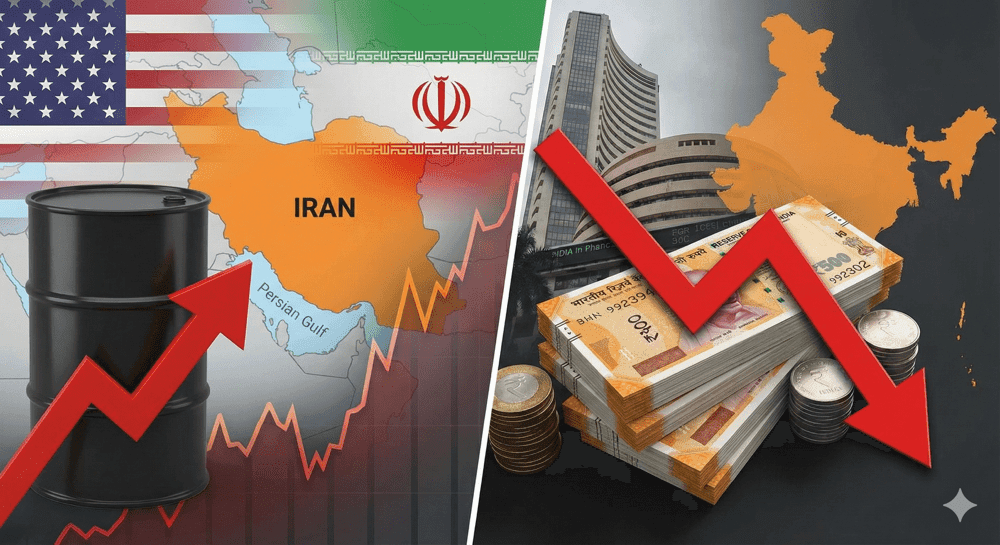
With massive protests rocking Iran and President Trump weighing “strong options”—including potential strikes on Iranian infrastructure—the global oil market has hit a panic button. For India, which imports over 85% of its crude oil requirements, this isn’t just a foreign policy headline; it’s a direct hit to our wallet.
Here is a technical breakdown of how the Iran-US escalation could impact the Indian economy, the Rupee, and your daily expenses.
1. The “Fear Premium” and India’s Import Bill
The immediate risk is the Strait of Hormuz. Roughly 20% of the world’s oil passes through this narrow channel. If Iran blocks it or if tankers are targeted, prices won’t just rise; they will spike.
• The Math: India buys nearly 5 million barrels of oil every single day.
• The Impact: Economists estimate that for every $10 increase in the price of a barrel of crude oil, India’s Current Account Deficit (CAD) widens by approximately 0.3% to 0.5% of GDP (roughly $13–$15 billion annually).
• Why it matters: A wider deficit means more dollars leaving the country than coming in, which puts pressure on our overall economic stability.
2. The Rupee: Under Pressure
The Indian Rupee (INR) and Crude Oil share an inverse relationship. When oil goes up, the Rupee tends to go down.
• The Mechanism: To buy expensive oil, Indian oil marketing companies (like IOCL, BPCL) must buy massive amounts of US Dollars. This surge in demand for the Dollar strengthens it while weakening the Rupee.
• The Forecast: Before this crisis, experts hoped the Rupee would stabilize below ₹88/USD. If Brent Crude sustains above $75-$80, we could see the Rupee testing new lows against the dollar, making all imported electronics, parts, and gold more expensive.
3. Inflation: The “Pass-Through” Effect
In India, fuel prices are theoretically deregulated (linked to market rates), but in practice, they are often managed politically.
• Direct Impact: If the government passes the cost to consumers, petrol and diesel prices at the pump will rise.
• Indirect Impact (Second-Order Effects): Diesel is the lifeline of Indian logistics. When diesel gets expensive, truck freight rates go up. This increases the cost of vegetables, milk, and daily essentials transported from rural Chhattisgarh to cities like Raipur.
• RBI’s Dilemma: The Reserve Bank of India aims to keep inflation near 4%. An oil shock adds roughly 30 basis points (0.3%) to inflation for every 10% rise in oil prices. This could force the RBI to keep interest rates high for longer—meaning your home and car loan EMIs won’t come down anytime soon.
The “optimistic” scenario is that the US-Iran tension remains a war of words and prices stabilize. The “pessimistic” scenario involves a physical disruption in the Persian Gulf.
For now, watch the Brent Crude price ticker. If it crosses $75 and stays there, get ready for a tighter budget in the coming months.
Stay tuned to Roots Alert for real-time updates on this developing story.