By Roots News Desk l Jharkhand
DHANBAD — In the soot-choked heart of the Jharia coalfield, the earth has once again turned on its inhabitants. A lethal seepage of carbon monoxide from a long-defunct colliery has claimed three lives in Dhanbad’s Kenduadih area, reigniting the desperate debate over the safety of thousands living atop India’s burning coal lands.
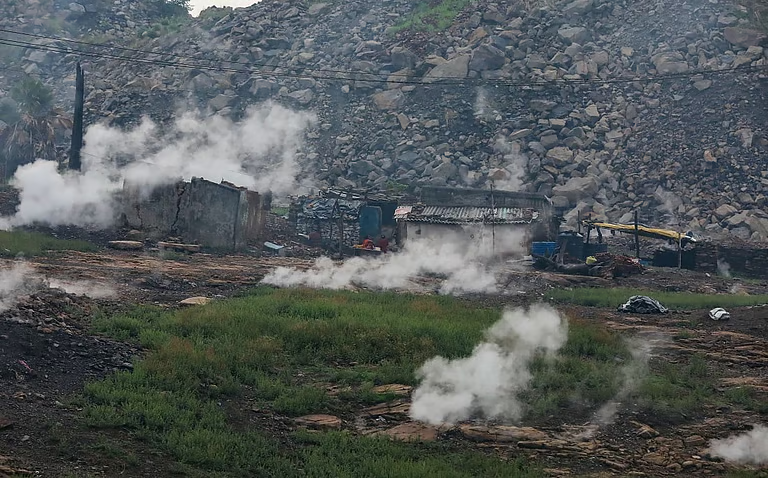
The tragedy, which unfolded over the course of December 2025, serves as a grim reminder of the subterranean fires that have raged here for over a century. The gas leak, triggered by land subsidence and underground combustion at the Putki-Balihari Colliery, has effectively turned the homes of the Rajput settlement into gas chambers, forcing a confrontation between a terrified populace and an administration struggling to contain an invisible enemy.
A Silent Killer Stalks the Night
The crisis began on December 3, when residents of the Kenduadih settlement reported a pungent, suffocating thickness in the air. The source was quickly identified: seams 13 and 14 of the Bharat Coking Coal Ltd (BCCL) mine, closed for over 15 years, had breached. Fissures in the unstable ground allowed carbon monoxide (CO)—a colorless, odorless, and deadly byproduct of incomplete combustion—to escape into the dwellings above.
The toll was immediate. On December 3, Priyanka Devi, 28, of Naya Dhaura, collapsed and died. The following day, 58-year-old Lalita Devi of Rajput Basti succumbed to the toxic fumes. Both deaths were attributed to asphyxiation.
Weeks later, on December 30, the gas claimed a third victim. Surendra Kumar Singh, 46, a member of the Janata Mazdoor Sangh, was found unconscious in his home. Despite being rushed to the Shaheed Nirmal Mahto Medical College Hospital, he was declared dead on arrival.
“He went to sleep normally the night before,” recounted his brother, Loknath Singh, struggling to comprehend the sudden loss. “When we tried to wake him in the morning, he did not respond.”
Loknath revealed a haunting detail: while many family members had fled to relief camps as the gas intensity spiked, Surendra had stayed behind to guard their home. It was a fatal decision in an environment where air quality readings had become catastrophic.
“30 to 40 Times the Safe Limit”
The medical implications of the leak are staggering. Dr. Atari Gangopadhyay, a prominent respiratory and critical care specialist in the region, emphasized the insidious nature of the threat.
“Carbon monoxide is an extreme danger because it is impossible to detect without instruments,” Dr. Gangopadhyay explained. “It replaces oxygen in the body by binding with hemoglobin to form carboxyhemoglobin, effectively blocking oxygen transport in the blood.”
According to the World Health Organization, safe CO exposure levels should not exceed 9 parts per million (ppm). In the narrow lanes of Kenduadih, readings have reportedly surged between 1,500 and 2,000 ppm.
“These levels are 30 to 40 times the safe limit and can prove fatal within minutes,” Dr. Gangopadhyay noted, urging authorities to declare the situation a disaster to mobilize adequate relief and monitoring.
The Relocation Standoff
The leak has brought the long-standing issue of rehabilitation in Jharia back into sharp focus. Mining in this region dates back to 1894, and the first underground fire was recorded in 1916. Today, the fires continue to hollow out the land, leading to subsidence that cracks open the surface, releasing toxic cocktails of gas.
In response to the deaths, the district administration and BCCL officials have accelerated calls for residents to relocate to the Belgadia Township. However, the proposal has been met with fierce resistance.
Residents view the township not as a sanctuary, but as an economic wasteland. “There are no facilities there. It is far away, there are no jobs, and no education,” said Loknath Singh. “How can we move there? We are not ready to leave our homes unless the gas leak is fully stopped.”
Ravi Singh, another local resident, described a community living on the edge of panic. “People are sleeping in masks, yet waking up with headaches and vomiting,” he said. While BCCL established relief camps on December 5, Ravi noted that around 40 homes remain directly in the danger zone, with fear rippling through a population of nearly 5,000. “Our jobs are here,” he insisted. “If relocation is unavoidable, it must be to a place with proper facilities.”
Authorities Scramble for a Solution
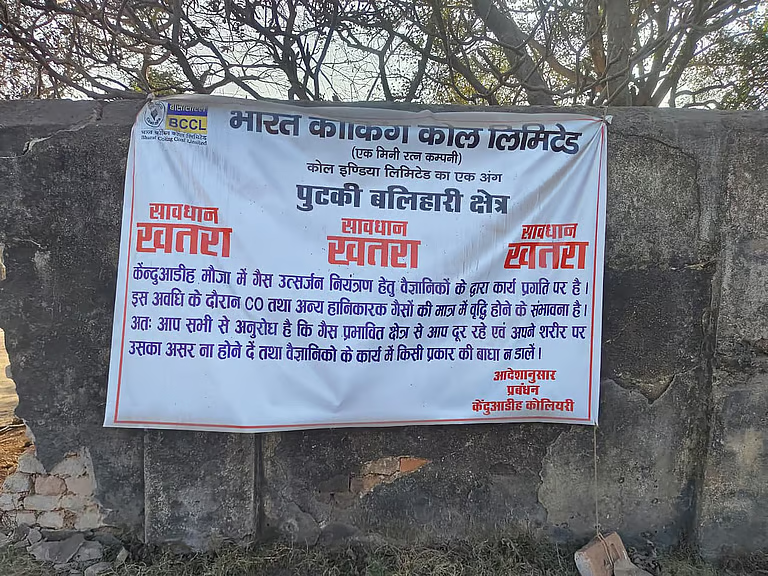
BCCL officials maintain they are taking aggressive steps to neutralize the immediate threat. Project Officer Lakhan Lal Barnwal confirmed that the company is utilizing cryogenic technology to battle the underground blaze.
“We consulted experts in Kenduadih who suggested nitrogen filling,” Barnwal stated. “So far, six tankers of liquid nitrogen—each containing 14,000 liters—have been injected through boreholes.”
The liquid nitrogen expands into gas, displacing oxygen and starving the fire, theoretically reducing the pressure of the escaping carbon monoxide. However, Barnwal admitted the battle is far from won. “The situation is not yet normal. Gas flow continues to fluctuate,” he said.
Experts from premier institutions, including IIT-ISM Dhanbad and the Central Institute of Mining and Fuel Research, have been drafted to conduct impact studies. Yet, for the residents of Jharia, scientific studies offer little comfort against the reality of a burning ground and the invisible poison seeping into their bedrooms.
As the fires burn below and the administration pushes for evacuation above, the people of Kenduadih remain trapped in a perilous limbo—caught between the lethal fumes of their heritage and the uncertain future of displacement.
Source:- Downtoearth.org.in