A satirical youth movement just surpassed the ruling party’s social media following, exposing the brutal legal mechanics the state uses to crush digital dissent and free expression.
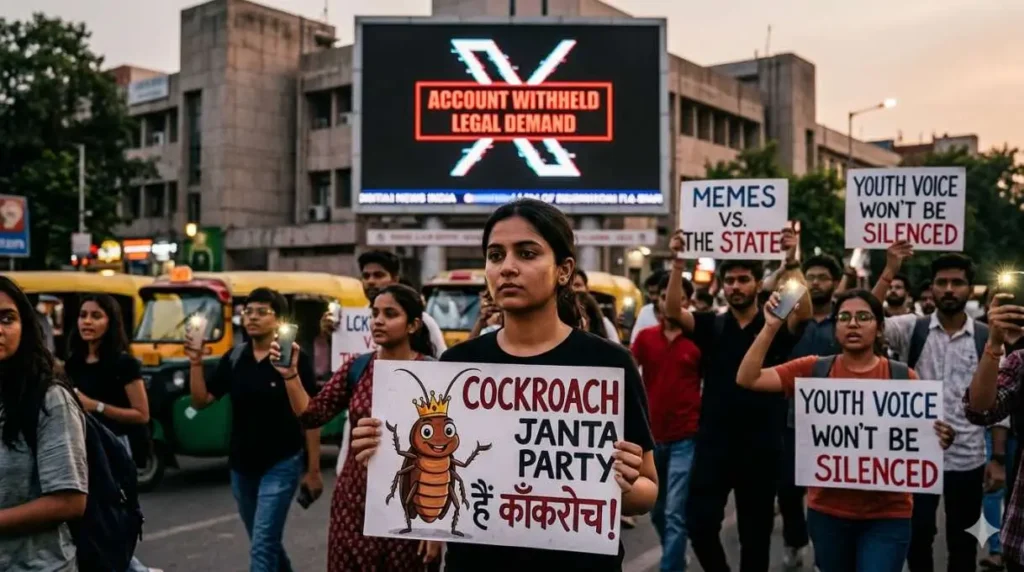
NEW DELHI, May 21 — X withheld the official account of India’s fastest-growing satirical political movement today, just hours after the group surpassed the ruling Bharatiya Janata Party’s follower count on Instagram. The Cockroach Janta Party, or CJP, didn’t exist a week ago. Now, it commands an online army of over 13 million users who mock the government and demand sweeping structural reforms.
Abhijeet Dipke, a 30-year-old public relations student at Boston University, founded the party on May 16. He didn’t start the group as a calculated electoral machine. He built it out of sheer frustration after India’s Chief Justice Surya Kant allegedly compared unemployed youth to “cockroaches” and “parasites” during a Supreme Court hearing. The Chief Justice later claimed journalists misquoted him, but the damage was already done.
Young Indians embraced the insult immediately, and they aren’t letting it go. Dipke launched a Google form on X calling for members, branding the new outfit as “Secular, Socialist, Democratic, and Lazy.” The joke spiralled into a national phenomenon almost overnight. LiveMint reports that more than six lakh people have officially registered as members.
And the numbers keep climbing at an unprecedented rate. The CJP’s Instagram page crossed the 10 million mark by Thursday morning, overtaking the BJP’s 8.7 million followers on the platform. The group hit 13 million shortly after. They didn’t buy these followers. They earned them through sharp, meme-driven anti-establishment commentary that resonated with jobless graduates and furious students.
But digital dominance often attracts official scrutiny. Indian users trying to access the CJP’s X account on Thursday hit a blank page displaying a legal restriction notice. The Union government hasn’t issued a formal explanation for the sudden censorship. Dipke quickly pivoted to Instagram and Facebook to address the blackout.
Platform manipulation isn’t just a glitch in India. It’s built right into the legal architecture. Under Section 69A of the Information Technology Act, the Ministry of Electronics and Information Technology can force platforms to rip down accounts without warning or transparency. Social media giants don’t fight back because they can’t afford to. If companies like X refuse these opaque takedown orders, the government strips their safe harbour protection, leaving local executives legally exposed to criminal prosecution. They cave immediately to protect their bottom line, burying real facts and valid criticism before they spread.
Shouldn’t a free press protect those who expose the establishment’s failures?
Reporters Without Borders doesn’t think the current system protects anyone. The international watchdog ranks India 159th out of 180 countries on the 2024 World Press Freedom Index, placing the nation barely above authoritarian regimes. Independent journalism and digital dissent face systematic algorithmic suppression and coordinated legal harassment. When a satirical account exposes uncomfortable truths about unemployment and institutional decay, the state doesn’t debate the facts.
They just can’t risk the exposure.
He didn’t hold back his fury over the ban. Dipke asked his followers why the authorities fear a simple satirical movement. He revealed that unknown hackers tried to breach the account right before X restricted it. He insisted the party only did what a functioning democracy demands — ask tough questions of powerful people.
“We didn’t do anything wrong,” Dipke said in a video statement released to The News Minute. He pointed out that they merely demanded accountability for a Goan student who died by suicide on May 13. That tragedy followed the massive NEET medical entrance exam paper leak, an ongoing crisis that has shattered the dreams of countless young Indians. Dipke has aggressively demanded the resignation of Union Education Minister Dharmendra Pradhan over the resulting exam cancellation.
The CJP doesn’t just post memes about the establishment. They drafted a five-point manifesto that attacks core systemic issues. The Times of India reports their demands include an absolute ban on post-retirement Rajya Sabha seats for chief justices. They want a strict 20-year election ban for MLAs who defect to rival parties for financial gain. They also demand 50 per cent reservation for women in parliament without increasing the total number of seats.
They aren’t ignoring everyday corruption either. The party demands the Central Board of Secondary Education scrap its exam rechecking fees entirely. They call the fee structure blatant extortion that exploits anxious students. On Reddit, the party’s supporters have organically expanded the platform with highly specific policy proposals. Users demand strict penalties for food adulteration, insisting that officials heavily fine anyone who tampers with public health. They also propose tying criminal fines directly to a person’s income bracket. Under their system, wealthy offenders can’t just buy their way out of trouble by paying a flat fee that means nothing to them.
The NEET controversy acts as the primary fuel for this youth anger. The National Testing Agency cancelled the crucial medical entrance exam after widespread reports of cheating and paper leaks surfaced across multiple states. Millions of students study for years just to get a single shot at this test. When the system failed them, the political establishment offered little comfort. Dipke capitalized on this raw anger. He didn’t just ask for an investigation. He went straight for the top, demanding the education minister step down.
Dipke knows exactly how to build a digital narrative. Before moving to the United States to study public relations, he worked as a political communication strategist in Pune. He spent three years volunteering with the Aam Aadmi Party’s social media team between 2020 and 2023. During the 2020 Delhi Assembly elections, he helped Arvind Kejriwal’s party win by engineering meme campaigns that captured the youth vote. Now, he’s applying that exact playbook on a massive national scale.
Mainstream politicians see the shifting momentum, and they aren’t sitting on the sidelines. Trinamool Congress MPs Mahua Moitra and Kirti Azad jumped into the fray this week. Azad publicly asked on X what qualifications he needed to join the group. The CJP welcomed Moitra with open arms, praising her as the fearless fighter Indian democracy needs against communal hatred. Hindustan Times reports that Samajwadi Party leader Akhilesh Yadav has also extended his support to the youth-driven campaign.
So the joke breached the boundaries of the internet. The movement didn’t just stay online. Young volunteers across Bihar, Madhya Pradesh, the Bastar region, and Uttar Pradesh marched through city streets wearing elaborate cockroach costumes over the past few days. They ran neighbourhood clean-up drives. They transformed a derogatory label into a badge of honour that unites a disillusioned generation.
They won’t stop at street theatre. Political observers report the CJP plans to test its actual electoral strength very soon. Supporters are actively preparing to contest the upcoming Bankipur Assembly by-election in Bihar. They aim to field a candidate against heavyweights from the BJP and the Jan Suraaj Party, bringing their digital rebellion directly to the ballot box.
The youth of India feel entirely disconnected from legacy politicians who speak a different language. Dipke told Business Today that young voters want politics that reflect their humour, their internet slang, and their profound economic anxiety. They don’t want polished speeches from elderly officials. They want immediate action on the jobs crisis, and they want respect from the institutions that govern them.
The government’s move to block the CJP’s X account might just pour gasoline on the fire. Censorship provides immediate validation for the group’s core argument that the system fears the people. The party has scheduled a virtual Gen-Z convention to organise its next steps, proving they aren’t backing down from the confrontation.
A judge threw a careless insult, and he didn’t realise he just birthed the largest opposition force on the Indian internet.