
With 38,000 GPUs deployed and local startups hitting unicorn valuations, India isn’t just adopting artificial intelligence it’s building the infrastructure to control it.
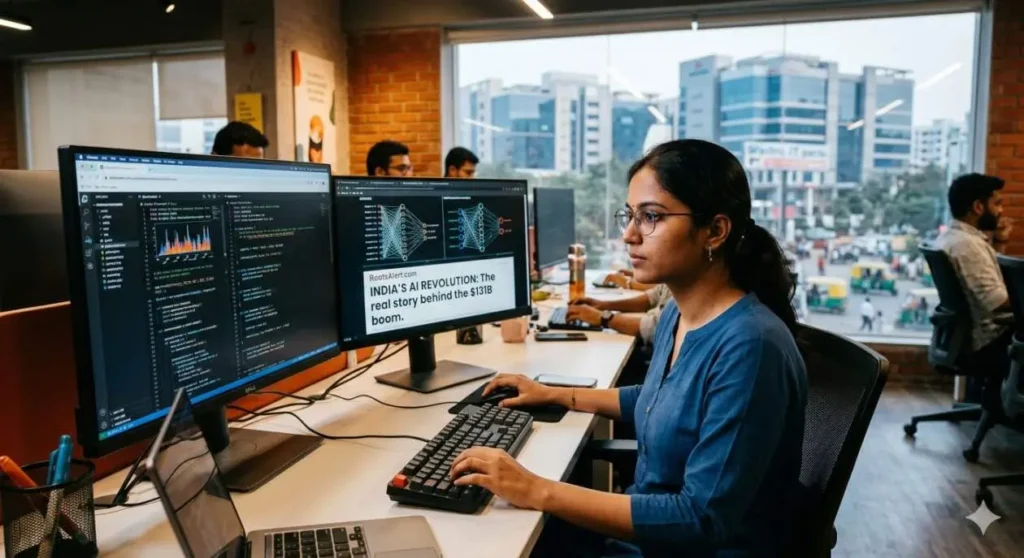
BENGALURU, April 7 — The numbers don’t lie. India’s artificial intelligence market isn’t a future projection anymore. It is an active, $7.6 billion economy projected to hit $131 billion by 2032, and the ground reality looks nothing like the Silicon Valley narrative.
For beginners trying to cut through the corporate jargon, the Indian AI story boils down to three things: computing power, native language models, and a massive shift in the workforce.
We are watching a sovereign infrastructure play unfold in real-time.
In March 2024, New Delhi approved the IndiaAI Mission with a ₹10,371 crore budget. The mission aimed to secure 10,000 graphics processing units—the essential hardware required to train AI models. By December 2025, the government blew past that target, deploying 38,000 GPUs. They subsidise access at ₹65 per hour so local developers don’t get priced out by American tech giants.
Why does local hardware matter? Because the data processing stays within the country.
You can’t build tools for a billion people in English alone. That explains why the focus aggressively shifted to native models. In June 2025, the government launched BharatGen AI, a homegrown multimodal system supporting 22 Indian languages.
Private money chases the same goal. Bengaluru-based Sarvam AI released its 105-billion parameter model in February 2026. Weeks later, the startup entered advanced talks to raise $300 million from NVIDIA and Accel at a $1.5 billion valuation. They aren’t building a generic chatbot. They are building the plumbing for voice and text applications that work in Tamil, Hindi, and Kannada.
The corporate adoption rate reveals a massive shift. According to a February 2026 report from NASSCOM, 87% of Indian enterprises actively use AI solutions. The banking, healthcare, and automotive sectors lead the charge.
But adoption doesn’t mean replacing humans wholesale. It means the nature of work shifts.
Stanford University’s 2025 Global AI Index ranked India third worldwide for AI competitiveness. More importantly, the report found that the penetration of AI skills in the Indian workforce sits 2.5 times higher than the global average. Employers doubled their AI job postings between 2023 and 2025, driven heavily by the southern tech corridors of Bengaluru, Hyderabad, and Chennai. Those roles carry a 28% wage premium.
India already laid the digital foundation. Internet connections crossed 1 billion last year. The country boasts the world’s second-largest 5G subscriber base. Now, that infrastructure carries AI-driven healthcare diagnostics to rural clinics and multilingual crop advisory systems to farmers’ phones.
It isn’t just about writing faster emails or generating images.
The stakes remain fundamental. India aims to build an AI ecosystem where the data, the computing power, and the talent stay onshore, capturing a projected $1.7 trillion in economic value by 2035.