By Roots Global Desk|01-march-2026
A legacy of uncompromising defiance ends in a flash of fire, plunging the Islamic Republic into a terrifying, leaderless void.
The announcement came not with a flourish of trumpets, but with a hollow, shattering silence that has gripped the heart of the Middle East. On February 28, 2026, the geopolitical landscape was violently redrawn. Ayatollah Ali Khamenei, the Supreme Leader who served as the iron-willed architect of Iran’s modern identity, was killed in a high-stakes military operation that has left the world breathless and a nation paralyzed by a dark, agonizing grief.
To his millions of devoted followers, Khamenei was more than a political figure; he was the Rahbar, a spiritual father whose word was the final law. To his adversaries in Washington and Tel Aviv, he was the primary obstacle to a Western-aligned regional order. Now, with the news that he has been killed, both sides are staring into a vacuum that no one—friend or foe—is truly prepared to fill.
The reports suggest the strike was a masterpiece of intelligence and lethality, hitting the Supreme Leader’s inner sanctum with surgical precision. But the physical destruction of a building is nothing compared to the psychological demolition of the state’s foundation. For the first time in nearly four decades, the Islamic Republic is a ship without a captain, drifting in the most turbulent waters it has ever navigated.
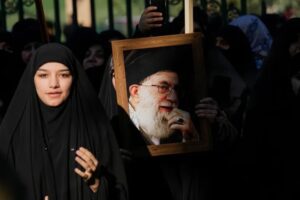
In the neighborhoods of south Tehran, the atmosphere is heavy with a Funereal gloom. Men and women have taken to the streets not to protest, but to collapse in shared despair. For the devout, the fact that Khamenei was killed by his greatest ideological enemies—the “Arrogant Powers”—is a spiritual wound that cuts deeper than any political defeat. It is a moment of profound national humiliation, a bruise on the collective ego of a civilization that prides itself on its thousand-year resilience.
The man killed on Saturday was a survivor who outlasted multiple U.S. presidents and navigated his country through decades of crippling sanctions. Since taking the mantle from Ayatollah Khomeini in 1989, Khamenei transformed Iran from a revolutionary state into a regional hegemon. He built the “Axis of Resistance,” a network of proxies and allies stretching from the Mediterranean to the Gulf of Oman, all designed to ensure that Iran’s enemies would never again set foot on its soil.
Yet, this fortress of defiance was built on a foundation of internal struggle. Even as he was killed, Khamenei left behind a country deeply divided by economic hardship and the aspirations of a younger generation that increasingly viewed his clerical rule as an anachronism. The tragedy of this moment is that his death does not resolve these tensions; it weaponizes them.
The immediate aftermath of the news that Khamenei was killed has been a scramble for stability. The Assembly of Experts, the body tasked with choosing a successor, now faces a task of existential proportions. With no clear heir apparent and the threat of further military strikes looming, the risk of a power struggle between the clerical establishment and the high-ranking generals of the IRGC (Revolutionary Guard) is at an all-time high.
“This is the decapitation of a system that was built entirely around one man’s worldview,” says a senior political analyst. “When you remove the cornerstone, the entire arch is at risk of collapse. The grief we see today is driven by the terrifying realization that there is no ‘Plan B’ for the Islamic Republic.”
For the West, the fact that Khamenei was killed represents a “maximum pressure” gamble of the highest order. The hope is that the removal of the Supreme Leader will lead to a collapse of the hardline system; the fear is that it will instead ignite a regional conflagration that will burn for decades.
As night falls over the Alborz mountains, the silence in Tehran is punctuated only by the distant, rhythmic chanting of mourners and the hum of military patrols. The defiance that Khamenei preached for thirty-seven years has been met with a final, violent answer.
The man is gone, but the ghost of his ideology remains, haunting the streets he once ruled with an iron hand. Iran is a nation in mourning, but more than that, it is a nation in fear—fear of the unknown, fear of its neighbors, and fear that the era of stability, however harsh, has died alongside the man who created it.