Hundreds gather on bridges in Dehloran and Ahvaz, holding flags and signs, after US president threatens to “decimate” all of Iran’s infrastructure.
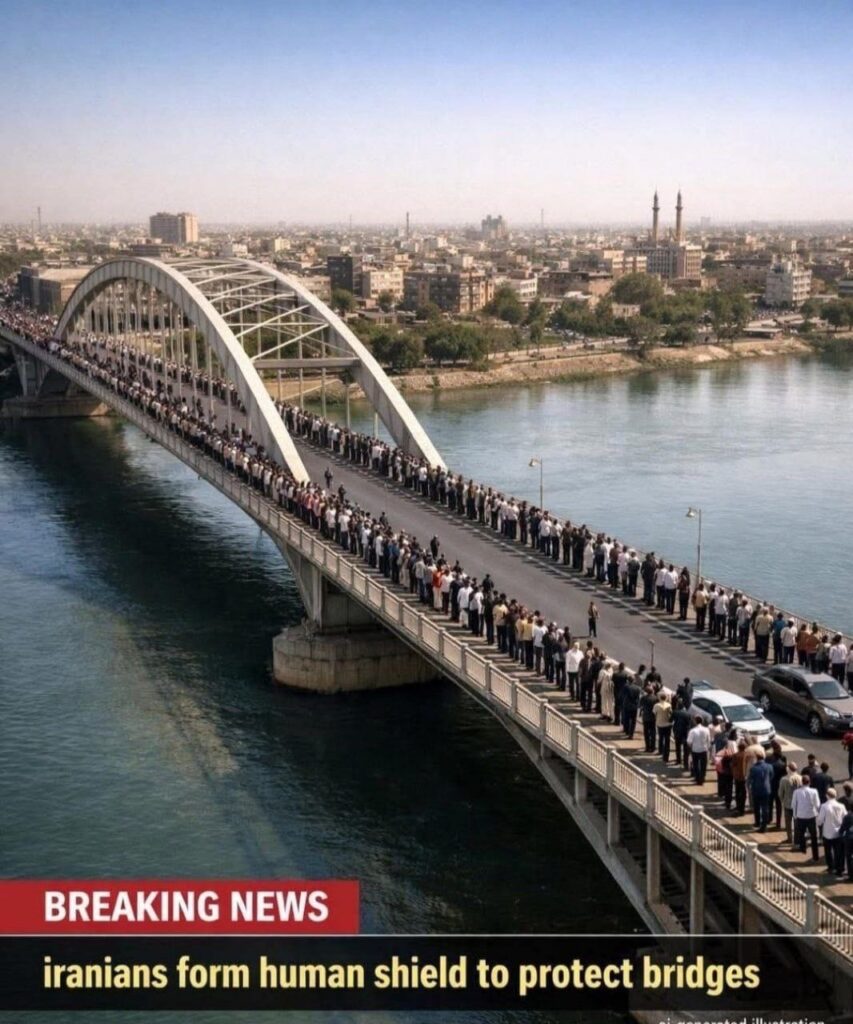
April 7 — Hundreds of Iranians stood hand-in-hand on bridges in Dehloran and Ahvaz on Tuesday, forming dense human chains to shield key infrastructure from threatened US airstrikes.
Children stood alongside their parents. Some held Iranian flags. Others carried signs that read: “Attacking power facilities is a war crime.”
The demonstrations came hours before President Donald Trump’s 8 p.m. EDT deadline for Iran to reopen the Strait of Hormuz — a choke point through which a fifth of the world’s oil transits in peacetime — or face the destruction of its power plants and bridges.
“Every bridge in Iran will be decimated by 12 o’clock tomorrow night,” Trump said Monday. “The entire country can be taken out in one night.”
Iran’s leaders called the bluff — and then raised it.
Ali Reza Rahimi, Iran’s Minister of Youth Affairs and Sports, went on state media Monday with an invitation. “We invite all our youth, athletes, artists, students, university students, and professors,” he said. “Regardless of belief or political inclination, we ask you to gather at 2 p.m. on Tuesday around power plants — our national assets and the future of Iran and its youth.”
He called it “a human chain of Iranian youth for a bright tomorrow.”
And they showed up.
Local outlets including Fars News Agency and Tasnim News Agency reported crowds at the Shahid Rajaei Thermal Power Plant — Iran’s largest — in Qazvin Province, as well as in Tabriz, Kermanshah Province’s Bisotun, and the northern Mazandaran power plant. In the southern city of Kazerun, families with children surrounded a power plant.
Fars quoted the crowd’s message directly: “They gathered in front of the power plant to condemn attacks on public infrastructure, defining them as clear war crimes.”
Then came the bridges.
In Khuzestan Province, hundreds locked arms on bridges in Dehloran and Ahvaz. Iranian social media lit up with video from Ahvaz’s White Bridge, showing rows of civilians standing shoulder-to-shoulder above the river. In Dezful, university students — many wearing traditional chadors — formed another chain on a 1,700-year-old bridge, waving the Islamic Republic’s flag.
The mobilisation wasn’t just symbolic. It was a direct response to an explicit threat.
Trump has extended deadlines before. This time, he insisted it was final. “I’ve already given Iran enough extra time,” he said, according to the Associated Press. The trigger: Iran’s blockade of the Strait of Hormuz, imposed after the US and Israel attacked on Feb. 28. Tehran rejected a 45-day ceasefire proposal Monday, demanding a permanent end to the war instead.
So the human chains formed.
But the airstrikes came anyway.
Iran’s Mehr News Agency, citing a source in Isfahan Province, reported Tuesday that “the US and Israel attacked the Yahyaabad Railway Bridge in the Khorramabad region, killing two civilians and injuring three.” A projectile struck the Tabriz-Tehran Highway, halting traffic. Bridges outside Qom, railways in Qazvin, and rail lines in Karaj were reportedly bombed.
Power went out in parts of Karaj and Pardis. All railway operations in Mashhad, northeastern Iran, were suspended due to air raid alerts.
The human chain didn’t stop the bombs. But it reframed the debate.
“Completely illegal,” Trump said of the human chain tactic in a phone interview with NBC News. “They’re not allowed to do that.”
International law suggests otherwise. Attacking power plants and bridges — civilian infrastructure — is widely considered a war crime. The Geneva Conventions prohibit targeting objects indispensable to civilian survival. French Foreign Minister Jean-Noël Barrot put it directly: attacks targeting civilian and energy infrastructure “are barred by the rules of war, international law.” He warned they “would without doubt trigger a new phase of escalation, of reprisals, that would drag the region and the world economy into a vicious circle.”
New Zealand Prime Minister Christopher Luxon urged restraint. “Any of those actions including bombing bridges and reservoirs and civilian infrastructure would be unacceptable,” he told Radio New Zealand.
The economic stakes are staggering. Brent crude traded above $111 per barrel Tuesday, up more than 50% since the war began. Some physical oil grades have hit nearly $150 a barrel, according to S&P Global Platts.
Fourteen million Iranians have volunteered to fight, President Masoud Pezeshkian posted on X. That number, if accurate, exceeds the population of many countries. It’s a signal — not just of defiance, but of a nation that sees no off-ramp.
The human chains are gone now, scattered by air raid sirens and the hard math of asymmetric warfare. But for a few hours on Tuesday, on bridges in Ahvaz and Dezful and Dehloran, Iranians made their choice clear: they would stand where the bombs were promised to fall.
The question is what happens at 8:01 p.m. — and who stands where tomorrow