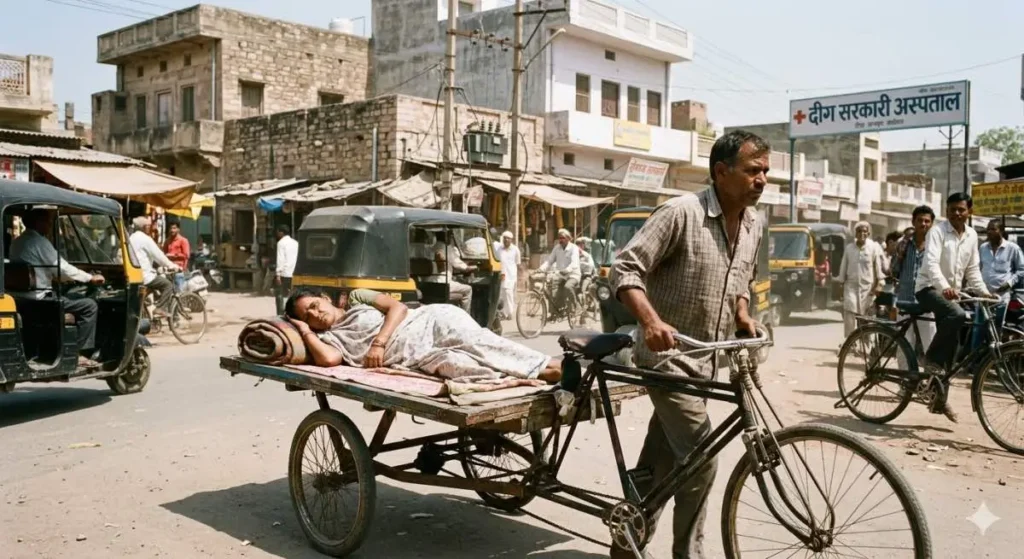
A viral video from Deeg-Kumher shows a discharged patient transported on a makeshift cycle cart after a government hospital failed to provide a wheelchair.
April 4 — The Rajasthan government promises world-class healthcare for everyone. A man in Kumher just exposed that lie with a bicycle and sheer desperation.
He strapped his sick wife to a makeshift cycle cart, navigating the crowded, dusty streets of Deeg district. They had just received her discharge papers from the local government hospital. They needed a wheelchair to get her out of the ward and secure transport. The hospital staff told them they didn’t have one.
So he pedaled.
The footage, captured by a bystander and now circulating across social media platforms, strips away the polished rhetoric of state health initiatives. You see a woman lying flat on a rudimentary cart, vulnerable and exposed to the elements. You see her husband pushing forward, pedaling past shops and onlookers. He doesn’t look at the camera. He just wants to get his wife home.
The text accompanying the video acts as a direct indictment of the administration. “Got discharged from the hospital, but didn’t get a wheelchair,” the caption reads. “Government claims are very big, but miles away from the truth.”
It asks a brutal question. Is this love, helplessness, a systemic failure, or a poor man’s slap across the face of the establishment?
It’s all of them.
Rajasthan recently positioned itself as a pioneer in public health. Lawmakers passed the ambitious Right to Health Act, guaranteeing free treatment and emergency care across government facilities. The budget speeches sound magnificent in Jaipur. Politicians talk about universal coverage, free diagnostics, and state-of-the-art district hospitals. They print glossy brochures. They put up billboards.
But policy doesn’t survive the 200-kilometer drive to Kumher.
Down here, the grand vision crashes into a brick wall of missing inventory. A hospital can possess doctors, medicine, and beds, but if it lacks a set of wheels to move a weak patient to the gate, the system has failed. The administration effectively abandons the patient at the ward door.
This isn’t an isolated supply chain glitch. It points to a chronic administrative rot destroying rural Indian healthcare. Medical superintendents at district levels constantly battle severe budget constraints for basic consumables. State funds flow toward massive infrastructure projects or high-visibility insurance schemes. Basic logistics — like replacing a broken wheelchair or maintaining an ambulance fleet — fall off the ledger.
Where was the ambulance? State guidelines mandate free transport for discharged patients belonging to vulnerable economic categories. The 108 emergency service network exists specifically to prevent these indignities. Yet, the video shows no ambulance. Whether the hospital refused to call one, the fleet was entirely broken down, or the driver demanded an under-the-table fee, the result remains identical.
A sick woman became a public spectacle.
Local health officials haven’t issued a formal statement explaining the absence of transport. They rarely do when confronted with mobile phone footage. The standard bureaucratic playbook involves ordering an internal inquiry, transferring a low-level ward boy, and waiting for the news cycle to churn.
Hospital Management Societies, known locally as Medicare Relief Societies, supposedly hold autonomous funds to fix these exact granular problems. They collect nominal user fees to ensure basic equipment stays functional. So where did the Kumher hospital’s money go? Why couldn’t they procure a standard folding wheelchair, an item that costs less than fifty dollars wholesale?
Nobody at the facility wants to answer that question.
We see this pattern repeat across the subcontinent. A citizen hits the hard edge of state apathy. Somebody hits record. The internet expresses collective outrage for forty-eight hours. Then, a new video replaces it.
But the humiliation endures for the family. The man pedaling that cart didn’t want to make a political statement. He didn’t set out to expose the hollow core of Rajasthan’s medical infrastructure. He just needed to protect his wife. He asked the state for the absolute minimum — a chair with wheels — and the state turned its back.
When citizens face this wall of silence, they adapt. They have to. The man in the video rigged a cycle cart into a mobile gurney. He transformed a tool of manual labor into an emergency transport vehicle.
It works, but it strips away all human dignity.
A law means nothing if the ward nurse tells you to figure it out yourself. A legal right to healthcare dissolves the moment you have to strap a sick relative to a rusted bicycle frame to get them off hospital grounds. The government can legislate dignity all it wants, but it refuses to fund the logistics required to deliver it.
This incident also highlights the total collapse of the referral and discharge transport system. The Janani Shishu Suraksha Karyakram and similar state schemes guarantee free drop-back facilities for specific patients, primarily pregnant women and infants. But general ward patients often fall through the cracks. They receive their medical clearance and are immediately pushed out the door to free up the bed.
The moment the doctor signs the discharge sheet, the patient becomes a liability. The hospital washes its hands of them.
And so, a man pedals his wife home. He navigates the erratic traffic of a Rajasthan district town, balancing the weight of the cart against the risk of the open road. Every pothole jolts the makeshift bed. Every passing truck kicks up dust.
The people who drafted the healthcare policies in air-conditioned offices will never have to experience that ride. They will never have to beg a disinterested ward clerk for a piece of basic equipment. They will never have to look their sick spouse in the eye and tell them they have to endure one last hardship just to sleep in their own home.
The video cuts off before they reach their destination. We don’t know how many kilometers he pedaled. We don’t know how much pain the jolting cart caused his wife over the uneven district roads.
What we do know is that tonight, health department officials will still claim their system works.
For this family in Kumher, the state forced them to carry the weight of its own incompetence all the way home.