
Japanese scientists fused vitamin K with retinoic acid to create a compound that penetrates the brain and forces stem cells to become new neurons.
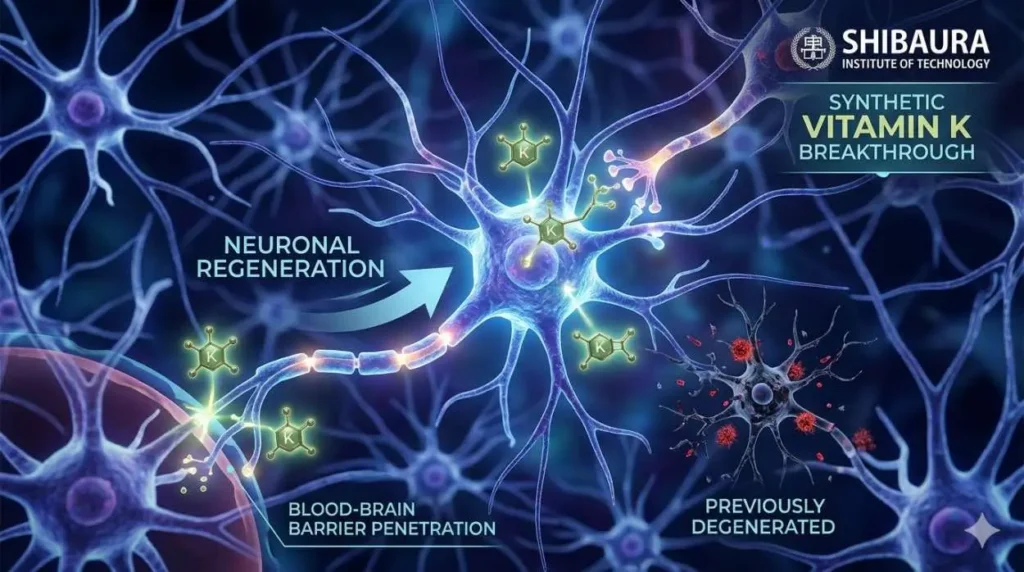
Japanese researchers have engineered a synthetic vitamin K compound that forces the brain to grow new neurons at three times the natural rate. They’ve effectively built a chemical switch. It could reverse the irreversible brain damage defining Alzheimer’s and Parkinson’s diseases. You can’t just take a pill to fix dead brain tissue today, but this laboratory breakthrough shatters that biological ceiling entirely.
Dr. Yoshihisa Hirota and Professor Yoshitomo Suhara drove this research at the Shibaura Institute of Technology in Tokyo. Their team took natural vitamin K, a fat-soluble nutrient your body uses to clot blood, and structurally fused it with retinoic acid. And this combination didn’t just politely encourage brain cell growth. It forcefully commanded neural progenitor cells to abandon their neutral state and transform directly into fully functioning neurons.
The peer-reviewed journal ACS Chemical Neuroscience published the exact chemical mechanics driving this synthetic trigger. Neurologists call this underlying mechanism neuronal differentiation. When neurodegenerative diseases ruthlessly wipe out neural networks, patients lose their memories, their motor control, and eventually their lives. We haven’t seen a single commercial drug that actually rebuilds those destroyed networks.
Current pharmaceutical treatments only mask the symptoms of cognitive decline. Doctors routinely prescribe medications that temporarily boost chemical messengers in the brain, but these drugs don’t stop the underlying neurons from dying. Hirota realised the medical industry desperately needed a regenerative agent to actually replace the dead cells and restore the brain function patients lose during the early stages of the disease. He didn’t want to just slow the rot.
Vitamin K occurs naturally in two primary forms: the plant-based phylloquinone, and the bacteria-derived menaquinones. While most people know the nutrient keeps humans from bleeding to death off a simple cut, scientists recently discovered it also shields brain cells from oxidative stress. But simply eating loads of leafy greens won’t cure a degenerative brain disease. The natural forms of the vitamin lack the aggressive potency required to jumpstart mass neural regeneration.
Why hasn’t the medical establishment solved this core problem yet? The human blood-brain barrier acts as a microscopic bouncer that aggressively blocks almost every foreign chemical compound you try to deliver into the skull. But Hirota and Suhara bypassed that absolute biological fortress using synthetic chemistry. They systematically synthesised 12 distinct hybrid homologues of vitamin K before they isolated the precise molecular structure that worked.
The chemistry team experimented by attaching different side chains to the main vitamin molecule. They linked some versions to a carboxylic acid moiety, and others to a methyl ester side chain. But the true magic happened when they conjugated the vitamin with retinoic acid, an active metabolite of vitamin A. Retinoic acid already carries a reputation in the scientific community for promoting cell differentiation, so combining it with vitamin K created an unprecedented biological synergy. They haven’t seen anything quite like it in previous literature.
They designated their most powerful creation as Compound 7. When the research team tested the chemical on live mice, the synthetic molecule slipped right through the blood-brain barrier without triggering biological alarms. Once inside the brain’s highly guarded environment, the compound metabolised over time into menaquinone-4, or MK-4. Scientists already know MK-4 operates as the most bioactive form of vitamin K inside the mammalian nervous system, but they haven’t figured out how to deliver it in massive, effective doses until now.
This new synthetic drug didn’t just float aimlessly around the brain matter. It aggressively targeted a specific protein structure called the metabotropic glutamate receptor, specifically locking onto the mGluR1 pathway. That specific receptor isn’t just a generic binding site—it acts like a master ignition switch for brain regeneration.
Hirota ran exhaustive transcriptomic analyses to map the resulting gene expression profiles inside the neural stem cells. He proved the compound activated the exact downstream epigenetic processes required to birth brand new neurons. In direct cellular comparisons, the engineered chemical demonstrated exactly three times the potency of natural vitamin K at forcing this biological evolution. It’s an absolute game-changer.
The financial and social stakes riding on this research couldn’t sit any higher. Alzheimer’s disease drains hundreds of billions of dollars from global healthcare systems every single year. Families sacrifice careers and life savings to provide round-the-clock care for relatives who don’t even recognise their own children anymore.
If a pharmaceutical company turns Compound 7 into an accessible consumer drug, we won’t just see a minor improvement in symptom management. We’ll witness the first genuine reversal of neurodegenerative brain rot. Hirota explicitly stated that replacing lost neurons offers the only realistic path to restoring actual brain function in terminal patients.
The researchers haven’t started human clinical trials yet. All current data stems exclusively from cell cultures and rodent models. Safety protocols require years of rigorous toxicological screening before human patients can ingest these synthetic analogues safely, ensuring the compounds don’t cause unforeseen organ damage. But the Shibaura Institute team has already mapped the exact molecular target drug developers need to hit.
The Japanese team plans to refine the molecular structure even further to maximise the neurogenic output while minimising any potential off-target toxicity. They’ve handed the pharmaceutical industry a complete, peer-reviewed blueprint for neuroregeneration.
The world can’t afford to wait much longer for pharmaceutical giants to actually build it.