A Delhi High Court bench took an “empathetic view” and overruled a trial court that had called his grounds “not reasonable” but limited his release strictly to three days, confined him to the NCR, and denied him leave to attend his uncle’s funeral rites.
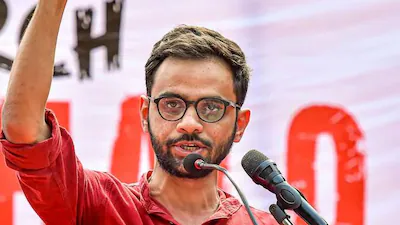
NEW DELHI, May 22 — Jailed student activist Umar Khalid will walk out of prison for three days in June. The Delhi High Court granted him interim bail Friday but not for the 15 days he’d asked for, and not for the death ritual he’d said he needed to attend.
He will be freed from June 1 to June 3. For one purpose only: to be with his mother when she goes under the knife.
A division bench of Justices Prathiba M. Singh and Madhu Jain took what they called an “empathetic view” of the case, overriding a trial court that had dismissed Khalid’s plea only three days earlier. “Interim bail is granted for 3 days from 1-3 June, in order to enable the appellant to spend time with his mother,” the bench recorded.
It was a partial win, carved out with surgical precision. The court refused Khalid’s request to attend the Chehlum — the 40th-day post-death ritual of his uncle, Khursheed Ahmad Khan, who died on April 10. That ceremony falls on May 24. He won’t be there.
So what changed between Tuesday and Friday?
On May 19, Additional Sessions Judge Sameer Bajpai of the Karkardooma Courts had dismissed Khalid’s interim bail application outright. “Attending the Chehlum ceremony of his uncle is not that necessary,” the judge had said. Things would have been different, he noted, if the deceased had been in “immediate relation” to the applicant.
The trial court also wasn’t moved by Khalid’s second argument — that his mother, scheduled for a lump-excision surgery on June 2 at a private hospital, needed her only son by her side. Khalid has five sisters, the judge observed. All of them married, all living away from the parental home. But the court concluded they would “definitely” come to their mother’s aid. And their 71-year-old father was there too. The surgery, the prosecution argued, was “minor” — requiring only local anaesthesia.
“Accordingly, finding the reasons unreasonable, the court doesn’t deem it appropriate to grant the desired relief,” Judge Bajpai ruled.
That decision landed with a thud — because it came barely 24 hours after the Supreme Court had publicly rebuked its own earlier order denying bail to Khalid.
On May 18, a bench of Justices B.V. Nagarathna and Ujjal Bhuyan had expressed “serious reservations” about a January 2026 Supreme Court ruling that refused bail to both Khalid and co-accused Sharjeel Imam. That earlier bench — Justices Aravind Kumar and N.V. Anjaria — had declared the two men stood on a “higher footing in the hierarchy of participation” in the alleged larger conspiracy behind the 2020 Northeast Delhi riots.
The Nagarathna bench said that order had violated “judicial discipline.” It pointed to a three-judge ruling in the K.A. Najeeb case from 2021, which held that an undertrial suffering prolonged incarceration under UAPA — with no end to the trial in sight — must be enlarged on bail. That, the bench said, is the law of the land.
Khalid has been in custody since September 2020. Five years and eight months.
And yet the trial court, a day after that stinging Supreme Court observation, still said no.
Khalid’s legal team moved the High Court immediately. The appeal, filed Thursday, landed before Justices Singh and Jain on Friday morning. Additional Solicitor General S.V. Raju, appearing for Delhi Police, fought the plea hard. He offered a compromise: let Khalid visit his mother under police escort and return to jail the same day. No need for interim bail.
The bench didn’t buy it. But it didn’t grant everything either.
The order comes with strings attached. Khalid must remain within the Delhi-NCR region. He can stay only at his Jamia Nagar residence and travel nowhere except the hospital. He must use a single mobile number and remain in continuous contact with the Investigating Officer. He must furnish a surety and personal bond of Rs 1 lakh.
And the Chehlum? The court was silent on it. No relief.
The pattern here is unmistakable. Khalid has been granted interim bail three times before — in 2022 for his elder sister’s wedding, for a week spanning December 2024 to January 2025 for a cousin’s wedding, and again in December 2025 for another sister’s wedding. Each time, he surrendered on schedule. Each time, the court acknowledged he had never flouted a single condition.
But as Judge Bajpai put it on Tuesday, past compliance “doesn’t mean that on every occasion, whenever the accused seeks bail, the court should grant it.” Every application, he insisted, must be assessed on its own merits.
The case against Khalid remains one of the most consequential legal battles to emerge from the February 2020 riots that tore through Northeast Delhi, leaving 53 dead and more than 700 injured. He is charged under the Unlawful Activities (Prevention) Act — the stringent anti-terror law where bail is the exception, not the rule. The Delhi Police Special Cell has alleged he was among the “masterminds” of the violence that erupted during protests against the Citizenship (Amendment) Act and the proposed National Register of Citizens.
Can a man accused of masterminding a massacre be trusted to visit his ailing mother and return? The Delhi High Court just answered: for three days, yes. But only three. And only for her.