
A crane moving a bucket of 1,600-degree molten iron catastrophically failed at Rashtriya Ispat Nigam Ltd, triggering a massive industrial disaster in Visakhapatnam.
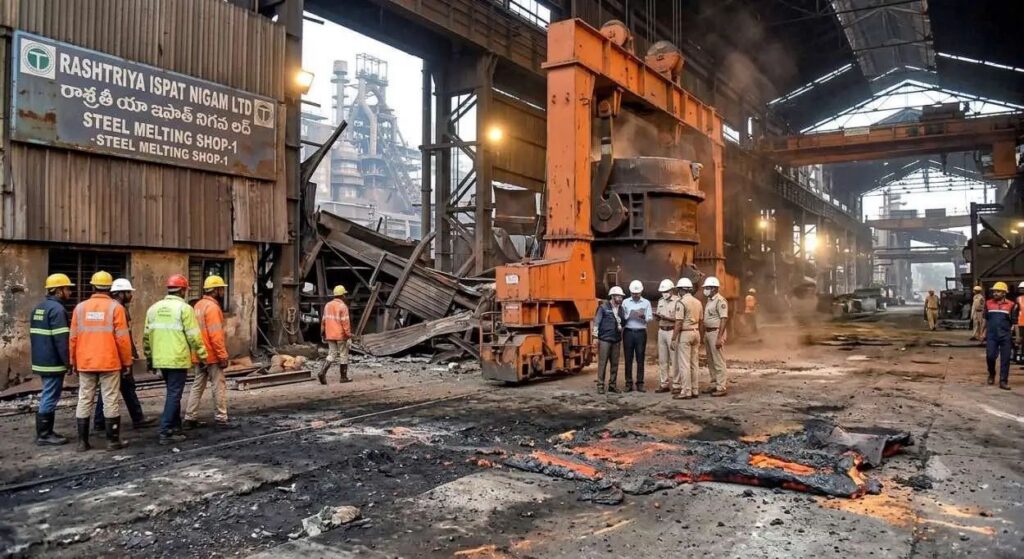
VISAKHAPATNAM, June 8 — Eight steelworkers didn’t survive a catastrophic crane failure Monday that dumped a bucket of 1,600-degree molten iron directly onto their crew at the Rashtriya Ispat Nigam Ltd plant. Six others sustained severe burns and remain in critical condition.
The liquid metal engulfed the workers instantly. Emergency crews haven’t finished pulling remains from the scorched industrial zone, and local authorities expect the death toll to rise as they clear the debris. Visakhapatnam police hold the primary scene, confirming the sheer temperature of the spill completely incinerated the immediate work area and vaporized anything in its direct path. We don’t see destruction at this scale without a systemic failure in heavy machinery.
And this wasn’t an unpredictable chemical reaction.
It happened because a piece of high-capacity lifting hardware dropped its lethal payload onto a populated factory floor. Police told the Press Trust of India the crew moved the boiling iron using a standard containment bucket when the crane system catastrophically faltered. State investigators already treat this as a massive operational breakdown, stripping the plant’s logbooks to find the exact moment the maintenance schedule fell behind. They haven’t announced whether a snapped cable, a hydraulic collapse, or a structural shear caused the drop.
So why couldn’t a flagship state-run facility keep liquid fire off its own people?
That question now falls to Andhra Pradesh Chief Minister N. Chandrababu Naidu, who deployed every available government department to the Vizag facility. His office didn’t release a timeline for the technical investigation, choosing instead to focus entirely on coordinating hospital transfers for the grievously wounded survivors. Medical staff at the plant’s general hospital haven’t stabilised the six living victims, fighting to manage catastrophic thermal trauma that burns right through to the bone. You can’t simply bandage a 1,600-degree contact burn.
Union Minister of State for Heavy Industries Bhupathiraju Srinivas Varma received the preliminary briefings late Monday. He confirmed the explosion occurred during a routine transportation phase involving a massive ladle of liquid steel at the Continuous Casting Department in Steel Melting Shop-1. Varma didn’t offer excuses for the failure, describing the tragedy as deeply unfortunate while instructing local authorities to accelerate rescue operations.
But words of condolence don’t cool the hardened slag covering the accident site.
Rashtriya Ispat Nigam Ltd executives haven’t named the dead workers, citing the grim reality that the intense heat left several bodies entirely unrecognisable. They locked down the facility’s perimeter, keeping the press outside the gates while specialised teams navigate the hazardous zone to find the missing men. The company won’t easily recover from this disaster, and labour unions already demand a full, independent technical audit of every crane operating inside the sprawling complex.
The Visakhapatnam industrial belt carries a dark history of workplace catastrophes. The region’s manufacturing sector drives the state’s economy, yet it routinely demands a bloody toll from the people working the shifts. We saw the LG Polymers gas leak suffocate the city in 2020, and shipyard crane collapses haven’t stopped claiming lives in the recent past. Industrial safety regulations look perfect on paper, yet they consistently fail the men standing under the loads.
Rashtriya Ispat Nigam Ltd, commonly known as Vizag Steel, anchors the entire local economy. The massive public sector enterprise employs thousands of permanent and contract workers who keep the blast furnaces running around the clock. The national government has debated privatising the plant for years, a move that sparked massive protests from labour unions fearful of corporate cost-cutting. While we don’t have proof that financial pressures compromised safety standards in this specific incident, the workforce already operates under the heavy shadow of an uncertain future. Contract labourers frequently take the most dangerous jobs on the floor, and they rarely receive the same safety net as their permanent counterparts.
Surviving a splash of molten iron requires immediate, highly specialised trauma care. The thermal energy transfers instantly, obliterating skin, muscle, and nerve tissue before the victim even processes the pain. Doctors at the general hospital didn’t hide the grim prognosis for the six survivors. They face months of grueling surgeries, skin grafts, and intense physical therapy, assuming they survive the critical infection window that follows severe third-degree burns. Visakhapatnam health officials mobilised burn specialists from across the district, ensuring the hospital had the necessary resources to handle the sudden influx of critical patients.
State-run steel plants operate under strict protocols designed exactly to prevent a ladle of molten iron from ever tilting off its axis. Engineers build redundant fail-safes into the lifting mechanisms, ensuring a single mechanical fault doesn’t result in a fatal spill. When those fail-safes break down, it usually points to deferred maintenance, ignored warning signs, or deliberate operational shortcuts. Investigators will pull the inspection records for that specific crane, and they won’t stop until they find the signature of the person who certified it safe for operation.
The families of the victims didn’t get answers Monday night. They gathered outside the plant’s general hospital, waiting for doctors to identify the survivors and coroners to process the dead. Visakhapatnam police dispatched extra units to manage the crowd, understanding the grief could quickly turn into fury. People want accountability when a state enterprise drops a bucket of liquid metal onto their husbands and sons.
Workers inside the Steel Melting Shop knew the risks of their trade. You don’t walk past vats of boiling metal without understanding the stakes. But they trusted the heavy machinery hanging above their heads, and that machinery betrayed them in the most horrific way imaginable. The government promises a thorough inquiry, and officials swear they will punish anyone found negligent in their duties.
The molten iron left zero margin for error, and the plant’s failing hardware didn’t give the crew a second to run.