
Tehran asserts a crushing blow to American air superiority as Kuwait confirms several U.S. warplanes crashed; Pentagon investigates “friendly fire” amidst a massive Iranian missile blitz.
By Rootsalert Global Desk| March 2, 2026
The Middle East has transitioned from a localized conflict to a full-scale regional air war as the Islamic Republic of Iran launched a massive retaliatory strike against U.S. and Israeli assets. In a series of bold proclamations today, Tehran claimed that more than seven U.S. fighter jets were “demolished” by its sophisticated missile batteries and loitering munitions.
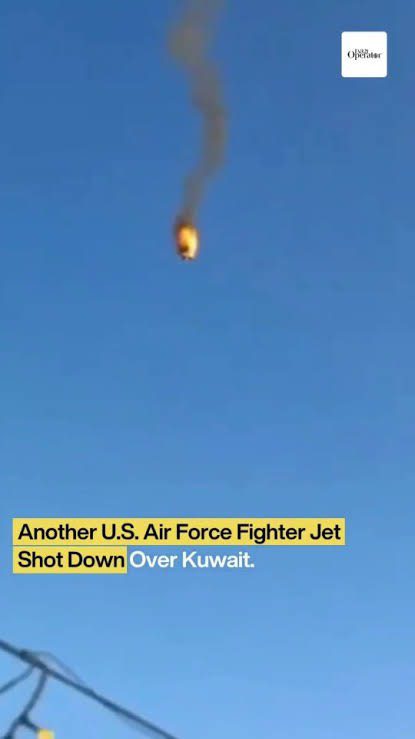
The chaos of the morning was punctuated by dramatic footage from Kuwait, where at least three U.S. F-15E Strike Eagles were confirmed to have spiraled into the desert floor. While Iran’s Islamic Revolutionary Guard Corps (IRGC) is taking full credit for the carnage, U.S. Central Command (CENTCOM) has released a startling counter-assessment, attributing the loss of the Kuwait-based jets to a tragic “friendly fire” incident involving Kuwaiti air defenses.
Following the reported death of Supreme Leader Ayatollah Ali Khamenei on Sunday, the IRGC has shifted its strategy from defense to a multi-front offensive labeled the “Tenth Wave.” Iranian state-run media, including IRNA and Tasnim, reported that Iranian air defense units and long-range ballistic missiles successfully intercepted and “erased” U.S. aircraft operating over the Persian Gulf and neighboring territories.
“The number of downed American fighter jets has reached seven, and the count is rising,” a spokesperson for the Khatam al-Anbiya Central Base stated. “Our Fattah-2 hypersonic missiles and Bavar-373 systems have proven that the American ‘stealth’ is a myth.”
Visuals shared by Iranian outlets showed fireballs descending over the Gulf, which Tehran claims are the remnants of F-15 and F-35 squadrons. These claims have galvanized domestic supporters even as the country faces a devastating “Operation Epic Fury” air campaign from the Trump administration.
The Kuwait Incident: Friendly Fire or Stealth Strike?
The most concrete evidence of U.S. losses emerged from Kuwait. On Monday morning, witnesses near the Ali Al-Salem Air Base captured terrifying video of F-15E Strike Eagles engulfed in flames, spiraling in “flat spins” before impacting the sand.
In a rare and immediate admission of operational failure, CENTCOM confirmed that three F-15Es were lost. However, they contested Iran’s narrative. “Three U.S. F-15E Strike Eagles flying in support of Operation Epic Fury went down over Kuwait due to an apparent friendly fire incident,” CENTCOM posted on social media. According to the report, Kuwaiti Patriot missile batteries, operating under high stress amidst waves of Iranian drones, mistakenly targeted the American jets.
“All six aircrew members ejected safely, have been recovered, and are in stable condition,” the statement continued. Kuwait’s Ministry of Defense echoed this, acknowledging “several” crashes while expressing gratitude that no pilots were lost.
The loss of these aircraft is merely one facet of a wider breakdown in regional security. Iran’s retaliation has not been limited to military dogfights. Black smoke was seen rising from the U.S. Embassy compound in Kuwait City, and the diplomatic mission has warned American citizens to take immediate cover as missile and UAV threats persist.
Across the region, the “fog of war” is absolute. In Bahrain, satellite imagery has confirmed damage to the U.S. Fifth Fleet Headquarters following a missile strike. In Saudi Arabia, the Ras Tanura oil refinery was temporarily shuttered after a swarm of Iranian “suicide” drones breached its defenses.
“We are seeing a total collapse of the traditional deterrence model,” says Dr. Julian Vance, a military historian. “Whether the planes were downed by Iranian missiles or by nervous allies in Kuwait, the result is the same: the U.S. air umbrella is showing holes, and Iran is proving it can project power despite the decapitation of its leadership.”
The Stakes for “Operation Epic Fury”
President Donald Trump, who launched “Operation Epic Fury” on February 28 to “crush the Iranian regime and end the nuclear threat,” has vowed that the mission will continue for “four to five weeks.” Despite the loss of aircraft, the U.S. maintains that it has destroyed nearly 2,000 targets within Iran, including the IRGC’s aerospace headquarters and key missile production sites.
However, the reported “7+ jets” claim by Iran has served as a potent propaganda tool, complicating the U.S. effort to project a narrative of total dominance. As oil prices surge by 12% and global stock markets tumble, the cost of the conflict is no longer measured solely in military hardware, but in global stability.
As night falls over the Persian Gulf, the world watches to see if the “Tenth Wave” will be met with an even more devastating American response, or if the mounting losses on both sides will force a desperate diplomatic opening.