
By Rootsalert Bussiness Desk- 05-March-2026
As the Middle East burns and Ukraine holds the line, India’s state-owned giants are seeing record production—but a looming energy crisis could spoil the party.
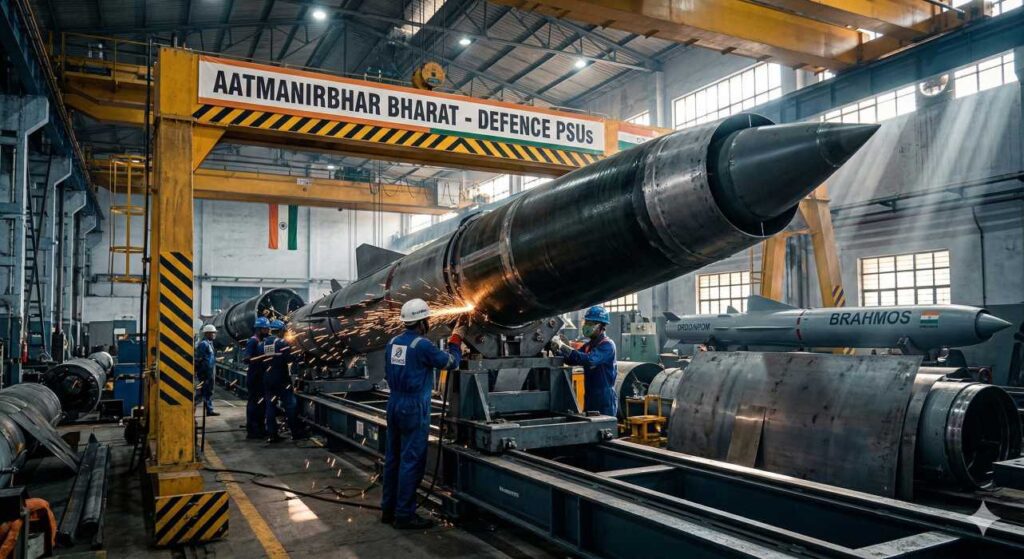
War is expensive, bloody, and unpredictable. But for India’s Public Sector Undertakings (PSUs), the current global chaos has become an unexpected, high-octane growth engine. While diplomats scramble to prevent a total meltdown in the Middle East, the order books at India’s defense giants are fatter than they’ve ever been.
The numbers don’t lie. India’s annual defense production just rocketed to a historic ₹1.51 lakh crore in the 2024-25 fiscal year. That’s a massive 18% jump from the previous year. And who’s leading the charge? State-owned behemoths. Defense PSUs (DPSUs) and other government entities now command a staggering 77% of this total production.
But don’t think this is just about local needs.
The export market is on fire. Defense exports touched an all-time high of ₹23,622 crore, with state-owned firms like Hindustan Aeronautics Limited (HAL) and Bharat Electronics Limited (BEL) emerging as the go-to suppliers for a world suddenly desperate for hardware. The government has set its sights even higher, targeting ₹50,000 crore in exports by 2029.
And why wouldn’t they?
The “Operation Sindoor” events of 2025 exposed critical gaps in joint operations and air defense. Since then, the Ministry of Defense hasn’t just been spending; it’s been transforming. For the 2025-26 budget, the allocation hit ₹6.81 lakh crore. That is the single largest slice of the national pie, making up over 13% of the entire union budget.
But it’s not all champagne and record dividends.
While the defense sector is thriving on volatility, the energy sector is staring down the barrel of a gun. The recent US-Israel strikes on Iran and the resulting retaliation have sent tremors through the Strait of Hormuz. This tiny chokepoint is a massive problem for India.
Why? Because roughly 20% of the world’s oil flows through it.
For India, the stakes are even more personal. Over 45% of our crude oil and 85% of our LPG imports pass through that narrow strip of water. If the Strait closes, the “war premium” on oil won’t just be a line on a spreadsheet—it’ll be a crisis at every petrol pump in the country.
Current Brent crude prices are hovering between $77 and $82 per barrel. Every single dollar increase in that price adds roughly $2 billion to India’s annual import bill. It’s a toxic cocktail of cost-push inflation that threatens to derail the RBI’s delicate balancing act.
“The Middle East’s Strait of Hormuz is critical to the Indian economy,” warns Sunil Shah, a fund manager at SRE PMS. He isn’t wrong. The market reaction on March 4, 2026, was a brutal reminder of this reality. The Sensex tanked over 1,100 points as the Strait of Hormuz closure reports hit the wires.
Yet, there’s a strange resilience on Dalal Street.
Investors are aggressively rotating their portfolios. They’re dumping fuel-intensive sectors and diving headfirst into “upstream” energy players like ONGC and Oil India. These firms actually benefit when oil prices spike because their realizations per barrel go through the roof.
It’s a classic “risk-off” setup. In times of extreme uncertainty, the market retreats to what it knows. And what it knows right now is that the world needs more missiles, more indigenous tech, and more energy security.
Are we looking at a permanent shift?
Probably not. Most analysts agree that geopolitical noise is usually temporary. The structural growth of the Indian economy remains the real story. But in the short term, the “war dividend” for PSUs is very real.
Look at Mazagon Dock Shipbuilders or Garden Reach. They aren’t just building ships; they’re building a naval shield that looks increasingly necessary as maritime routes become battlezones. The induction of the INS Vaghsheer and the expansion of the fleet to 170+ ships by 2027 are no longer just “plans”—they are urgent requirements.
But we have to ask the hard question. Can India maintain this momentum if the global economy buckles under the weight of $100 oil?
The government’s “Aatmanirbhar Bharat” push is being tested in real-time. By reducing reliance on Russian supplies—which dropped from 1.5 million barrels a day to just 436,000 by early 2026—India is trying to diversify. But moving away from one supplier often just leads you into the arms of another.
So, what’s the endgame?
The Ministry of Defense has declared 2025 the “Year of Reforms.” They’re simplifying acquisition and pushing for tech transfers like never before. They’ve realized that in a world of loitering munitions and AI-driven warfare, being “slow and steady” is just a fancy way of saying “dead.”
The next few months will be a trial by fire. If the conflict in West Asia stabilizes, the PSU rally might cool off as investors move back into high-growth tech and FMCG. But if the regional war drags on, the state-owned giants will continue to be the only green spots in a sea of red.
One thing is certain: the era of the “sleepy PSU” is over. These are now strategic assets in a world that has forgotten how to stay at peace.
The results of the upcoming April 2026 OPEC+ output meeting will likely determine if the energy PSUs can keep their heads above water or if the rising tide of crude prices will drown the broader recovery.