Households face a sharp ₹60 jump while commercial cylinders spike by ₹115 as the Strait of Hormuz conflict finally breaks India’s year-long price freeze.
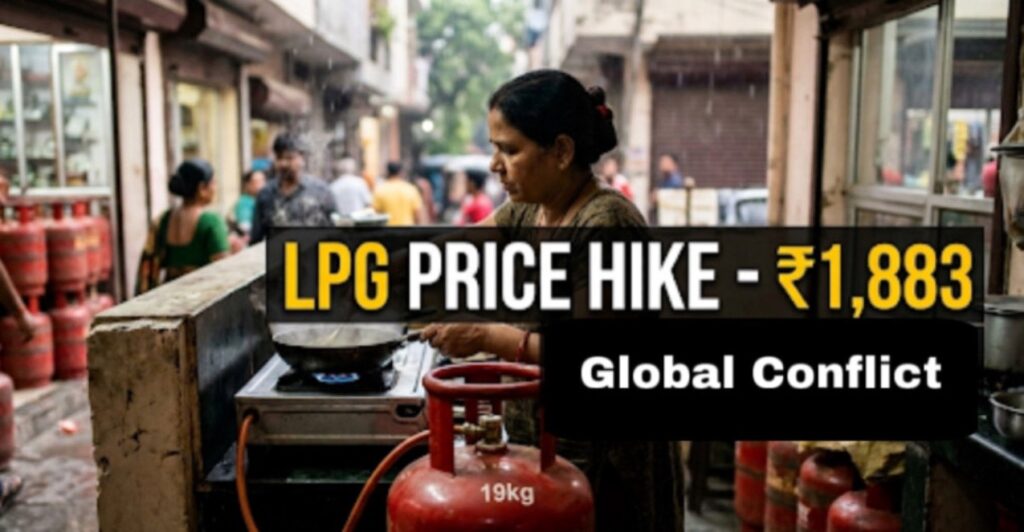
The geopolitical fire in West Asia just scorched the Indian kitchen. Starting Saturday, household budgets across the country took a direct hit as oil marketing companies hiked the price of domestic LPG cylinders by a steep ₹60.
It’s the first time in eleven months that the government has let the retail price budge. For nearly a year, the price in Delhi sat at ₹853, but that stability evaporated overnight. Now, residents in the capital will cough up ₹913 for a standard 14.2-kg refill.
But the pain isn’t distributed equally. Because of local taxes and the messy reality of state VAT, Kolkata residents are staring at a ₹939 bill, while Chennai clocks in at ₹928.50. Mumbai remains the “cheapest” of the metros, if you can call ₹912.50 cheap.
What changed? Look toward the Strait of Hormuz.
The military escalation involving the U.S., Israel, and Iran has turned global energy markets into a pressure cooker. India imports nearly 60% of its LPG, and most of that passes through the very chokepoints currently seeing missile exchanges. When the Saudi Contract Price—the benchmark for Asian gas—jumped 16% recently, the financial dam finally broke.
Oil marketing companies like IOC, BPCL, and HPCL have been bleeding cash for weeks to keep prices artificially low. Government sources claim they’ve absorbed losses of nearly ₹39,000 crore this fiscal year alone. But with Brent crude hovering around $92, someone had to pay the tab.
And that someone is you.
| City | New Domestic Price (14.2kg) | New Commercial Price (19kg) |
| Delhi | ₹913.00 | ₹1,883.00 |
| Mumbai | ₹912.50 | ₹1,835.00 |
| Kolkata | ₹939.00 | ₹1,990.00 |
| Chennai | ₹928.50 | ₹2,043.50 |
If you think the kitchen is getting hot, talk to a restaurant owner. Commercial LPG cylinders—the 19-kg workhorses of the food industry—just jumped by ₹115. In Delhi, a single bottle now costs ₹1,883.
This isn’t an isolated spike. It’s the third increase for businesses in three months, totaling a massive ₹302.50 since December. You don’t need an economics degree to know where those costs are going. Your next weekend dinner out just got a hidden surcharge.
Naturally, the political theater followed the price tag. The Congress party wasted no time branding the Prime Minister “Inflation Man,” while West Bengal CM Mamata Banerjee called for immediate street protests. They’re pointing at the timing—International Women’s Day—as a calculated slap to the face of homemakers.
But the government is playing defense with “math.”
Official spokespeople are spinning this as a minor “20 paise per person per day” adjustment. They’re quick to remind everyone that even at ₹913, Indian gas is still cheaper than the ₹1,000+ prices seen in Islamabad or Colombo. It’s cold comfort for a family in Bihar or Uttar Pradesh trying to stretch a monthly wage.
There is one small silver lining for the country’s poorest. The 10 crore beneficiaries of the Pradhan Mantri Ujjwala Yojana will keep their ₹300 subsidy. For them, the effective price lands around ₹613. It’s a shield, sure, but it doesn’t protect them from the inevitable rise in the price of milk, vegetables, and transport that follows every fuel hike.
So, is petrol next?
Minister Hardeep Singh Puri says no. He’s adamant that there’s no shortage and that fuel stocks are “comfortable” for the next eight weeks. But as long as tankers are dodging drones in the Persian Gulf, “comfortable” is a relative term.
The government is banking on the public’s short memory and a hope that the Middle East cools down. If it doesn’t, this ₹60 hike might just be the opening act of a much more expensive summer.
Keep your eye on the Strait. If the ships stop moving, the prices won’t stop climbing.