
A breach at Iran’s only active nuclear reactor would halt Gulf desalination plants and exhaust Qatar’s drinking water within three days.
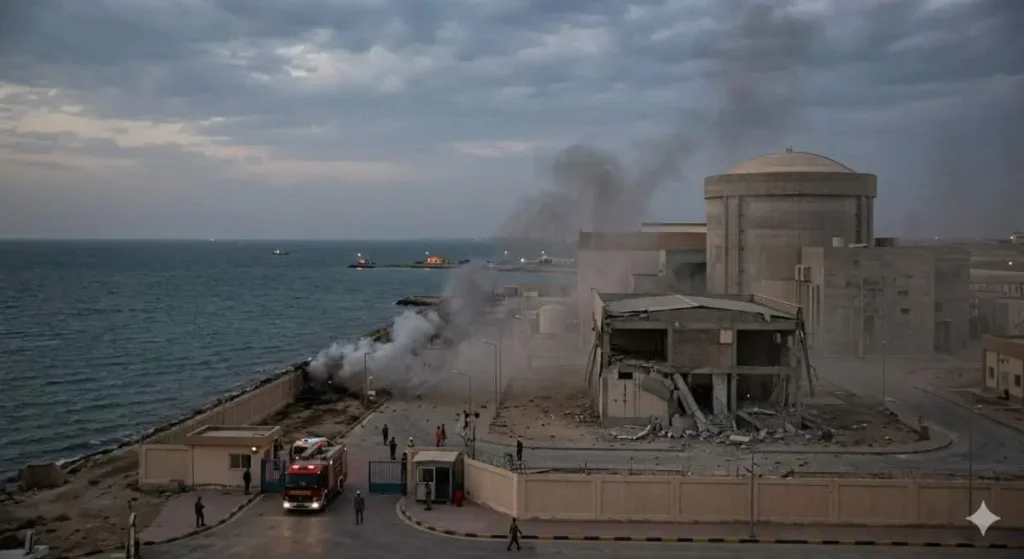
April 5, 2026 — Missiles struck the perimeter of Iran’s only functioning nuclear power plant on Saturday, killing a security guard and damaging an auxiliary building. State authorities confirm it is the fourth time the Bushehr facility has taken fire since the United States and Israel launched military operations against Iran on February 28.
The strike brings the Gulf region one structural failure away from a catastrophic radiological event.
Iran’s state-run Atomic Energy Organisation confirmed the weekend casualties. Foreign Minister Abbas Araghchi condemned the repeated targeting of the coastal facility, citing a severe lack of concern for nuclear safety by Washington and Israel.
Bushehr is not a hardened military bunker. It is a civilian power station feeding 1,000 megawatts into the national grid. It sits on the edge of the Gulf, flanked by a city of 250,000 people. Inside its reactor and cooling pools sits highly radioactive spent fuel.
A direct hit on those storage pools or the reactor core won’t just trigger an Iranian crisis. It will spark a regional one.
Breaching the containment structures would release radiological particles, specifically Caesium-137, into the atmosphere. Wind and water carry these isotopes across borders. They contaminate soil. They poison food networks. Close exposure burns the skin and spikes long-term cancer rates.
But the immediate, existential threat to the Gulf lies in the water.
The Gulf is a shallow body of water. Radioactive contamination here does not dilute the way it does in the open ocean. It lingers. This presents an acute crisis for nations like Qatar, Saudi Arabia, and the United Arab Emirates. They rely almost entirely on the desalination of seawater for their survival.
Desalination plants filter salt. And they aren’t built to scrub radioactive isotopes.
Can a region survive when its only source of drinking water turns toxic?
Alan Eyre, a researcher at the Middle East Institute, confirmed that a significant influx of radioactivity into the Gulf would force the immediate shutdown of regional desalination networks. Eyre noted that while the concentration of material might not trigger a Chornobyl-level atmospheric event, the threat to the water supply is absolute.
The math on that shutdown is brutal.
Last year, Qatar’s Prime Minister Sheikh Mohammed bin Abdulrahman bin Jassim Al Thani detailed a government simulation modeling a breach at Bushehr, which sits just 118 miles across the water from Qatari shores. The findings were definitive. The simulation showed the sea becoming entirely contaminated.
“No water, no fish, nothing,” Sheikh Mohammed said. “No life.”
Qatar would run out of drinking water in three days.
The United Nations knows this. The International Atomic Energy Agency has spent months demanding warring factions keep their crosshairs off Bushehr.
IAEA Director-General Rafael Grossi warned the UN Security Council that hitting the plant’s tonnes of nuclear material would trigger a massive release of radioactivity with severe transboundary consequences. He demanded maximum restraint. Grossi reiterated those demands immediately after Saturday’s strike.
You don’t even need to hit the reactor to cause a meltdown. Grossi noted that striking the external power lines feeding Bushehr could knock out the facility’s cooling systems. The resulting radioactive leak would force immediate evacuation orders stretching hundreds of kilometers into neighboring countries. Governments would scramble to distribute iodine tablets and restrict contaminated food supplies. Vast stretches of land would require rigorous monitoring for decades.
International law explicitly forbids this kind of targeting.
Article 56 of the Geneva Conventions’ Protocol I outlaws attacks on works and installations containing dangerous forces. This specifically shields nuclear electrical generating stations, even if they hold military objectives, if an attack risks releasing those forces and causing severe civilian losses. The IAEA’s own guidelines mandate that countries avoid hitting reactors, protect staff, and ensure grid power remains active to prevent core melts. Warring parties must differentiate between civilian infrastructure and military targets.
Bushehr is a civilian energy facility. Yet the diplomatic response remains fractured.
Araghchi highlighted the silence from Western capitals over the Bushehr strikes, drawing a sharp contrast with the global uproar over Ukraine’s Zaporizhzhia Nuclear Power Plant.
“Radioactive fallout will end life in GCC capitals, not Tehran,” Araghchi posted on X.
When Russian forces assaulted Zaporizhzhia with heavy armor in March 2022, the reaction was immediate. The United Kingdom and Ukraine convened an emergency UN Security Council meeting. The US, the European Union, and dozens of allied nations issued fierce condemnations. NATO threatened to trigger its collective defense mechanism if radioactive fallout touched a member state. French President Emmanuel Macron personally phoned Russian President Vladimir Putin to demand IAEA access.
No such coalition has mobilized for Bushehr. The European Union hasn’t commented on the strikes. Russia, which finished building the plant in 2011 and still maintains hundreds of personnel on site, issued a statement condemning Saturday’s attack as an atrocity. Several Russian technicians have already evacuated the Iranian coast.
History provides a clear map of what happens when nuclear containment fails.
When a reactor exploded at the Chornobyl facility in April 1986, the blast blew off the heavy roof and sparked a fire that burned for days. Thirty people died in the immediate blast and cleanup. Over the following years, some 20,000 people developed thyroid cancer. Authorities evacuated 300,000 residents. The surrounding exclusion zone remains deserted four decades later.
In 2011, an earthquake and tsunami triggered multiple reactor meltdowns at Japan’s Fukushima plant. The government evacuated 160,000 people. While direct radiation casualties were low, the sheer trauma, stress, and disruption of the evacuation caused thousands of premature deaths.
Bushehr combines the infrastructure risks of Fukushima with the deliberate violence of an active war zone.
The Gulf now waits on the trajectory of the next missile. If the containment holds, the region survives another week. If it breaks, the water stops.