As the Centre’s March 2026 deadline passes, the bloody history of the Maoist insurgency gives way to a new reality of mass surrenders and post-conflict governance.
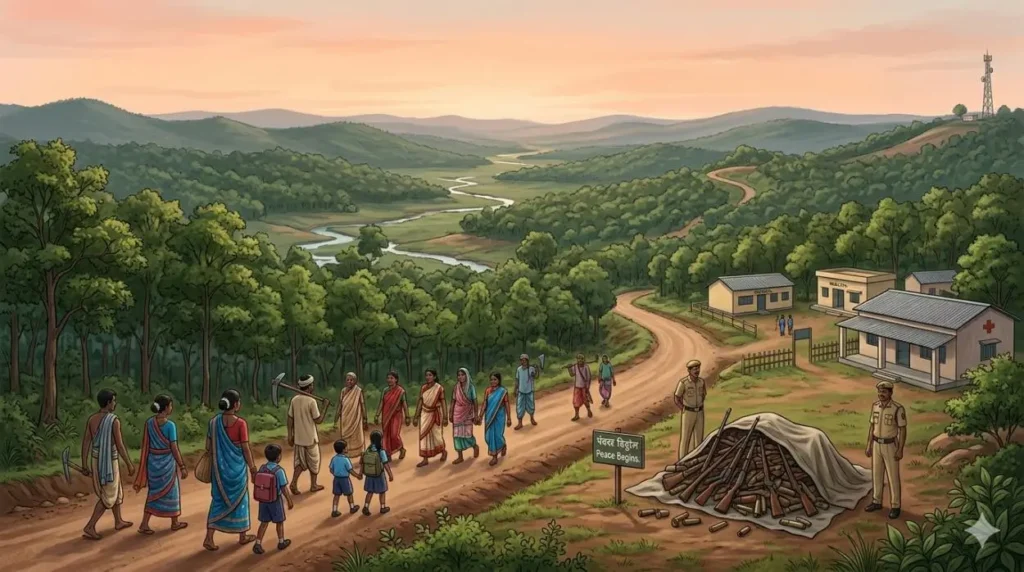
BASTAR, April 9 — The war didn’t end with a final, cinematic gunfight. It ended with exhausted cadres walking out of the forest, surrendering to the Constitution they spent three decades trying to destroy.
On March 30, Union Home Minister Amit Shah stood in the Lok Sabha and declared the Bastar region almost entirely free of Naxalism. He met his own March 31, 2026, deadline to stamp out Left-Wing Extremism. The remaining Maoists are no longer armed. They don’t wear uniforms anymore. The history of the insurgency is officially closed, and the reality on the ground is radically different.
To understand what just ended in Bastar, you have to understand what Naxalism actually built here.
For 59 years, the Maoists ran what they called the jantana sarkar—a parallel government that completely displaced the Indian state across 42,000 square kilometres of dense forest and mineral-rich earth. They held their own kangaroo courts, delivering summary executions to suspected police informants. They levied their own taxes on tendu leaf contractors, mining operations, and road builders.
They even forced crude sterilisation procedures on young cadres—vasectomies and tubectomies performed without anaesthesia—to sever their family bonds and forge ruthless fighters with no desire to return home. It was a history written entirely in blood and extortion.
The Indian government spent decades fighting this with an erratic mix of under-equipped police forces and controversial state-sponsored militias. The result was a grinding stalemate that hollowed out the local tribal population.
But the current situation shifted radically over the last three years. The Centre stopped treating Bastar like a slow-burning law-and-order problem. They treated it like a military objective with a hard expiration date.
The numbers tell a story of a brutal, systematic collapse. Since the government set its aggressive deadline, security forces killed 706 Maoists. They arrested 2,218. And crucially, 4,839 insurgents gave up.
Just weeks before the deadline hit, the capitulation accelerated. On March 11, 108 Maoists walked into a police station in Jagdalpur and gave up under the state’s Poona Margem rehabilitation initiative. They belonged to the Dandakaranya Special Zonal Committee, once the most feared operational wing of the insurgency. They didn’t surrender to negotiate. They surrendered because they were beaten.
The government’s strategy wasn’t complicated, but it was relentless. They used a clear, hold, and build doctrine. Security forces launched massive offensives to clear out the strongholds. Then they held the ground by establishing forward operating bases deep in hostile territory. Once the guns were silenced, they started building roads.
You can see this new reality perfectly in men like Chandraiyya.
The police know him as Papa Rao. He spent 33 years in the Bastar forests. He joined the movement as a teenager, eventually carrying a Rs 25 lakh bounty on his head. He survived countless ambushes and planted improvised explosive devices that killed 16 jawans in a single blast back in 1998. On April 7, he walked out of the jungle in Bijapur and laid down his arms.
He didn’t surrender because of a sudden ideological awakening. He quit because the organisation’s spine was snapped. Papa Rao admitted to journalists that the May 2025 killing of Maoist general secretary Nambala Keshav Rao, known as Basavaraju, in Narayanpur was the absolute breaking point. The leadership network shattered. The foot soldiers were trapped, unable to move safely between districts.
“The days of armed rebellion against the government are over,” Rao said shortly after handing over his weapon.
That shift from jungle law to constitutional governance is forcing a massive logistical pivot. Authorities are currently preparing to pull central paramilitary forces out of the region by March 2027. Elite anti-Maoist units like the District Reserve Guard are trading search-and-destroy missions for basic policing. It’s a critical, necessary redeployment. Men who spent their careers surviving ambushes are now going to be managing traffic and petty theft.
But the real measure of peace isn’t found in police rosters. It’s happening right now in the villages of South Bastar.
For two decades, children in these remote tribal pockets didn’t see a school. The Maoists either demolished the government buildings or the state abandoned them because the area was too dangerous to administer. In that vacuum, the insurgents ran camps masquerading as schools, where kids learned Maoist ideology and how to strip a rifle. The insurgency literally bred its own replacements.
Now, local administrations are clawing back that lost generation. Anganwadi centres are finally opening in villages like Gogunda. Kids who were primed to be guerilla fighters are learning to read instead.
And what happens to the ones who already fought?
Rehabilitation is the only thing standing between Bastar and a total relapse. If you take a man’s gun, you have to replace it with a paycheck. Without economic integration, former fighters will inevitably drift back toward organized crime.
Across the seven districts of the Bastar division, more than 1,200 surrendered cadres completed state-sponsored skill development training by last month. Another 520 are currently enrolled. Young men and women who once carried rifles are working as masons in neighbouring Telangana and tailors in local garment units. The children of surrendered cadres are finding work in industrial plants as far away as Nagpur. They are taking home regular wages. It’s deeply mundane work. And that is exactly why it matters. It is normal.
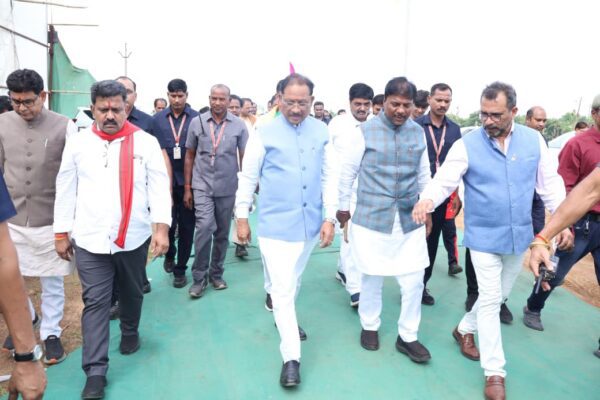
Chief Minister Vishnu Deo Sai knows the window to solidify this peace won’t stay open forever. His government just announced a plan to raise the average family income to Rs 30,000 in these affected districts through cluster-based farming, animal husbandry, and micro-enterprises.
The demands are basic but massive. They need roads. They need telecom towers. They need hospitals. They need immediate, undeniable proof that the Indian state can deliver a better life than the Maoists did.
The stakes couldn’t be higher. Bastar sits on staggering mineral wealth. As security improves, industrial and mining projects will inevitably move into these newly pacified zones.
If the locals feel exploited, if they watch their land get carved up while their villages remain poor, will the grievances that originally fuelled the rebellion spark right back up?
Operational dominance only buys a government time. Inclusive governance is the only thing that builds lasting peace.
Bastar is finally quiet. Now the state has to prove it was worth the fight.