The battle for control of the holy city remains the defining geopolitical flashpoint of the modern Israeli-Palestinian conflict.
April 10, 2026 — The Roman legions tore down the Second Temple in 70 CE. The Ottoman Empire collapsed after World War I. The British mandate fractured under the weight of sectarian violence. Through every imperial collapse and redrawn map, Jerusalem has remained exactly what it is today. It is the most fiercely contested ground on Earth.
Religion drives the passion. Geography drives the war.
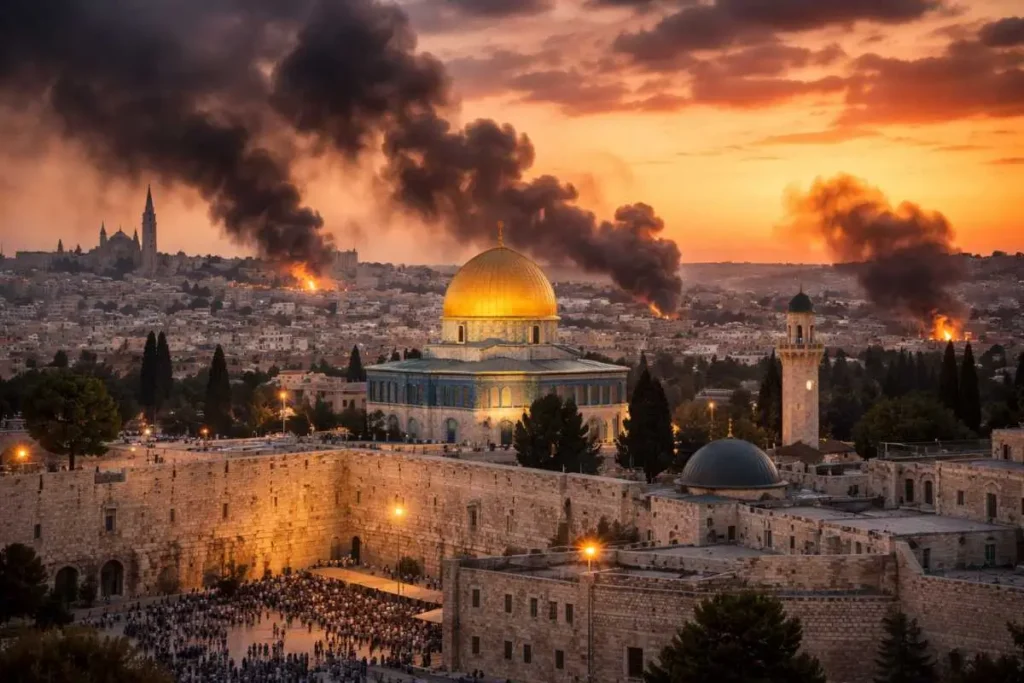
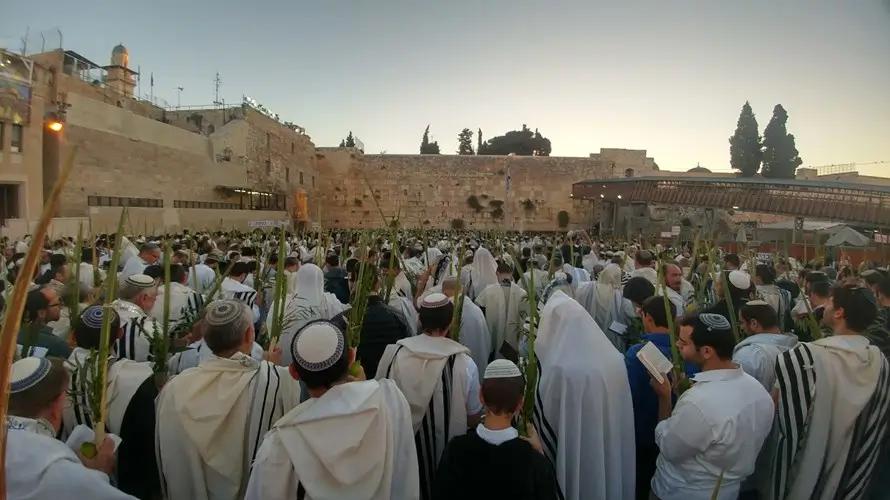
Billions of people lay spiritual claim to this city. The devotion isn’t abstract. It is anchored to specific, overlapping coordinates in the Old City. Jews revere the Western Wall, the last structural remnant of the ancient temple complex built by King Solomon and destroyed by Rome. Just above it sits a 35-acre elevated plaza. Muslims call it the Haram al-Sharif, the Noble Sanctuary. It houses the Al-Aqsa Mosque, the third holiest site in Islam, where tradition dictates the Prophet Muhammad ascended to heaven. A short walk away through a labyrinth of stone alleys, Christians walk the Church of the Holy Sepulchre. They venerate it as the exact site of Jesus Christ’s crucifixion, burial, and resurrection.
These faiths do not exist in separate vacuums. They bleed into one another. The proximity guarantees friction.
The modern political lines hardened after World War I. Britain seized control of Palestine under a League of Nations mandate. They promised self-determination to the Arab majority while simultaneously endorsing the establishment of a national home for the Jewish people through the Balfour Declaration. The Zionist movement accelerated Jewish immigration. They wanted a homeland. Arab residents, rooted in the region for generations, fought the influx. They feared demographic and physical displacement. The resulting violence forced Britain’s hand.
The United Nations stepped in with a map in 1947. Resolution 181 proposed partitioning Palestine into separate Jewish and Arab states. Jerusalem held too much weight for either side to own completely. The UN drafted a plan to carve the city out as a corpus separatum — an international city administered by the UN.
That plan died on paper.
Israel declared statehood in May 1948. War ignited across the region within hours. Neighboring Arab armies moved in. When the shooting stopped and the armistice lines were drawn in 1949, troops had ripped Jerusalem in half. Israel controlled West Jerusalem. The Jordanian military held East Jerusalem, locking down the Old City and its holy sites. Barbed wire, concrete barriers, and sniper positions severed the city.
The barricades stood for 19 years.
Everything flipped in June 1967. The Six-Day War broke the stalemate. Israeli paratroopers pushed into East Jerusalem. They captured the Old City. They seized the Western Wall and the Temple Mount. Within weeks, Israel formally annexed the eastern half of the city. They expanded the municipal borders, absorbing 28 surrounding Palestinian villages, and declared the newly unified city their eternal and indivisible capital.
The international community refused to sign off. The United Nations Security Council passed resolutions condemning the annexation. Decades later, the UN and most foreign governments still designate East Jerusalem as occupied territory. Palestinian leaders demand the eastern sector as the capital of their future independent state. Sovereignty over these specific blocks of stone remains the central, unmovable wedge in the Israeli-Palestinian conflict.
Today, the battle isn’t fought with tank columns. It is fought with zoning laws, building permits, and eviction notices. It is a demographic war.
Israeli authorities maintain a clear policy objective: preserve a Jewish demographic majority in the city. To achieve this, the government continuously backs settlement expansion across East Jerusalem. State-backed housing projects ring the city, cutting Palestinian neighborhoods off from the occupied West Bank. International law classifies these housing projects as illegal. Israel rejects that ruling outright, citing historical ties and security imperatives.
For the 350,000 Palestinians living in East Jerusalem, the reality is stark. They make up roughly 40 percent of the city’s population, yet human rights groups report their neighborhoods receive less than 15 percent of the municipal budget. Services lag heavily behind the western half of the city.
The deepest crisis is housing. Palestinian residents face a labyrinthine bureaucracy when applying for building permits. Israeli planning committees approve a fraction of the requests from Arab neighborhoods. When families expand and build without permits, the state issues demolition orders. Israeli bulldozers routinely tear down unauthorized Palestinian homes. The United Nations tracks these demolitions meticulously. They report hundreds of structures flattened annually, leaving thousands displaced.
The fight plays out house by house in neighborhoods like Sheikh Jarrah and Silwan.
In Sheikh Jarrah, a leafy district north of the Old City, Palestinian families face relentless legal campaigns from private Jewish settler organizations. These groups use Israeli laws that allow Jews to reclaim property owned before 1948. No parallel law exists for Palestinians who lost property in West Jerusalem during the same war. The resulting eviction orders regularly ignite global outrage. Protests in Sheikh Jarrah in 2021 spiraled into clashes across the city, eventually triggering an 11-day war between Israel and Hamas militants in Gaza.
In Silwan, just south of the Old City walls, the mechanism is different but the result is the same. The settler organization Elad spearheads a massive archeological project known as the City of David. They conduct state-sanctioned digs directly beneath Palestinian homes, searching for ruins from King David’s era. The project functions as both a tourist attraction and a mechanism for territorial control. Palestinian residents report structural damage to their homes from the tunneling. Elad heavily funds legal battles to evict Arab families and move Jewish settlers into the neighborhood.
Then there is the physical architecture of the occupation.
In the early 2000s, responding to a wave of suicide bombings, Israel constructed a separation barrier. In rural areas, it is a wire fence. In Jerusalem, it is a 26-foot-high concrete wall. The barrier snakes through the city’s eastern edges. It physically amputates several Palestinian neighborhoods like Kufr Aqab and the Shuafat refugee camp from the rest of the city.
Tens of thousands of Jerusalem residents now live on the “wrong” side of the wall. They hold municipal ID cards and pay city taxes, but they must pass through heavily militarized military checkpoints, like the massive terminal at Qalandia, just to go to school, reach a hospital, or get to work. The economic suffocation in these walled-off zones is absolute. Law enforcement rarely enters. Basic municipal services like trash collection have collapsed.
Security dictates the rhythm of the entire city.
The Old City operates under one of the densest surveillance networks on the planet. The Israeli police run the “Mabat 2000” program. More than 8,000 closed-circuit cameras monitor the one square kilometer inside the historic walls. Facial recognition software tracks movement through the ancient stone gates. Heavily armed border police patrol the narrow corridors. The tension is a physical weight.
The ultimate flashpoint remains the Temple Mount.
Following the 1967 capture of the site, Israel established a fragile arrangement known as the Status Quo. Israel holds overall security control. A Jordanian-funded Islamic trust, the Waqf, handles daily administration of the mosque compound. Under this unwritten agreement, Muslims can pray at the site. Non-Muslims can visit during specific hours but are strictly forbidden from praying.
That arrangement is shattering.
In recent years, Israeli ultranationalist groups have pushed aggressively to assert Jewish prayer rights on the Mount. Assisted by sympathetic government ministers, record numbers of Jewish activists now tour the compound. Many openly pray. The Waqf views this as a deliberate attempt to partition the holy site.
When the Status Quo breaks, the city burns. A change in access rules, a heavy security deployment during Ramadan, or a provocative visit from a political figure sets off a chain reaction. Clashes between rock-throwing Palestinian youth and Israeli riot police firing stun grenades and rubber-coated steel bullets inside the Al-Aqsa Mosque are not isolated events. They resonate globally. They trigger mass protests in Amman, Cairo, and Istanbul.
Foreign governments spent decades stepping around the dispute. Most kept their embassies in Tel Aviv. They adhered to the international consensus that Jerusalem’s final status must be negotiated at a peace table.
The United States broke that consensus in 2017.
President Donald Trump formally recognized Jerusalem as Israel’s capital and ordered the relocation of the American embassy. Israeli officials celebrated the move as a historic validation of their sovereignty. Palestinian leaders cut diplomatic ties with Washington. Allied nations warned the unilateral move gutted the remaining framework of the peace process. A few countries followed the American lead. Most did not.
Diplomacy remains completely paralyzed.
The Oslo Accords of the 1990s tried to box the Jerusalem question into a broader peace framework. Those frameworks are dead. There is no active peace process. Negotiators haven’t sat at a table in years. No one can find a compromise on borders, municipal governance, or control over the holy sites. Every proposed line cuts through someone’s identity.
For the people living in Jerusalem, the geopolitical stalemate dictates daily survival. Media narratives clash just as violently as the factions on the ground. A self-defense operation in an Israeli broadcast plays as military oppression on Al Jazeera. Online networks weaponize the dispute, stripping away context and pushing highly polarized, emotionally charged content to a global audience. The algorithms profit from the outrage.
No one is backing down. No one is leaving.
Jerusalem isn’t just a city. It is a symbol. It is a zero-sum game played out over holy stones and contested neighborhoods. Until negotiators solve the underlying demands for human rights, identity, and belonging, the city will remain locked in a cycle of faith and fire.