Private school managements demand RTE reimbursements match government school spending, threatening the future of 15,000 students as the standoff intensifies.
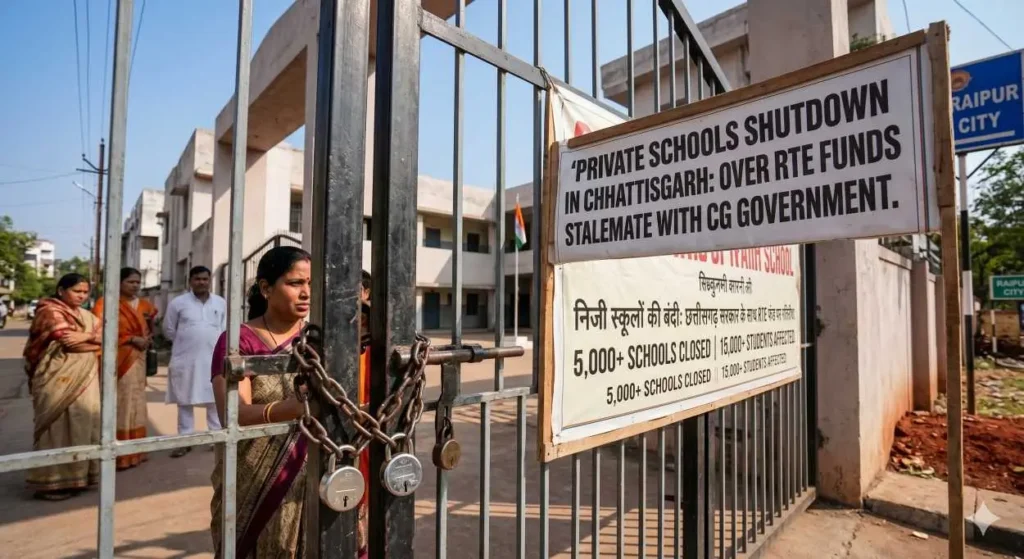
RAIPUR, April 19 — Five thousand private schools across Chhattisgarh locked their gates this weekend. The mass shutdown leaves the education of 15,000 children hanging in the balance as operators escalate their fight with the state government over Right to Education reimbursements.
The demand cuts straight to the bottom line. Private school owners want the state to match their RTE reimbursement rates with the actual per-child expenditure incurred in government schools.
They aren’t backing down.
The Private School Management Association orchestrated the statewide closure following a black-ribbon protest on Friday. Teachers and administrators wore black armbands to signal their deep frustration with the government’s rigid stance on funding. They argue the current reimbursement rates choke their daily operations.
The arithmetic simply fails. The state forces these private institutions to reserve a specific percentage of their seats for children from economically disadvantaged backgrounds. The law dictates this mandate. The government promises to compensate the schools for these forced admissions.
But that compensation is breaking the system apart.
School managements say the money the state provides falls drastically short of the real cost to educate a child. They look directly at the government’s own balance sheets to make their case. They demand exact parity. If the state spends a specific amount per student in its own public school network, private operators argue they must receive that identical figure for every RTE student they enroll.
Anything less forces them to operate at a massive deficit.
It forces them to shift the financial burden onto someone else. Administrators usually plug this gap by raising fees for regular paying students or slashing budgets for essential facilities. The Association says neither option works anymore. The parents of regular students refuse to absorb the cost of a government mandate. The financial strain has hit an absolute breaking point.
So the gates stay locked.
The Association confirmed that nearly 5,000 campuses refused to open for regular operations today. This isn’t a localized flare-up in a single district or a minor administrative dispute. It is a coordinated, statewide freeze. The protest has effectively paralyzed a massive segment of Chhattisgarh’s educational infrastructure.
And the standoff is poised to widen dramatically.
In the next phase of the agitation, administrators from 8,000 private schools across the state will petition the Education Minister directly. Their letters will demand an immediate, structural hike in the per-student payout to reflect real-world operational costs. They won’t settle for bureaucratic committees or delayed reviews. They want hard numbers revised now.
Until the state updates those reimbursement figures, school operators warn they’ll maintain their agitation.
This puts the state government in a severe bind. The entire Right to Education framework relies heavily on private sector participation to guarantee universal access. The state cannot simply absorb these 15,000 displaced students into the public system overnight. The physical infrastructure doesn’t exist. The teaching staff isn’t there. The public classrooms are already bursting at the seams.
The state desperately needs these private operators. But the government hasn’t signaled any willingness to negotiate the rates. State education departments traditionally operate under tight, unforgiving budgetary constraints. Adjusting the reimbursement rate to match government per-student spending would require a massive reallocation of state funds. Politicians rarely want to divert funds from visible infrastructure projects to invisible administrative reimbursements.
How long can a government ignore a paralyzed school system before the public demands immediate intervention?
The silence from the capital is deafening right now. Meanwhile, the clock ticks loudly on the academic calendar. Every single day these 5,000 schools remain shuttered is a day permanently lost for every enrolled student. The collateral damage compounds by the hour.
While the fight centers on government policy and private school ledgers, the immediate victims are 15,000 children. These are students whose access to quality education relies entirely on this fragile, failing partnership between the state and private enterprise. They are caught in a financial crossfire they didn’t create and cannot control.
For the parents of these 15,000 students, the anxiety is mounting rapidly. They watched the black-ribbon protests unfold on Friday. They saw the administrators organize. They watched the heavy iron gates lock shut. Now they face the very real prospect of a prolonged, bitter shutdown that could derail an entire academic year.
The government promised them a secure seat in these private classrooms. The private schools say they can no longer afford to subsidize that unfunded government promise.
The Private School Management Association is utilizing the only real leverage it possesses. By bringing daily operations to a grinding halt, they force the issue directly onto the minister’s desk. Coordinating letters from 8,000 schools is a massive logistical flex. It demonstrates total, unyielding unity.
It shows the government that this isn’t a fringe group of disgruntled owners. It is a unified front encompassing the vast majority of the state’s private educational network.
They’ve drawn a hard line in the sand.
The baseline cost of running a school has skyrocketed over the past decade. Infrastructure maintenance, teacher salaries, administrative overhead, and strict regulatory compliance costs drain resources faster than ever before. Electricity rates climb. Property taxes rise. Technology upgrades demand constant capital. When the government dictates the tuition fee for a significant portion of the student body and sets that fee far below market reality, the business model simply collapses under its own weight.
That is the core argument driving this massive, unprecedented strike.
This gridlock transforms a dry bureaucratic funding dispute into a vibrant, immediate crisis. It exposes the fundamental flaw in how the state manages its educational mandates. You cannot legislate widespread access without adequately funding the institutions providing it. The private sector refuses to play the role of a state charity indefinitely.
The coming days will severely test the resolve of both sides in this standoff. The 8,000 letters will soon flood the Education Minister’s office. The mailrooms will overflow. The political pressure will mount. Parents will start demanding answers from their local representatives.
Someone has to sign a check or compromise on a legal mandate. The current system is mathematically broken. The private operators know this fact. The government knows this fact. The only question is who blinks first.
The Friday black-ribbon protest was just a warning shot. The closure of 5,000 schools is the actual war. The Private School Management Association has made it clear they will escalate this battle until the numbers make sense. They are perfectly willing to halt the state’s educational machinery to make their point. They feel they have absolutely nothing left to lose.
The government must now decide if its budget is more important than its mandate. The state’s strict enforcement of RTE rules triggered this exact backlash. Bureaucrats pushed the private operators into a corner, expecting compliance. Instead, they got a statewide shutdown.
Now the ball is in the government’s court. They can ignore the 8,000 letters and hope the schools cave under parental pressure. Or they can open the treasury and pay the actual cost of education.
There is no middle ground left to navigate.
If the state doesn’t bridge this widening financial gap, the entire RTE system in Chhattisgarh could collapse entirely.
Those 15,000 vulnerable children won’t have a classroom when the bell rings.