A highly suspicious, catastrophic fire in an Alipore government complex wiped out voting records from 10 constituencies, exposing glaring security failures and igniting fierce political accusations.
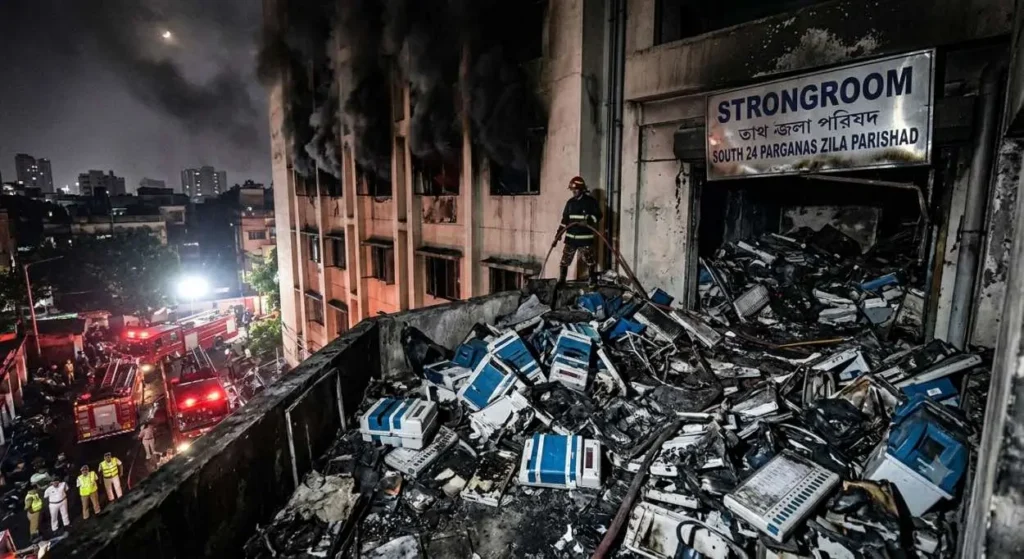
KOLKATA, June 13 — Four thousand electronic voting machines sit as toxic ash today because a fire in a nine-storey government building somehow jumped from the third floor to the eighth, neatly skipping the levels in between. State Fire and Emergency Services Minister Koushik Chowdhury isn’t calling this a tragic accident, and he absolutely shouldn’t. It’s a blatant, horrifying mockery of democratic security.
The blaze broke out Wednesday afternoon inside the sprawling complex housing the South 24 Parganas Zila Parishad. These weren’t discarded or obsolete electronics waiting for the scrap heap. Election officials had securely locked the EVMs, actively deployed across 10 high-stakes constituencies during the recent state assembly elections, inside a dedicated strongroom on the ninth floor. By the time hopelessly delayed fire crews finally arrived—an unforgivable lag, according to Chowdhury’s own public admission—the flames had entirely gutted the machines. And you can’t just write off 4,000 polling devices as a bad stroke of luck in a state where political operatives treat electoral violence and data manipulation like a regional sport.
“Prima facie, the fire first broke out at the third and fourth floors,” Chowdhury told reporters as he surveyed the blackened concrete and shattered glass. He pointedly noted it isn’t at all clear how the flames completely bypassed the fifth, sixth, and seventh floors before thoroughly incinerating the top levels. Police haven’t wasted time registering a First Information Report, but specialized forensic teams couldn’t immediately enter the core of the damage. The blazing heat kept the building literally baking hours after crews pitifully sprayed water at the inferno. They’re searching the perimeter for evidence of chemical accelerants, because normal fires don’t take the elevator.
So how exactly does a blaze neatly target a locked room full of voting records? You don’t need a degree in thermal dynamics to know that fire burns what sits directly in front of it. When flames leapfrog thirty feet of flammable office space to perfectly hit an election repository, it isn’t an act of God. It’s a calculated, undeniable act of arson meant to cover someone’s tracks.
The political fallout hasn’t taken long to materialise, and the rhetoric is already poisonous. The Trinamool Congress, which comfortably controls the Zila Parishad, didn’t hesitate to point fingers directly at the cowardly silence of the Election Commission of India. Releasing a blistering public statement on the social platform X, the party laid out the exact, horrifying inventory of the destruction: 4,000 control units, 4,000 ballot units, and 4,000 Voter Verifiable Paper Audit Trail systems. They didn’t stop there. They explicitly named the specific constituencies tied to the burned machines, and the resulting list reads like a map of West Bengal’s most brutally fought political battlegrounds.
Kasba. Jadavpur. Behala East. Behala West. Metiaburuz. Satgachia. And crucially, multiple assembly segments falling under the Diamond Harbour sub-division. Diamond Harbour isn’t just another district on the map; it’s the undisputed political fortress of Trinamool’s National General Secretary, Abhishek Banerjee. The stakes simply couldn’t climb any higher. The party’s statement accused the ECI of hiding behind “planted narratives” and reminded the public that Trinamool leadership had previously sought judicial intervention just to preserve these exact EVMs and their corresponding CCTV footage.
Now, the fire has permanently erased that critical surveillance footage and the machines themselves. We’re left looking at a massive pile of melted plastic, fused wiring, and hopelessly compromised microchips. The ECI hasn’t provided a comprehensive, transparent answer explaining how their supposedly airtight secure storage protocols failed so spectacularly in the middle of the state capital. But they can’t simply brush aside the total destruction of 4,000 machines in a highly secure district stronghold with a standard, lifeless press release.
Alipore isn’t some forgotten rural outpost where emergency vehicles take hours to arrive. It’s one of Kolkata’s most elite, heavily guarded neighbourhoods, housing senior bureaucrats, historic institutions, and major administrative hubs. A massive fire burning uncontrolled in a government building here, raging long enough to completely melt thousands of hardened electronic devices, represents a catastrophic, systemic failure of basic municipal infrastructure. It defies logic that a blaze of this magnitude could gut the ninth floor without triggering a massive, immediate response from local authorities. But the engines dragged their feet, and the evidence burned.
The crisis isn’t just about the physical hardware; it’s about the irreplaceable data the machines hold. Every EVM acts as a self-contained, legally binding ledger of democratic intent. When you burn the ledger, you don’t just destroy expensive government property. You permanently obliterate the only physical proof revealing how thousands of citizens cast their ballots. In a political climate as volatile and deeply corrupt as West Bengal’s, perpetrators don’t commit that kind of targeted erasure by accident.
Someone set out to systematically destroy the record, and they frankly didn’t care how incredibly obvious the crime looked.
By law, the Election Commission must preserve election materials for a specific period, allowing candidates to file electoral petitions challenging the results. If a losing candidate suspects foul play, high courts will only accept the EVM data and the VVPAT slips as hard evidence. Whoever torched the South 24 Parganas Zila Parishad building knew exactly what they were doing. They didn’t just burn plastic; they burned the entire legal appeals process.
We won’t know the exact method of ignition until the forensic teams finish painstakingly sifting through the toxic debris. They’ve got a remarkably difficult job ahead, navigating severe structural damage and heavily compromised crime scenes. But the basic physics of the incident already tell the most sickening part of the story. The building also houses the local District Forest Officer’s setup and the Sarva Shiksha Abhiyaan administrative offices. Neither of those civilian departments suffered the highly targeted, catastrophic data loss that mysteriously hit the election commission’s stockpile.
The police continue their investigation, but the critical window for recovering any meaningful data from those specific 10 constituencies has firmly slammed shut. If genuine discrepancies existed in the vote counts for Jadavpur or Kasba, we’ll never uncover them. If the printed VVPAT slips held the key to a major legal challenge in Diamond Harbour, the wind is now blowing that carbon dust over the Kolkata skyline. We aren’t getting those ballots back.
There isn’t a credible fire safety expert anywhere who will look at the strange, leaping trajectory of this blaze and call it a natural phenomenon. The authorities must stop treating this like a routine structural incident and start investigating it as a violent, targeted assault on electoral integrity. They owe the voters the truth about who struck the match. They murdered the evidence, and the public deserves to know why.