
A coordinated strike by six ballistic missiles and 29 drones has left a critical E-3 Sentry “flying radar” in ruins and 15 Americans wounded.
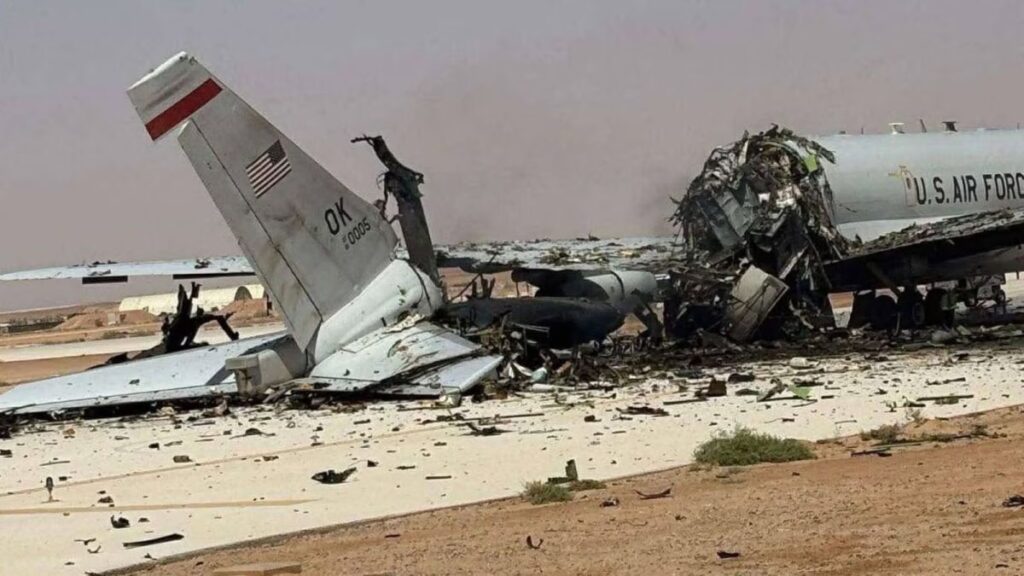
An Iranian precision strike has destroyed a $500 million U.S. Air Force E-3 Sentry AWACS aircraft, a loss that guts the Pentagon’s ability to manage the air war over the Persian Gulf.
The attack, which occurred in the early hours of Friday, March 27, targeted the Prince Sultan Air Base (PSAB) located 60 miles south of Riyadh. It wasn’t a lucky shot. It was a coordinated barrage of six ballistic missiles and 29 attack drones that overwhelmed local defenses to find high-value targets.
At least 15 U.S. service members were wounded in the blast, five of them seriously, according to officials briefed on the matter. This latest strike pushes the total number of Americans wounded since the conflict began on February 28 past the 300 mark.
The primary victim of the metal rain was the E-3G Sentry, tail number 81-0005. Images from the scene, verified by aviation analysts and first reported by Air & Space Forces Magazine, show the aircraft’s central fuselage and its iconic rotating radar dome completely devastated.
It’s a catastrophic blow to the 552nd Air Control Wing. These “flying radars” are the brains of any modern air campaign. They coordinate strikes, track incoming threats, and manage the chaotic airspace where U.S. and Israeli jets operate.
Without this specific airframe, the remaining fleet of 15 operational E-3s must shoulder the entire burden of a widening regional war.
“The loss of this E-3 is incredibly problematic,” said Heather Penney, a former F-16 pilot and current director of studies at the Mitchell Institute for Aerospace Studies. She noted that these battle managers are crucial for everything from aircraft deconfliction to providing lethal targeting data.
But the AWACS wasn’t the only target.
The barrage also heavily damaged at least three KC-135 Stratotanker refueling aircraft. These tankers are the lifeblood of the mission; without them, U.S. fighters can’t stay in the air long enough to reach Iranian territory or defend Saudi oil fields.
How did Tehran’s missiles find them?
Iranian state media, including Press TV, began circulating satellite imagery and ground-level photos of the wreckage almost immediately. The accuracy suggests Iran possessed timely intelligence on exactly where these high-value assets were parked on the tarmac.
It’s the second time this month that PSAB has been hit. A March 1 attack claimed the life of Army Sgt. Benjamin N. Pennington. This time, the damage to hardware is what has the Pentagon scrambling.
Replacement for the E-3 Sentry is a decade away. The successor, the E-7 Wedgetail, isn’t expected to be fully operational until the 2030s.
Is the U.S. losing its technological edge in a war of attrition?
For now, the USS Tripoli has arrived in the region with 2,500 Marines and a fresh contingent of strike fighters to shore up the line. But Marines on the ground can’t replace a radar in the sky.
The Pentagon has not yet issued a formal public confirmation of the aircraft’s total loss, but the imagery from the base tells a story of twisted aluminum and charred electronics that no mechanic can fix.
As the war enters its second month, the vulnerability of “impenetrable” bases in the Gulf is no longer a theoretical debate. It’s a visible, smoking reality on a Saudi runway.
What remains is a depleted surveillance net and a growing list of casualties that Washington can no longer claim are “minor.”