
Tehran’s IRGC declares the start of a “new phase” of retaliation following the killing of Supreme Leader Khamenei, while Washington dismisses the strike as a “desperate lie.”
By Roots Global Desk
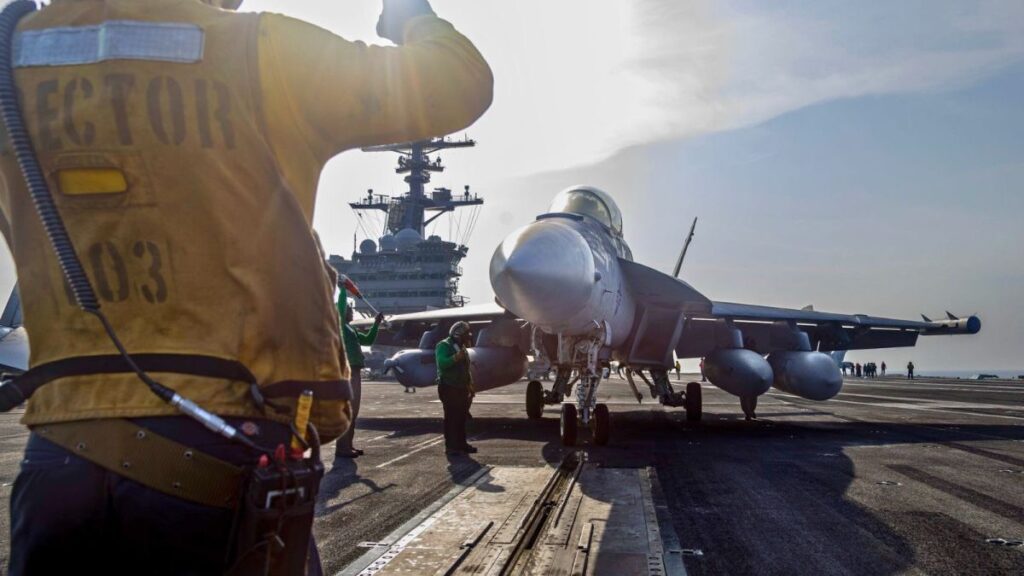
The specter of a full-scale regional war in the Middle East moved one step closer to reality on Sunday as Iran’s Islamic Revolutionary Guard Corps (IRGC) announced it had successfully targeted and struck the USS Abraham Lincoln, a Nimitz-class aircraft carrier, with a volley of ballistic missiles. The claim, broadcast across Iranian state media, marks the most significant direct provocation against American naval assets in decades, coming in the wake of a devastating U.S.-Israeli air campaign that reportedly decapitated Iran’s top leadership.
The IRGC statement was as chilling as it was defiant. “The U.S. aircraft carrier Abraham Lincoln was struck by four ballistic missiles,” the Guard declared, adding a grim warning that the Middle East would “increasingly become the graveyard of the terrorist aggressors.” According to Tehran, the strike was part of ‘Operation True Promise 4,’ a retaliatory offensive launched after the reported death of Supreme Leader Ayatollah Ali Khamenei in a precision strike on Saturday.
The Fog of War in the Arabian Sea
Despite the bold assertions from Tehran, the Pentagon and U.S. Central Command (CENTCOM) moved swiftly to debunk the narrative of a crippled carrier. In a bluntly worded rebuttal, CENTCOM characterized the Iranian claims as a “lie,” asserting that while missiles were indeed launched, they failed to find their mark.
“The Lincoln was not hit. The missiles launched didn’t even come close,” a CENTCOM spokesperson stated. “The Lincoln continues to launch aircraft in support of our relentless campaign to defend the American people and eliminate threats from the Iranian regime.”
The discrepancy highlights the intense information warfare currently defining the conflict. While Iran seeks to project strength to its domestic audience and regional proxies after suffering staggering losses, the United States is working to maintain the image of an impenetrable maritime presence. Military analysts suggest that while a direct hit on a carrier is statistically difficult due to advanced Aegis missile defense systems, the mere attempt to sink a “floating city” like the Lincoln represents a total collapse of traditional deterrence.
A Decapitated Leadership and a Nation at Bay
The reported strike on the USS Abraham Lincoln did not happen in a vacuum. It is the violent byproduct of “Operation Epic Fury,” a massive joint military operation by the U.S. and Israel aimed at dismantling Iran’s nuclear infrastructure and command-and-control nodes. Over the last 48 hours, reports have trickled out of Tehran suggesting that not only Khamenei but also several high-ranking IRGC commanders and cabinet members were killed in bunker-busting strikes.
With the traditional chain of command in tatters, the IRGC appears to be operating on a doctrine of total retaliation. Beyond the carrier strike, Iranian missiles and drones have reportedly targeted U.S. facilities across Kuwait, the UAE, and Bahrain. The intensity of the exchange has forced commercial aviation to a standstill, with hundreds of flights cancelled across the Gulf and India, as the region’s airspace becomes a corridor for hypersonic projectiles.
The Stakes for Global Stability
The USS Abraham Lincoln, carrying a full complement of F-35 stealth fighters, has been the centerpiece of the U.S. presence in the Arabian Sea since January. If the IRGC’s claims were even partially true, the implications for global oil markets and maritime security would be catastrophic. Even with the U.S. denial, the proximity of the attack to the Strait of Hormuz—the world’s most vital oil chokepoint—has sent shockwaves through the international community.
Already, the diplomatic fallout is visible. The UAE has shuttered its embassy in Tehran, and regional powers are scrambling to convene emergency summits. Meanwhile, in Washington, the Trump administration has signaled that the goal is no longer just containment, but the systematic destruction of Iran’s offensive military capacity.
As both sides dig in, the world watches the waters of the Gulf with bated breath. Whether the missiles hit or missed, the “red line” of direct conflict between a superpower and a regional heavyweight has been crossed. In the words of one diplomat in the region, “We are no longer talking about a shadow war; the masks are off, and the era of restraint is over.”