
The Supreme National Security Council says Washington bowed to its terms, opening the door to a two-week ceasefire and high-stakes talks in Islamabad.
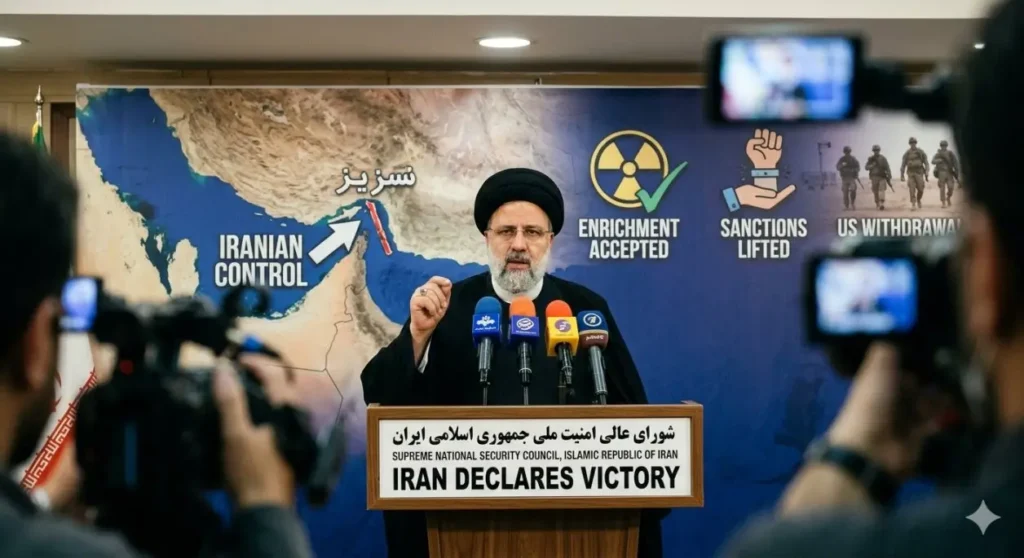
April 8 — Iran declared victory Wednesday. The Supreme National Security Council published a 10-point peace plan they say Washington accepted to pause a five-week war. They call the agreement a crushing defeat for the United States. The terms rewrite the security architecture of the Middle East.
Washington hasn’t signed a surrender document. White House Press Secretary Karoline Leavitt called the Iranian proposal a workable basis to negotiate. But the optics currently belong to Tehran. President Donald Trump agreed to a two-week ceasefire just 90 minutes before a deadline he said would end with a whole civilization dying. Instead, the guns stopped firing.
Now, the world gets to read Iran’s demands. The 10-point plan doesn’t ask for favors. It demands total capitulation on decades of American foreign policy.
First, Iran demands continued and expanded control over the Strait of Hormuz. They plan to regulate maritime traffic through the chokepoint under the strict coordination of their Armed Forces. They want to charge a $2 million transit fee per vessel. They will share that revenue with Oman, using their cut to rebuild infrastructure US bombs destroyed rather than seeking traditional war reparations. This gives Tehran a permanent grip on a waterway that handles a fifth of the world’s oil.
Second, Tehran demands formal American acceptance of its uranium enrichment program. They aren’t offering a return to the 2015 nuclear deal. They want outright recognition of their nuclear rights. They commit to not seeking nuclear weapons, but they demand the world accept their domestic program as a permanent reality.
Third and fourth, the plan requires the immediate lifting of all primary and secondary sanctions. Every economic shackle the US Treasury placed on the Iranian economy over the last decade must vanish. They want Washington to release their frozen funds immediately.
Fifth and sixth, Iran insists on terminating all United Nations Security Council resolutions against it. They also demand an end to all International Atomic Energy Agency Board of Governors resolutions. They demand a completely clean slate.
Seventh, the United States must pay financial compensation. Iran calls it reconstruction costs. They want Washington to foot the bill for the five-week air campaign that devastated their infrastructure.
Eighth, all US combat forces must withdraw from the region. This upends the American military footprint across the Persian Gulf, demanding an exit that generations of US defense secretaries swore would never happen.
Ninth, Washington must guarantee no future acts of aggression.
Tenth, the plan demands a complete and permanent cessation of hostilities across all regional fronts. That includes halting Israeli military operations against Hezbollah in Lebanon, and ending conflicts in Iraq and Yemen. They refuse a temporary truce. They demand a permanent end to the war with no time limit.
This is the document Iran says forced Washington to the table. And they have leverage. The Strait of Hormuz remained effectively closed to international shipping for five weeks. Global energy markets hemorrhaged. The threat of a shattered global economy drove the sudden pivot to diplomacy.
Pakistan orchestrated the breakthrough. Prime Minister Shehbaz Sharif passed the terms between Tehran and Washington while the bombs still fell. Now, Islamabad hosts the fallout. Formal negotiations begin there on Friday. Trump dispatched a heavy-hitting delegation. Steve Witkoff, Jared Kushner, and Vice President JD Vance will sit across from Iranian diplomats. Vance reportedly adjusted a planned trip to Hungary just to make the table.
They have two weeks to turn a fragile ceasefire into a permanent treaty.
Iran’s Foreign Minister Seyed Abbas Aragachi didn’t mince words. He said safe passage through Hormuz happens now only through coordination with Iran’s Armed Forces. He cited technical limitations left behind by the conflict. He means they control the gate, and they decide who gets through. He publicly thanked the Pakistani government for stepping in before the region burned.
The Supreme National Security Council statement read like a victory speech. They framed the five-week conflict as an unfair, unlawful, and criminal war against the Iranian nation. They promised to fight side by side in the field until all demands meet reality if the talks collapse. Iran previously dismissed a reported US 15-point counter-proposal as excessively demanding. They drew a line in the sand.
But will the US actually swallow these terms?
Trump claimed his military pressure forced Iran to reopen the strait. Leavitt insisted the president’s words speak for themselves. The reality looks much messier on the ground. A two-week pause gives both sides time to breathe, but it gives Iran time to cement its hold on the region’s most vital shipping lane. The $2 million toll alone redefines global maritime trade. It effectively taxes international shipping to fund Iranian reconstruction.
You don’t tax the world unless you hold all the cards.
The military reality forced the political compromise. The United States launched massive strikes, including a recent high-risk operation in Isfahan. Trump said the Isfahan mission simply rescued a service member tied to a downed F-15 jet. Tehran suspected it targeted enriched uranium. Either way, Iran absorbed the blows and kept the strait closed. The global economy cannot survive a permanently closed Strait of Hormuz. The math always favored the geography.
And now the diplomats have to clean up the mess. Kushner, Witkoff, and Vance face an impossible mandate in Islamabad. They must secure a permanent reopening of the strait without handing Iran a total geopolitical victory. But Tehran already published the receipt. They want their money. They want their security. They want American forces gone.
The Iranian Foreign Ministry issued its own warning. They cautioned that a ceasefire without firm guarantees simply allows adversaries to regroup. They won’t let Washington stall.
If Washington rejects the core of the 10-point plan, the ceasefire expires. The bombs start falling again. The strait stays closed. Oil prices will shatter records, sending a shockwave through Western economies just as they try to recover.
If Washington accepts the terms, they effectively surrender their position as the dominant security guarantor in the Middle East. They hand the keys to Tehran, legitimizing their nuclear program and funding their reconstruction with a global shipping tax. The entire post-1945 order in the Persian Gulf changes overnight.
The clock started ticking Wednesday morning. Two weeks. Fourteen days to decide who actually won the five-week war.