By Roots Global Desk
Pro-Tehran militia claims direct hit on American weapons warehouse in bold retaliation for Supreme Leader Khamenei’s death; no US casualties reported as region teeters on wider war
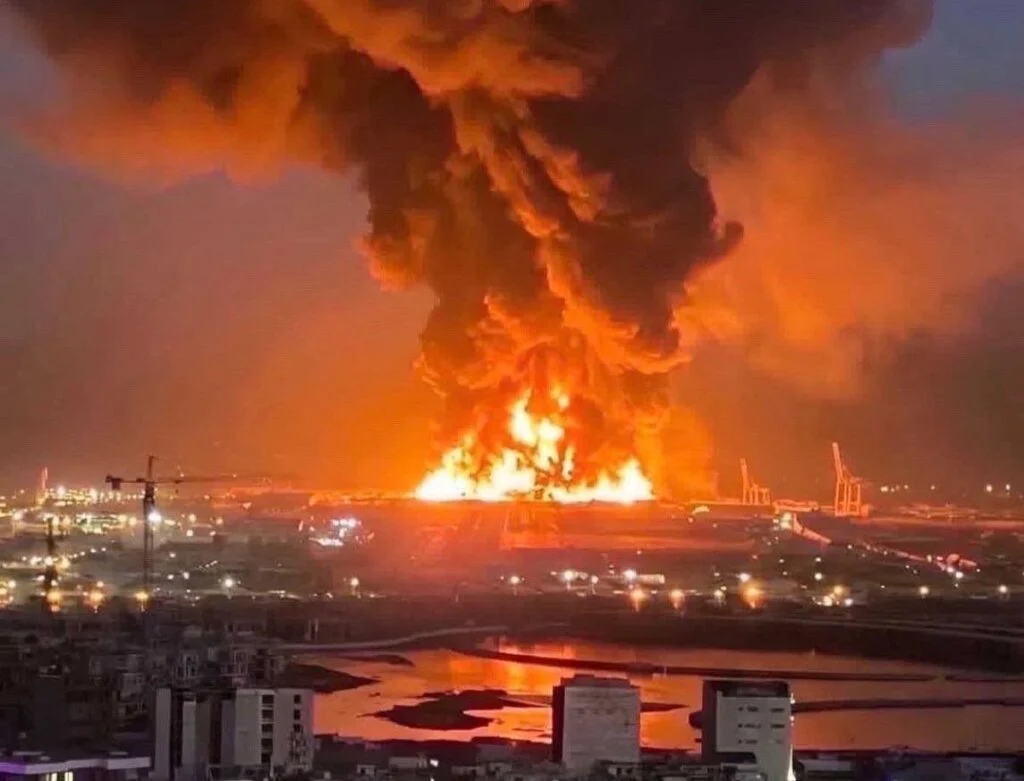
March 2, 2026 – Under a moonless sky late Sunday night, the calm of northern Iraq’s semi-autonomous Kurdistan region was shattered by a thunderous barrage of explosions that lit up the horizon like a fireworks display from hell. Multiple one-way attack drones slammed into a U.S. military facility adjacent to Erbil International Airport, with at least one penetrating deep enough to strike an ammunition warehouse. The impact triggered a cascading series of secondary detonations, sending towering plumes of black smoke and orange flames hundreds of feet into the air as stored munitions cooked off in rapid succession.
Viral footage circulating on social media geolocated by open-source analysts to the vicinity of the U.S.-controlled section of the airport shows repeated bright flashes followed by the distinctive crackle of exploding ordnance. Residents in nearby neighborhoods described the blasts as “earth-shaking,” with windows rattling for miles and the acrid smell of burning explosives drifting on the wind. “It sounded like the end of the world,” one Erbil resident told local Kurdish media, requesting anonymity for fear of reprisal.
The attack was swiftly claimed by Saraya Awliya al-Dam “Guardians of Blood” an Iran-backed Shiite militia operating under the umbrella of the so-called Islamic Resistance in Iraq. In a statement posted to Telegram and rapidly amplified by Iranian state media, the group declared: “In adherence to our religious duty and in retaliation for the blood of the martyr, Supreme Leader Ali al-Husseini al-Khamenei, and in full support of the Islamic Republic of Iran, our valiant mujahideen carried out a swarm-drone operation targeting American bases in Erbil.”
While many initial viral posts labeled it an “Iranian drone strike,” the operational fingerprints point to a proxy force: inexpensive, GPS-guided Shahed-style loitering munitions launched from within Iraq, a tactic militias have refined since the 2023-2024 wave of attacks on U.S. forces. Kurdish security officials confirmed that air-defense systems — including American C-RAM guns and Patriot batteries — engaged multiple incoming threats. Several drones were visibly intercepted, exploding in mid-air in brilliant fireballs. Iraqi authorities later stated the situation at the airport remained “under control” with no civilian casualties or damage to commercial aviation infrastructure.
U.S. Central Command (CENTCOM) has not yet issued a detailed damage assessment for the Erbil incident specifically, but a broader statement issued Sunday acknowledged “limited kinetic activity” across multiple regional bases while emphasizing that American and coalition forces “successfully defended against the majority of threats.” Officials privately briefed that the Erbil strike caused visible fires and secondary explosions but produced no American fatalities or serious injuries at that location. (Note: Three U.S. service members were killed earlier in the day in a separate Iranian-linked strike on a base in Kuwait.)
This latest salvo is the clearest sign yet that Iran’s vast network of proxies is fully mobilized following the stunning U.S.-Israeli military campaign launched February 28 that killed Supreme Leader Ali Khamenei and decimated senior IRGC leadership. Tehran’s retaliation has been swift and multi-pronged: ballistic missiles and drones have rained down on U.S. facilities from Bahrain to Qatar, Jordan, and now deeper into Iraq. Iranian state TV has broadcast dramatic footage of “successful strikes,” while pro-regime accounts celebrate every plume of smoke over American positions.
The Erbil base which houses a mix of U.S. special operations forces, coalition trainers, and logistics personnel supporting the residual anti-ISIS mission has long been a symbolic irritant for Tehran and its Iraqi allies. Under a 2024-2026 security agreement between Washington and Baghdad, American troops were scheduled to complete their drawdown from most Iraqi sites by September, but the Kurdistan presence was quietly extended at the request of Kurdish leaders wary of both ISIS remnants and Iranian influence.
Analysts warn the militia’s involvement risks dragging Iraq itself deeper into the vortex. “This isn’t just about avenging Khamenei,” said Dr. Renad Mansour of the Chatham House think tank. “It’s a calculated message: any continued U.S. footprint in Iraq will come at a price. The question now is whether Baghdad can restrain these groups or whether we’re seeing the beginning of a new front that collapses the fragile post-2022 status quo.”
Iraqi Prime Minister Mohammed Shia’ al-Sudani convened an emergency security meeting Monday morning. A terse readout condemned “any violation of Iraqi sovereignty” without naming the perpetrators — a familiar diplomatic tightrope walk for a government heavily influenced by pro-Iran factions within the Popular Mobilization Forces.
On the ground in Erbil, life continued with surreal normalcy by Monday afternoon. Traffic flowed past the airport perimeter as Kurdish peshmerga and airport security maintained heightened alert. Yet beneath the surface, anxiety is palpable. Kurdish officials privately expressed frustration that their region long America’s most reliable partner in Iraq is once again paying the price for conflicts not of their making.
As night fell again over Erbil, the fires at the ammunition depot had been brought under control, but the political embers continue to glow. With President Trump’s administration vowing “overwhelming” retaliation for any American deaths and Iran promising further waves of attacks, the drone strike on the Erbil ammo warehouse may be remembered not as an isolated incident, but as the spark that turned a bilateral U.S.-Israel operation into a full-spectrum regional war.
The coming hours will be critical. Will Washington respond directly against the militias inside Iraq? Will more powerful Iranian ballistic missiles follow the cheap drone swarm? And can Iraqi and Kurdish leaders prevent their territory from becoming the next bloody battlefield in a conflict already claiming hundreds of lives across the Middle East?
For now, the smoke over Erbil serves as a stark reminder: in this new era of shadow wars and proxy vengeance, no base is truly safe, and no retaliation goes unanswered.
Discover more from Rootsalert
Subscribe to get the latest posts sent to your email.