A single photograph of a burning, cleared forest tract in Chhattisgarh’s untouched tribal heartland signals a devastating new wave of industrial extraction.
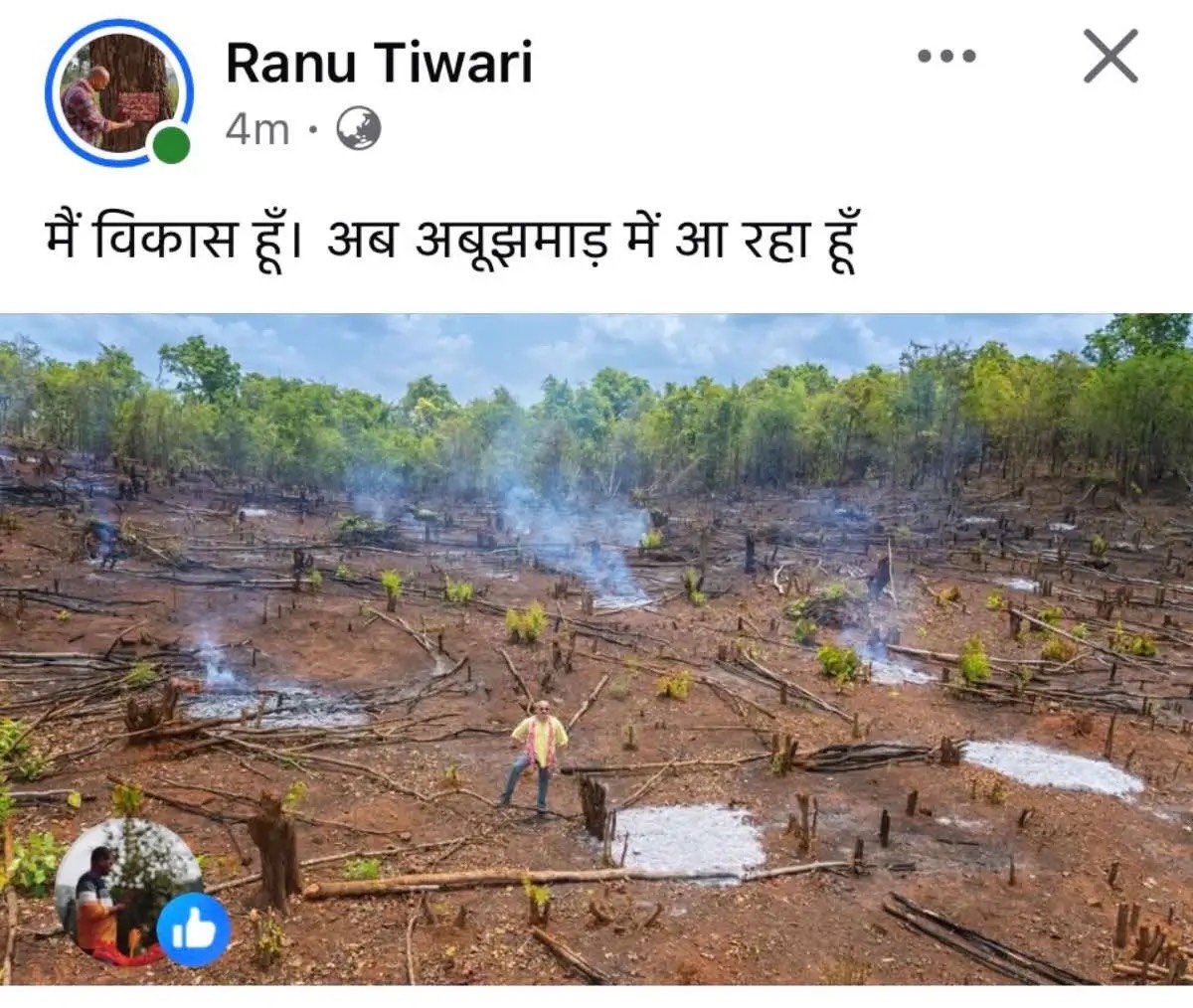
BASTAR, June 14 — A photograph showing acres of freshly cut, smoking tree stumps in Chhattisgarh’s pristine Abujhmad forest has surfaced, triggering immediate alarm about an impending corporate mining push.
The image, posted to Facebook by Ranu Tiwari, shows a lone figure standing amidst a completely decimated forest tract. Small fires smolder across the scorched red earth where towering trees recently stood.
The accompanying caption carries a dark irony. “Mai vikas hu. Ab abujhmarh me aara hu,” the post reads.
Vikas Tiwari isn’t a peripheral observer. He is one of Bastar’s most formidable independent voices. Anchoring the hard-hitting regional network Bastar Talkies, Tiwari amplified the image as a grim harbinger. He points to the photograph as undeniable proof that heavy, systematic deforestation is already underway to pave the way for large-scale mining operations in one of India’s last largely unsurveyed tribal strongholds.
The chainsaws have already arrived.
Abujhmad stretches across roughly 4,000 square kilometers of dense, undulating terrain, primarily in the Narayanpur district. For decades, it’s historically remained isolated, sheltering vulnerable indigenous tribal communities and acting as a massive ecological buffer. But the ground beneath these ancient trees holds rich deposits of iron ore and other highly lucrative minerals. Corporate extraction firms haven’t ignored this geology. They’ve simply waited for the political and security apparatus to clear the path.
So what does “development” actually look like when it finally reaches an untouched forest?
The stark photograph provides the exact blueprint. It doesn’t show schools, hospitals, or sustainable infrastructure. It shows total ecological extraction. The image reveals a methodical clearing operation. The organized spacing of the felled timber and the controlled brush fires burning away the undergrowth indicate professional preparation. This is the precise, standard preliminary phase before heavy earth-moving machinery rolls in to strip the topsoil and rip open the earth.
Activists and environmental defenders in Chhattisgarh warn that clearing this specific jungle carries catastrophic human costs. Bringing open-cast mining into Abujhmad means forcibly displacing tribal populations who rely entirely on the forest canopy for their daily survival, food security, and cultural identity. When industrial mining operations move in, the traditional ecosystem collapses fast. Local water sources quickly dry up or become toxic with run-off, and deep-rooted communities get pushed out to the fringes as ecological refugees.
Journalists operating on the ground face intense, often dangerous pressure when attempting to report on resource extraction in the Bastar division. Documenting the clearing of Abujhmad carries severe professional and personal risks. Security forces and local authorities frequently restrict civilian and media access to these deep interior zones, consistently citing active security operations against Maoist insurgents as the justification.
This deliberate isolation makes raw, unedited visual evidence like the burning stumps exceptionally rare. It punctures the official narrative. Companies and state officials usually frame forest diversion for mining as a clean, bureaucratic process managed through distant regulatory approvals. The reality on the ground is raw destruction.
And the timing of this deforestation raises urgent questions about regulatory oversight. Under Indian law, any diversion of forest land in these scheduled zones requires the explicit, documented consent of the local indigenous councils. Have local indigenous councils approved the destruction of this specific tract? Regional reporters covering the Narayanpur district suggest that mining clearances in Bastar frequently bypass genuine community consent. Corporations often rely instead on coercion or a forged Gram Sabha to rubber-stamp their environmental clearances.
The warning broadcast by Bastar Talkies leaves little room for ambiguity. The image isn’t an isolated incident of illegal logging. It represents the vanguard of a massive industrial land grab.
State environmental ministries and local administrative officials haven’t issued any immediate statements regarding the specific tract of land shown in the Ranu Tiwari post. They rarely respond to visual evidence until public pressure forces a reaction. By the time official inquiries begin, the heavy machinery usually has the land entirely locked down.
But the visual proof is now circulating. The alarm bells from independent reporters are ringing loudly. Corporate boards in distant metropolises haven’t just proposed the aggressive march of industrial mining into the heart of Abujhmad.
It’s already burning the ground.