
Lionsgate shifted production to Macau to court the Asian market, turning a $120 million bloated script into a global financial triumph.
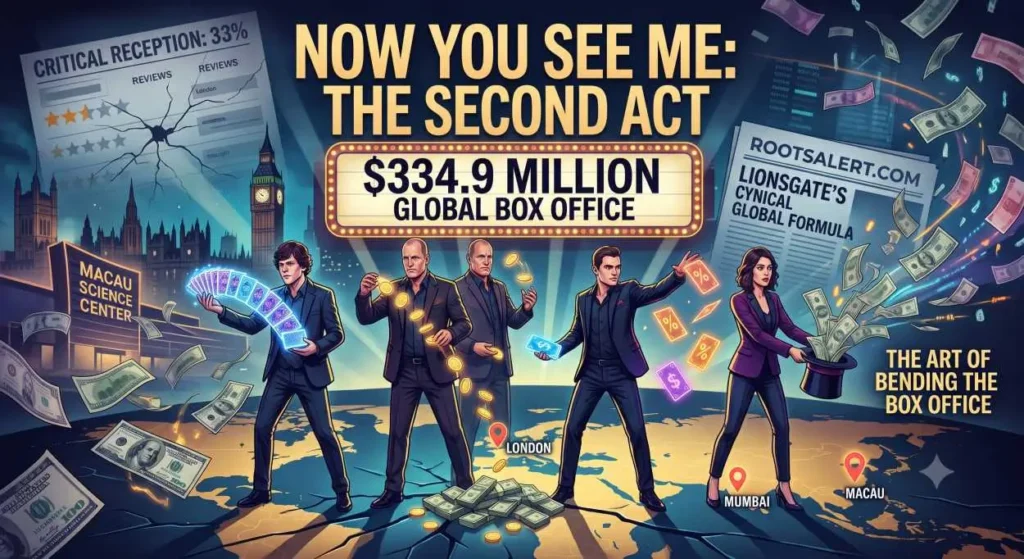
LOS ANGELES, July 3 — Lionsgate poured up to $120 million into a sequel about a global data heist, only to pull off an entirely different sleight of hand by extracting $334.9 million from international box offices. Ten years after its release, Now You See Me 2—frequently referred to by its alternate title, The Second Act—remains the definitive blueprint for Hollywood’s aggressive globalisation strategy. The studio didn’t rely on critical acclaim to drive revenue. They’ve built an industrial product perfectly calibrated to cross international borders, bypassing narrative coherence for pure visual scale, and they didn’t hesitate to abandon their American backdrop to shoot directly in Macau, China.
The narrative structure mirrors the very corporate deception it attempts to critique. Eighteen months after outwitting the FBI, the fugitive illusionists known as the Four Horsemen resurface on the orders of a secret society called the Eye. Their handler, FBI Special Agent Dylan Rhodes, played by Mark Ruffalo, instructs them to expose corrupt tech CEO Owen Case. The script, written by Ed Solomon and Peter Chiarelli, claims Case’s new mobile phone will secretly harvest personal data to sell on the black market. But the film isn’t truly interested in data privacy. Director Jon M. Chu uses the tech-thriller premise merely as a vehicle to transport the cast across the globe, landing them firmly in the laps of international financiers.
Critics at The Guardian openly hammered the film’s palpable desperation. Reviewer Nigel M. Smith pointed out that the sequel plays like a try-hard cousin to the original, showboating by throwing more of everything at the screen. He argued the screenplay doesn’t boast a single whiff of character development. Instead, the runtime is stuffed with a sprawling ensemble cast of more than sixty actors. Jesse Eisenberg returns as J. Daniel Atlas alongside Dave Franco’s Jack Wilder and Woody Harrelson, who isn’t just reprising his role as Merritt McKinney but also playing his own sinister twin brother, Chase.
Where’s the artistic merit in handing a veteran actor a dual role solely to pad a bloated two-hour-and-nine-minute runtime? There isn’t any, and Lionsgate clearly didn’t care. The studio focused entirely on spectacle, bringing in Daniel Radcliffe to play Walter Mabry, a tech prodigy and illegitimate son of the first film’s villain, Arthur Tressler. Radcliffe leans heavily into the absurdity of the role, a casting choice that reviewers found both hysterical and deeply ironic given his history as cinema’s most famous boy wizard. Mabry forces the Horsemen to steal a data chip that can decrypt every computer on the planet. The resulting heist sequence features the magicians tossing a CGI playing card back and forth inside a heavily guarded vault, sliding it down trousers and flicking it through the air. The Guardian dismissed the entire set piece as an inane, endless exercise in digital choreography.
Independent outlets like Rendy Reviews echoed this frustration, noting that while the magic appears more expensive, the constant hand-holding ruins the experience. The original 2013 film left audiences spellbound until the final moments. The Second Act takes the opposite approach. The script systematically strip-mines the mystery, replacing the unknown with tedious, momentum-killing exposition. The writers painstakingly explain every single trick immediately after it happens, treating the audience like children who can’t grasp basic misdirection.
Yet the film’s mechanical flaws didn’t derail its financial momentum. Lionsgate recognised early on that domestic audiences alone wouldn’t guarantee a return on their massive nine-figure budget. They cast Taiwanese pop superstar Jay Chou as Li, a Macanese magic shop owner, and brought in veteran actress Tsai Chin as his grandmother, Bu Bu. These aren’t just diverse casting choices; they’re calculated demographic targets aimed squarely at foreign theatrical blocks. The production literally moved the narrative centre to the Macau Science Center, ensuring the film would resonate in the world’s fastest-growing box office market.
So the picture transformed into an unstoppable financial juggernaut, completely ignoring its abysmal 33 percent critical rating on aggregators. Global audiences bought a ticket for the spectacle, letting the studio gloss over the structural failures of the story. Lionsgate simply weaponised the heist formula, proving they couldn’t be derailed by bad press. Michael Caine returned to cash a cheque as the vengeful sponsor, while Morgan Freeman reprised his role as magic debunker Thaddeus Bradley, dragging the plot through a series of endless, manufactured twists.
Lizzy Caplan, stepping in as the new female lead Lula May after Isla Fisher declined to return due to pregnancy, provides the only genuine spark. Reviewers consistently noted she steals the show, delivering sharp barbs that cut through the script’s overriding self-importance. She doesn’t just fill a vacancy; she actively rescues scenes that would otherwise collapse under the weight of Eisenberg’s neurotic dialogue and Harrelson’s dual-character gimmickry.
But even Caplan’s chaotic energy couldn’t save the structural collapse of the third act. Chu stages a grand finale in London on New Year’s Eve, executing the sequence with the slick precision he honed directing the Step Up dance films. The choreography is undeniably impressive. Yet the story stubbornly refuses to embrace its inherent dumbness, choosing instead to layer pointless convolutions over a basic caper framework. By the time the credits roll, Chu entirely exhausts the element of surprise, leaving viewers with a hollow resolution.
Hollywood executives haven’t learned a creative lesson from this, only a financial one. Lionsgate officially announced the project in July 2013, shot it between November 2014 and May 2015, and methodically rolled it out across the globe. It secured a massive release in India on June 17, 2016, before blanketing streaming platforms like Apple TV and Netflix across the Middle East, Africa, and Latin America. The box office returns validated the studio’s cynical approach, effectively greenlighting a third instalment scheduled for late 2025. You don’t need a compelling script when you have star power, international locations, and a relentless marketing machine.
They didn’t sell a story; they sold a perfectly engineered illusion.