Passengers currently face grueling layovers, but Birsa Munda Airport management is actively pushing airlines to launch non-stop routes connecting Jharkhand to Chhattisgarh, UP, and Assam.
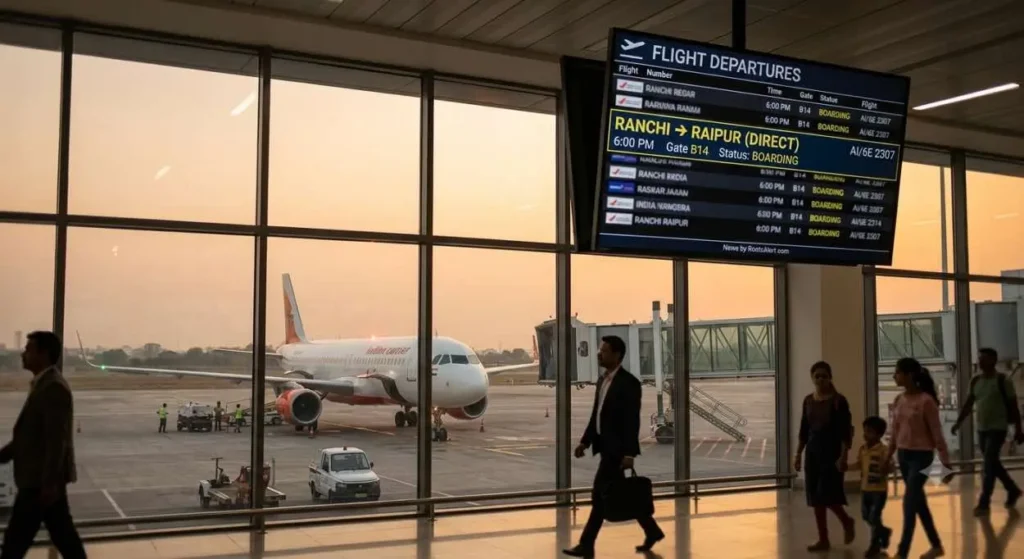
RANCHI, June 8 — Birsa Munda Airport management has officially urged domestic carriers to launch non-stop routes to Raipur, Guwahati, and Varanasi to rescue passengers from punishing transit times. They’ve submitted formal requests to multiple airlines, aiming to capture an untapped market of business travelers, students, and pilgrims who’re currently forced into exhausting multi-city detours.
Right now, the logistics of flying from Ranchi to Raipur are completely broken. While the aerial distance barely crosses 400 kilometres, passengers can’t just hop on a quick direct flight. They’re heavily reliant on IndiGo and Air India connecting flights that route them completely out of the way through New Delhi, Kolkata, or Hyderabad. It’s a journey that should take under an hour but routinely stretches into a massive ordeal. Current flight schedules show trips ranging from 4.5 hours on IndiGo to a grueling 23 hours and 20 minutes on Air India, heavily padded by overnight layovers in the national capital.
That’s an unacceptable drain on both time and capital for a region trying to accelerate its economic output.
The push for direct connectivity didn’t just materialize out of thin air. It’s the direct result of coordinated pressure from local business communities. The regional Chamber of Commerce, alongside former MP Ajay Maroo, have actively lobbied for these specific routes. They’ve repeatedly pointed out that Jharkhand shares deep commercial, educational, and cultural ties with Chhattisgarh, Uttar Pradesh, and Assam. People aren’t just traveling for leisure; they’re moving for heavy industry deals, university placements, and vital religious pilgrimages.
But sending a formal request doesn’t instantly guarantee a runway slot. The Birsa Munda Airport Director confirmed that several airline companies are currently evaluating the proposed routes. They’re actively analyzing potential passenger volumes and crunching the numbers to determine if operating direct flights will actually be commercially viable. It’s a standard industry stress test, and the airlines won’t commit their aircraft until the data proves the demand is consistent enough to turn a profit.
The Ranchi-Raipur corridor represents a massive missed opportunity for regional aviation. Raipur serves as the administrative and commercial heart of Chhattisgarh. Both Jharkhand and Chhattisgarh operate as mineral-rich powerhouses driving India’s core industrial sectors. When corporate executives, government contractors, and mining officials can’t fly direct between the two capitals, the inefficiency directly impacts business velocity. They’re losing entire workdays to airport transit lounges instead of closing deals on the ground.
And the geographical strategy extends far beyond corporate travel. Connecting Ranchi directly to Guwahati opens a crucial, high-speed gateway to the Northeast. It’ll allow traders and students to bypass the congested Kolkata airspace entirely. Meanwhile, a direct link to Varanasi offers immediate access to one of the country’s most vital spiritual hubs. With the recent infrastructure upgrades around the Kashi Vishwanath temple, religious tourism has skyrocketed, yet Jharkhand’s pilgrims haven’t had a straightforward way to get there by air.
A quick glance at current booking platforms illustrates the financial absurdity of the situation. A standard connecting flight from Ranchi to Raipur booked within a 30-day window currently sets a passenger back anywhere from ₹8,500 to over ₹12,500. IndiGo commands the lion’s share of this indirect traffic with over a thousand weekly connecting options, while Air India picks up the rest. It’s a pricing model that aggressively punishes regional travelers simply because they don’t have direct options.
So, why haven’t the airlines locked in these routes yet?
The reality of Indian aviation complicates the timeline. Major carriers like IndiGo and Air India Express are aggressively expanding, but they’re also battling severe supply chain constraints. Aircraft shortages and engine maintenance backlogs mean airlines don’t have idle planes sitting around waiting for a new route. Any aircraft deployed to the Ranchi-Raipur sector will have to be pulled from an existing, potentially lucrative run elsewhere in the country.
The airport authority remains optimistic, but they’re inevitably playing the waiting game. If the airlines return a positive commercial assessment, we’ll see official flight schedules and pricing structures rolled out in the coming months. Travelers could see fares drop significantly compared to the steep premium they’re often forced to pay for convoluted tickets today.
Until the first direct flight takes off, travelers won’t have a choice but to keep navigating the frustrating maze of layovers.
The demand isn’t fading; now the carriers just need to deliver the planes.