In his 80th Independence Day address, CM Vishnu Deo Sai emphasized massive infrastructure projects, AI initiatives, and the historic transformation of Bastar as central to building a ‘Viksit Chhattisgarh’.
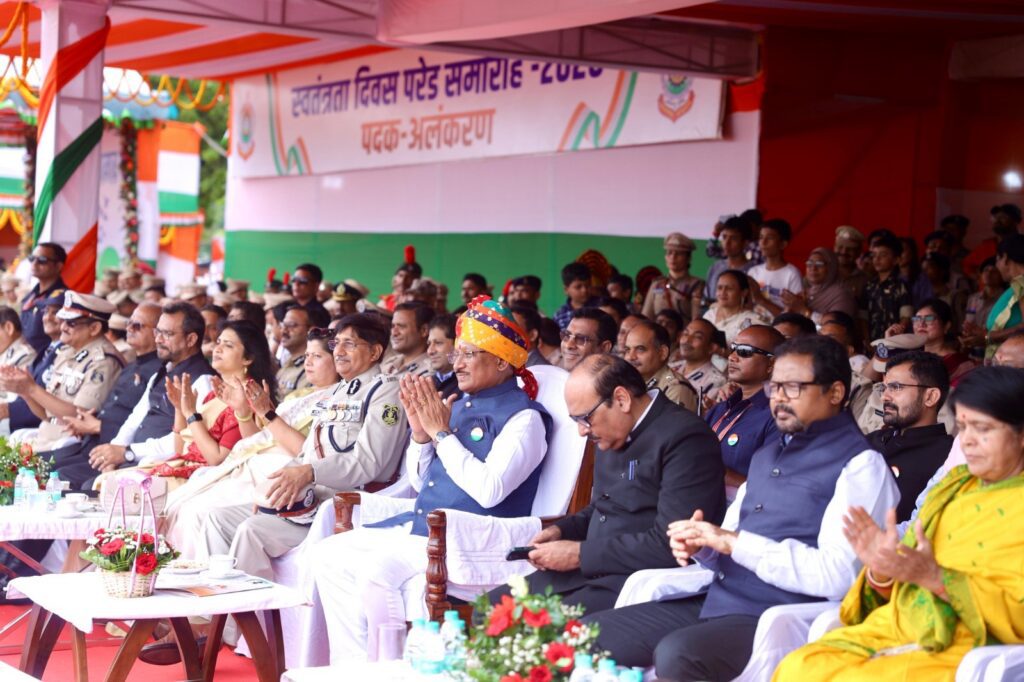
RAIPUR, August 15 — On India’s 80th Independence Day, Chief Minister Vishnu Deo Sai didn’t just highlight past achievements; he outlined the blueprint for a ‘Viksit Chhattisgarh’. Addressing the state from the Police Parade Ground in Raipur, he unfurled the Tricolour and declared that Chhattisgarh has entered a transformative era. He noted that this was the state’s first Independence Day celebration after being declared free from armed Maoists earlier this year.
A significant portion of his address focused on the dramatic shift in Bastar. With the region now free from the grip of Naxalism, citizens are openly celebrating with Tiranga Yatras. The state’s double-engine government is heavily prioritizing Bastar’s comprehensive development, utilizing initiatives like ‘Niyad Nellanar 2.0’ and ‘Bastar Munne Abhiyan’. These programs aim for the 100 percent saturation of 31 government schemes across the division, directly benefiting over 39 lakh people. Schools forced to close during periods of violence have reopened, and new Education Cities are being constructed in remote areas such as Orchha in Narayanpur and Jagargunda in Sukma. Additionally, an Aajeevika Unnayan Yojana with a massive Rs 4,824-crore outlay has been launched to boost the incomes of nearly 10 lakh families in Bastar.
Beyond Bastar, the Chief Minister underscored the state’s commitment to farmers, calling them the “makers of our destiny.” Paddy procurement is continuing at Rs 3,100 per quintal, and the government is actively promoting crop diversification. Farmers switching from paddy to pulses, oilseeds, or maize will receive Rs 15,000 per acre as an exchange grant under the Krishak Unnati Yojana. To support agriculture further, the state has sanctioned over Rs 11,000 crore to expand irrigation networks, including the revival of defunct projects under the Atal Sinchai Yojana.
Women’s empowerment remains a cornerstone of the state’s development strategy. The Mahtari Vandan Yojana has already transferred Rs 19,444 crore into the bank accounts of women across the state. Emphasizing the dignity and well-being of the girl child, Sai announced the launch of the ‘Meri Beti-Mera Abhimaan’ campaign. Under this initiative, which runs until January 26, 2027, the government will construct new toilets for girls in 6,671 rural government schools at a cost of Rs 286.85 crore. The initiative is part of the broader VB-G RAM G scheme, which also includes the construction of Muktidhams (crematoriums) and waiting sheds in 6,524 villages.
The government is also focusing heavily on youth employment and modern skills. Sai highlighted the recruitment of 7,000 youngsters into the police force and ongoing recruitment drives for teachers and power company roles. Crucially, the Chief Minister announced a 10 percent reservation for Agniveers in direct recruitment for police, forest guard, and jail guard posts. Looking to the future, the state has approved a Rs 500-crore AI Mission to train six lakh students and 1.5 lakh government employees in artificial intelligence.
Cultural preservation is also receiving major backing. To honor the late Padma Vibhushan Dr. Teejan Bai, the government has instituted the ‘Dr. Teejan Bai Lok Kala Alankaran’ award, which will be given annually during the state Rajyotsava to artists making significant contributions to folk art. Furthermore, a new ‘Chitrotpala Film City’ is being developed over 93 acres in Nava Raipur to boost the Chhattisgarhi cinema industry.
With major investments rolling in across both traditional manufacturing and emerging tech sectors, Sai painted a picture of a rapidly modernizing state. “A developed India and a developed Chhattisgarh are the collective goals of all citizens,” he said, concluding his address by calling for unity to realize the vision of a ‘Viksit Bharat’ through a ‘Viksit Chhattisgarh’.