
Record-high jet fuel prices and West Asia airspace restrictions force India’s flagship carrier to slash global operations through August.
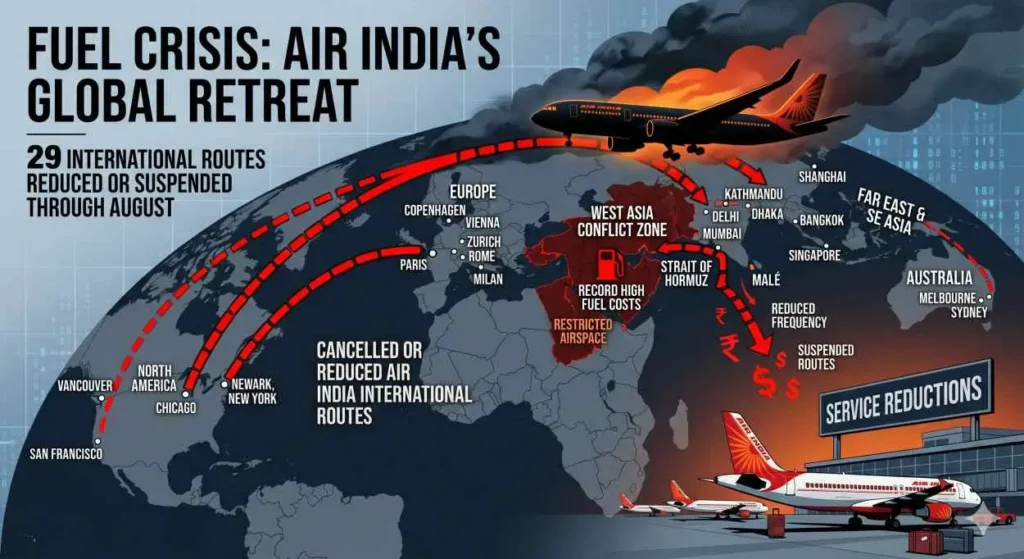
NEW DELHI, May 13 — Air India will suspend or shrink operations across 29 international routes from June through August as the West Asia conflict sends jet fuel prices skyrocketing. The airline isn’t hiding the brutal math behind the decision. Record aviation turbine fuel costs and closed airspace around the Strait of Hormuz have destroyed the commercial viability of these specific flights. They’ve pinpointed operational stability and the need to reduce last-minute passenger inconvenience as the primary drivers for this massive schedule reduction.
It’s a strategic retreat that spans five continents and impacts thousands of daily travellers.
Flight frequencies to North American hubs won’t survive the summer intact. The carrier is temporarily scrapping the Delhi-Chicago, Delhi-Newark, and Mumbai-New York flights entirely. Passengers flying out of Delhi to San Francisco will see their options drop from ten weekly flights to seven. And those headed to Vancouver will find only five weekly departures instead of seven. But the airline isn’t cutting everywhere. They’ve increased the Mumbai-Newark service from three weekly flights to daily operations, while keeping the Delhi-New York route on a daily schedule.
European routes face similar surgical cuts as the carrier scrambles to offset costs. The airline can’t sustain its current volume to major capitals. They’re reducing the Delhi-Paris service from 14 weekly flights down to seven. Travellers heading to Copenhagen, Vienna, Zurich, and Rome from Delhi will only have three weekly flights to choose from, down from four. Delhi-Milan drops from five to four. So how long can airlines sustain these brutal operating conditions when fuel dictates every strategic move?
The Far East, Southeast Asia, and SAARC regions aren’t escaping the axe. The airline completely suspended direct flights like Delhi-Shanghai, Chennai-Singapore, Mumbai-Dhaka, and Delhi-Malé through August. They’ve slashed the heavily trafficked Delhi-Singapore route from 24 weekly flights to just 14. Delhi-Bangkok drops from 28 to 21 flights starting in July. Even shorter regional hops face serious reductions. Delhi-Kathmandu plummets from 42 weekly flights to 28 in June, and then down to 21 for July and August.
Australian services won’t look much better. Air India is pulling back on its routes from Delhi to Melbourne and Sydney, reducing both from seven weekly flights to four. Industry experts tracking the crisis say carriers are facing mounting pressure from soaring crude oil prices and weakening travel demand. The threat forces them to fly longer, circuitous routes just to avoid active conflict zones in West Asia. It’s a logistical nightmare that pushes operating expenses past the breaking point.
The geopolitical crisis driving these cuts hasn’t shown any signs of cooling. The ongoing West Asia conflict directly threatens the Strait of Hormuz, a maritime chokepoint that handles nearly one-fifth of the global oil supply. Whenever tensions flare in this specific corridor, aviation fuel markets panic. Airlines globally are bleeding cash as the Iran war crisis chokes off the region. Air India’s leadership explicitly cited these record-high prices as the reason they can’t maintain commercial viability on planned long-haul services.
The financial damage goes far beyond a few cancelled tickets. Air India has already suffered estimated losses exceeding Rs 22,000 crore in the last financial year. This latest network rationalisation follows an earlier cut of roughly 90 daily flights in May. They can’t simply absorb the soaring costs indefinitely. The airline promises affected passengers free date changes or full refunds, but that doesn’t solve the broader industry-wide cash burn.
The pressure isn’t just coming from corporate balance sheets. Prime Minister Narendra Modi recently urged citizens to postpone non-essential foreign travel and adopt virtual meetings instead. He’s pushing the country to conserve foreign exchange amid the global disruption. It’s a clear signal from the top that the financial strain stretches far beyond the aviation sector.
Despite the severe scaleback, Air India insists they aren’t abandoning their global footprint. They’ll still operate more than 1,200 international flights per month across their remaining network. The global energy chokehold hasn’t broken the airline completely.