Raipur and nearby districts see long queues and temporary pump shutdowns as panic buying strains fuel supply and triggers confusion across Chhattisgarh.
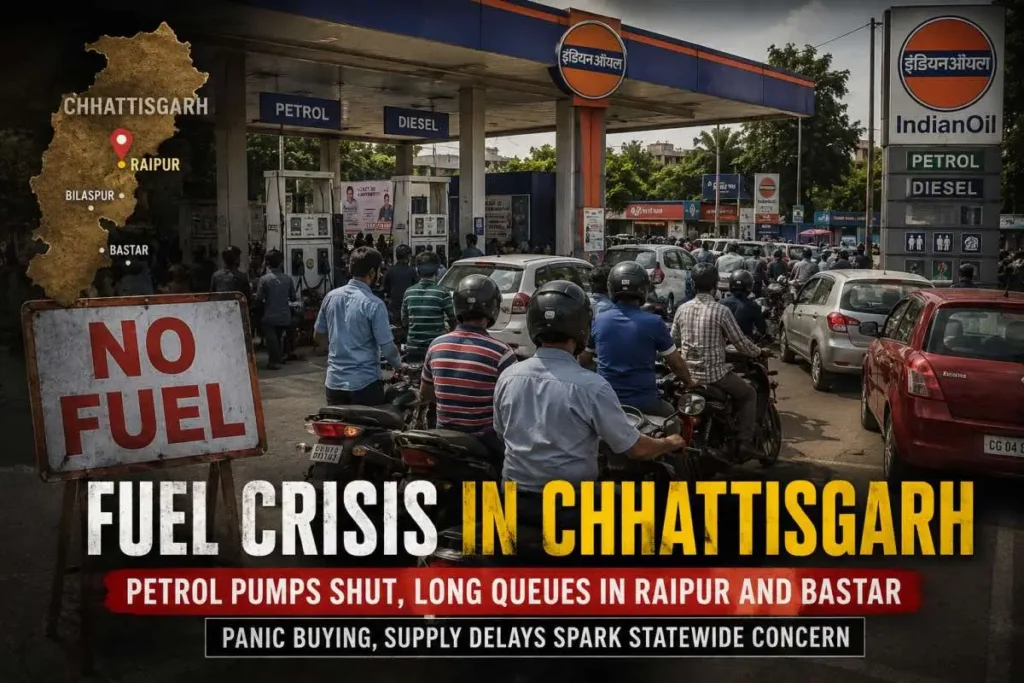
RAIPUR, May 15 — The first thing people noticed wasn’t an official announcement. It was the line.
Outside petrol pumps in Raipur, vehicles stretched onto roadsides as residents queued for fuel in numbers that caught even station staff off guard. Some pumps shut early. Others began rationing. And in a few locations, boards reading “No Petrol” appeared before sunset.
By evening, the same pattern had started showing up in parts of Durg, Bilaspur and Bastar.
The common thread wasn’t a confirmed supply breakdown from oil companies. Officials in Chhattisgarh have denied any statewide shortage and say supplies are being dispatched normally. But on the ground, demand has clearly surged faster than distribution systems can adjust.
And that gap — between supply flow and public perception — is where the trouble began.
In Raipur, several petrol stations reported stock running lower than usual after a sudden spike in footfall. People weren’t just filling tanks. They were topping up cans, bikes, scooters and backup storage, reacting to rumours circulating on messaging apps about possible shortages.
A simple chain reaction followed. One crowded pump led to another. One “no fuel” sign turned into three.
And suddenly, normal fuel stations started behaving like emergency points.
In Bastar region, the concern is sharper. Districts like Dantewada, Sukma and Bijapur depend heavily on tanker supply routes over long distances. Any delay in movement or sudden spike in demand can show up faster there than in bigger cities like Raipur.
There’s no official confirmation of a fuel supply collapse in Chhattisgarh. Oil marketing companies continue to supply petrol and diesel to stations, and state authorities have urged people not to panic buy.
But the scene outside pumps tells its own story.
One sentence kept coming up from people standing in line: “Kal milta hai ya nahi, pata nahi.”
That uncertainty more than actual shortage is what drives most of the rush.
India consumes nearly 5 million barrels of crude oil every day and imports most of it from overseas suppliers. The system is built on continuous movement: ships to refineries, refineries to depots, depots to tankers, tankers to pumps. If any link slows, the effect shows up quickly at the retail level.
Strategic reserves exist as a buffer for emergencies, but those reserves are not sitting at every petrol pump. They are crude stockpiles meant to stabilise national supply over time, not manage sudden local demand spikes in individual districts.
And that difference matters more than most people realise.
Because when panic buying begins, even a stable supply chain can look unstable at street level.
Diesel is where the pressure becomes more serious. Trucks carrying food, construction material and essential goods depend on uninterrupted diesel supply. Even short-term disruption can ripple into transport costs and daily pricing across markets.
For now, there is no confirmed nationwide shortage and no official declaration of crisis in Chhattisgarh. But the visuals from Raipur and nearby districts show how quickly confidence can shift when rumours and crowd behaviour move faster than supply logistics.
It didn’t start with empty pipelines.
It started with empty assumptions.
And in fuel markets, that’s sometimes enough.