The Punjabi superstar confronted disruptors during his Canadian tour, rejecting backlash over his television appearance and refusing to let extremists hijack his global platform.
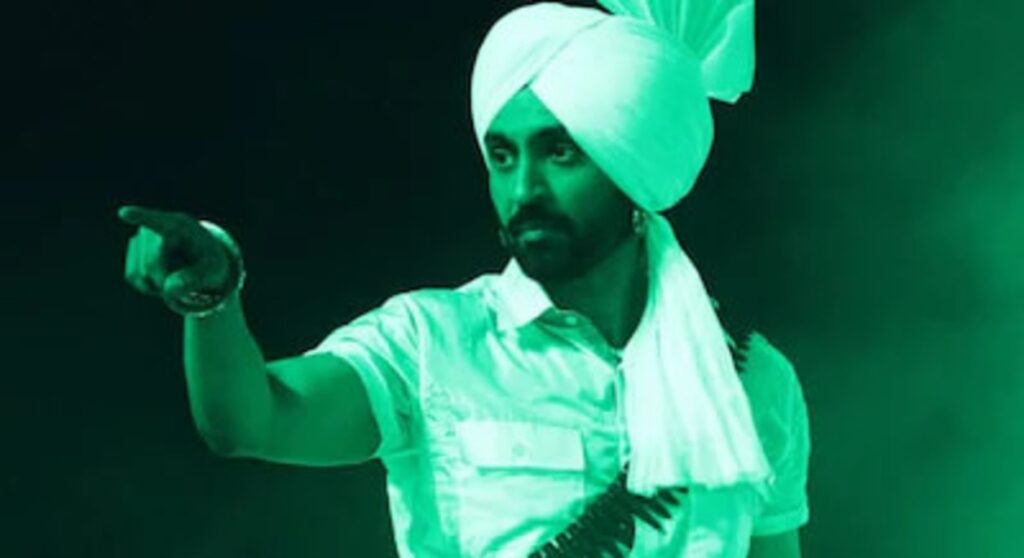
Diljit Dosanjh halted his Calgary concert mid-performance to confront a group waving Khalistan flags, instructing them in Punjabi to leave the venue immediately. He didn’t just eject them from the arena. He seized the moment to publicly defend his controversial television appearance alongside Amitabh Bachchan, tackling head-on the threats he’s faced from separatist factions since last October. It’s a rare, direct political confrontation from an artist who usually lets his music speak for itself.
The clash happened Thursday night during Dosanjh’s ongoing North American Aura tour. He spotted the yellow flags waving in the packed crowd and decided he wouldn’t let the provocation slide. “My job is not to do charity,” Dosanjh told the cheering audience, according to The Indian Express. “But whichever platform I go on, I always talk about Punjab.”
So, what exactly triggered this transatlantic standoff? It all traces back to Dosanjh’s guest appearance on Kaun Banega Crorepati 17 late last year. He’d gone on the Sony Entertainment Television broadcast to raise funds for Punjab flood relief. During the episode, he touched Bachchan’s feet—a traditional Indian gesture of deep respect. The veteran actor reciprocated by praising his relief efforts and declaring him “Punjab da puttar” (son of Punjab), while Dosanjh performed a hit track from his 2024 period musical Chamkila, directed by Imtiaz Ali.
But that brief television exchange ignited immense fury across radical diaspora networks. The Sikhs for Justice (SFJ)—a pro-Khalistan group that India banned in 2019 under the Unlawful Activities (Prevention) Act—immediately issued threats against the singer. They didn’t see an artist respecting a legendary actor. They saw a betrayal of their community’s deepest trauma.
The group’s anger stems entirely from Bachchan’s alleged role in the 1984 anti-Sikh riots following the assassination of Prime Minister Indira Gandhi by her Sikh bodyguards. After the KBC episode aired, the SFJ released a blistering statement. “By touching feet of Bachchan the man whose words orchestrated Genocide, Diljit Dosanjh has insulted every victim, every widow, and every orphan of 1984 Sikh Genocide,” the group declared. It’s a heavy, devastating accusation that Bachchan has spent decades fighting to disprove.
Bachchan has categorically denied any involvement in inciting the violence against the Sikh community. He’s addressed the accusations head-on in a detailed public statement, emphasising his family’s deep ties to the community and their shared grief during that violent era. He called the allegations a preposterous and blatant lie, insisting he’s always propagated the soothing of injured feelings and the maintenance of serenity. “The unfortunate incidents of the riots of 1984 against the Sikhs shall always remain a blot and a dark phase in the history of our country,” Bachchan wrote, explicitly stating that India prides itself on its secular credentials. He even attached a photograph of his Sikh maternal grandparents to prove his familial roots.
Yet, extremist factions won’t accept his defence. And the SFJ didn’t stop at issuing angry statements. The group actively threatened to disrupt Dosanjh’s concerts in Australia last year, leading to minor skirmishes and relentless online trolling. Now, they’ve followed him to Canada, hoping to hijack his record-breaking international tour for their political agenda.
They haven’t succeeded. Dosanjh used the Calgary stage to dissect their outrage and systematically dismantle their arguments in real time. “We often say national media doesn’t talk about Punjab enough,” he argued to the massive Canadian crowd. “I went everywhere, including on that channel for the sake of Punjab. I put forth Punjab’s issues there. I’ve even donated generously to my state whenever needed.”
He isn’t limiting his defence to his appearances on Indian television. Dosanjh reminded the audience that he didn’t just sing when he appeared on Jimmy Fallon’s US late-night show. He went there to bring Punjab’s history to a mainstream American audience, specifically highlighting the Guru Nanak Jahaz Komagata Maru incident. “I didn’t go there to promote any film or song,” he declared on Thursday. “If you still have an issue that I sat across someone on television, then keep waving how many flags you want to.”
Why hasn’t the diaspora forgotten a 112-year-old historical tragedy, and what does it have to do with a modern pop tour?
It’s everything.
Dosanjh has consistently woven the Komagata Maru incident into his global narrative because it’s central to the Punjabi diaspora’s experience. In 1914, a Japanese steamer carrying 376 passengers—mostly from Punjab—reached the shores of Canada but faced an immediate blockade in Vancouver. Canadian authorities detained them under racist immigration laws designed to keep them out, denying them entry despite their valid documentation as British subjects. It took over a century for the Canadian government to formally acknowledge the inhumane act, with Prime Minister Justin Trudeau finally issuing an official apology in 2016, followed by another from the Vancouver City Council in 2021.
For Dosanjh, this history isn’t an abstract textbook chapter; it’s geographically immediate and deeply personal. Last year, he performed for 55,000 people at BC Place in Vancouver, marking the largest-ever Punjabi music concert outside of India. He reminded that massive crowd that they were standing just two kilometres away from where the Komagata Maru passengers faced detention. “So, it’s a big thing for us now, 55,000 people in the one stadium there, just two kilometres away, you didn’t allow us to come,” he told them from the stage. “And now, here we are, man.”
He’s acutely aware of what his global platform represents, and he won’t let a radical fringe dictate how he uses it. Following the Australian skirmishes last year, he advocated for peace over politics. “For me, this Earth is one,” he told a Brisbane crowd, quoting his Guru’s teaching of ‘Ik Onkar’. “So, there is only love from my side for everyone, even if someone gets jealous of me or trolls me. I’ll always spread the message of love.”
In Calgary, he backed up that philosophy with firm, unyielding action. He didn’t negotiate with the flag-waving disruptors. He didn’t apologise for honouring Amitabh Bachchan. He simply stated his case, ejected the agitators, and returned to his music.
He’s making it explicitly clear that his loyalty lies with the people of Punjab, not with the politics of separation.