
The Pentagon admits no alien evidence exists — so why are classified UAP files landing in public view during one of Washington’s most turbulent political moments?
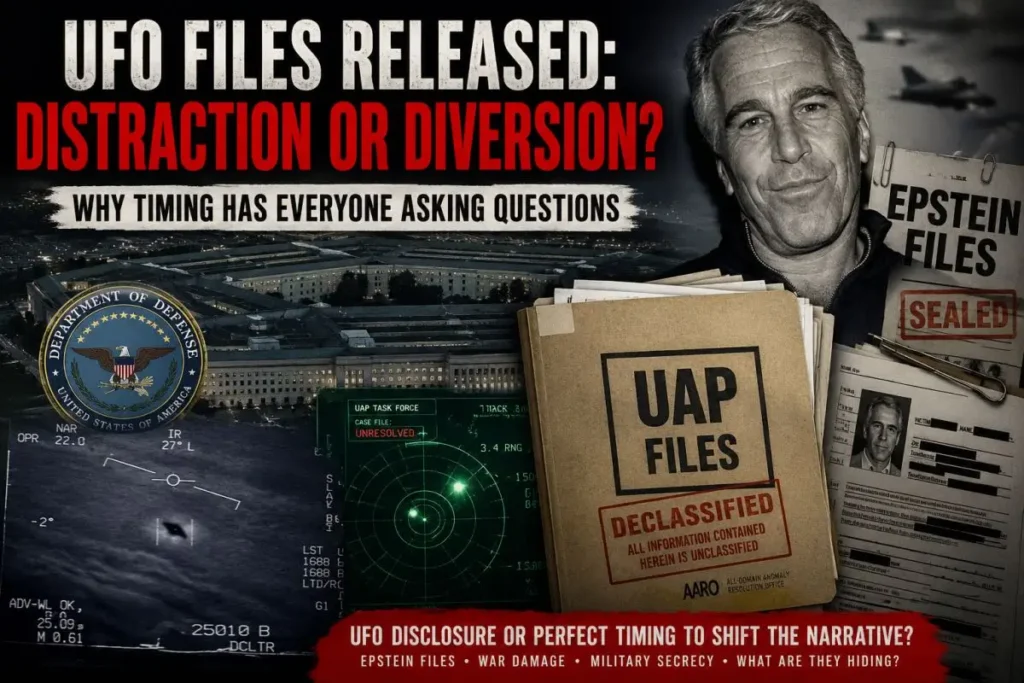
The U.S. Department of Defense has released a new batch of declassified documents on Unidentified Anomalous Phenomena, and the files have produced two separate storms: one about what’s in them, and a louder one about why they’re out now.
The material includes military pilot encounter reports, infrared footage, radar tracking data, intelligence memos, and historical investigation files assembled over decades by U.S. defense and intelligence agencies. The Pentagon’s All-domain Anomaly Resolution Office, known as AARO, has been the institutional face of this disclosure effort — and it has been consistent on one point. There is, officials say, no verifiable evidence that any of the reported objects are extraterrestrial in origin.
So the question hanging over the entire release isn’t about aliens. It’s about timing.
AARO’s official framing describes the documented incidents as unresolved aerial phenomena, possible sensor anomalies, foreign surveillance technology, drones, atmospheric effects, or cases where available data simply isn’t sufficient for any conclusion. Officials simultaneously argue the issue warrants serious investigation because unidentified objects operating near military installations represent a genuine national security concern. That dual position — worth investigating, but nothing confirmed — is exactly what critics find maddening.
If the files don’t prove anything extraordinary, why are they being released at this particular moment?
The disclosure lands during a stretch of acute political sensitivity in Washington. Public pressure around Jeffrey Epstein-related documents and sealed records hasn’t dissipated. U.S. foreign policy is facing sustained criticism over its connections to active conflicts, weapons transfers to embattled allies, and the human cost of proxy engagements across multiple theatres. Domestic trust in intelligence agencies, political institutions, and mainstream media is measurably low — and falling. Against that backdrop, a globally captivating, politically neutral, emotionally charged story about mystery objects in military airspace arrives like a pressure valve.
The most viral theory circulating across independent media and social platforms is the simplest one: the UFO narrative is pulling attention away from unanswered questions about Jeffrey Epstein’s network, his elite connections, and the sealed records that remain out of public reach. Proponents of this theory don’t argue that UAP sightings are fabricated. They argue the timing of their amplification is convenient. UFO stories generate enormous public engagement. News cycles pivot hard toward spectacle. Accountability stories lose oxygen when something more viscerally fascinating fills the room.
There is no public evidence of coordination between UAP disclosures and Epstein-related proceedings. But the coincidence in timing has been enough to sustain the theory across millions of posts and threads.
A second theory runs parallel. Critics suggest the disclosures may also function as a redirect away from the geopolitical fallout of modern U.S. military engagement. Washington is currently tied — through alliances, aid packages, intelligence cooperation, and direct strategic operations — to several of the world’s active flashpoints. Public debate over civilian casualties, the ethics of weapons transfers, defence spending overruns, and the outcomes of foreign interventions generates domestic political pressure. A sustained public obsession with unknown aerial objects is, in that environment, a far more comfortable conversation for official Washington than detailed scrutiny of the last decade’s military record.
Again, no evidence proves intent. But the suspicion itself is worth treating as data — because it reflects something real about how large portions of the public now process official announcements.
The third theory is more structural and perhaps the most overlooked. Some researchers and former intelligence officials argue the government’s actual goal isn’t to prepare the public for alien contact, but to normalise the presence of unexplained objects in sensitive airspace. Advanced drone systems, AI-driven surveillance platforms, classified aerospace technologies operating beyond what’s been publicly acknowledged — all of these could theoretically account for a portion of documented UAP sightings without a single extraterrestrial explanation required. Under this framework, the UAP disclosure program creates a durable public category — “things we can’t explain” — that absorbs awkward questions about classified domestic programmes without forcing their exposure.
Several former military and intelligence officials have publicly acknowledged that some sightings likely involve classified technology from either the U.S. or rival nations, primarily China. That’s not a fringe position. It’s been stated on the record, in congressional testimony, by people with direct access to the relevant programmes.
What does any of this add up to?
Whether the release reflects genuine institutional transparency, the results of years of sustained public and congressional pressure, or something more calculated, it lands in a media environment profoundly hostile to official narratives of any kind. Every major government disclosure now moves through a filter of competing interpretations simultaneously: legitimate revelation, propaganda, distraction, psychological operation, or political theatre staged for domestic consumption. The Pentagon can insist, correctly, that its released files contain no confirmed evidence of alien life.
But the public’s biggest question was never really about the documents themselves.
It’s about who decided this was the right moment to open the file cabinet — and what else was happening when they did.
Disclaimer: This article examines public theories, media analysis, and documented speculation around recent UAP disclosures. No verified evidence currently establishes that the Pentagon released these files to intentionally divert attention from Epstein-related proceedings, ongoing conflicts, or other political controversies.