
Elon Musk is bypassing traditional Wall Street pricing to dump 555.6 million shares onto the Nasdaq, fundamentally rewriting global market mechanics overnight.
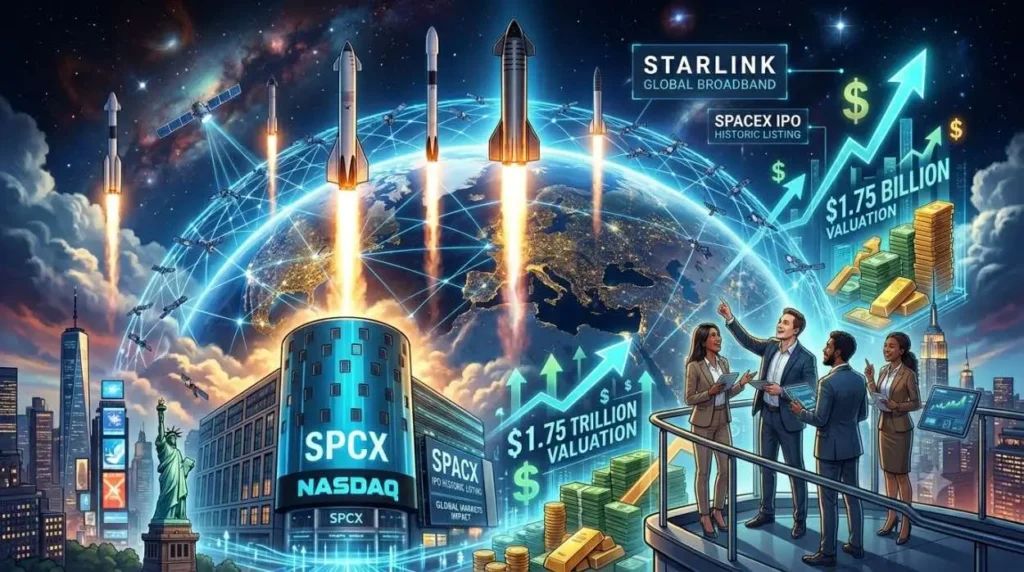
NEW YORK, June 12 — Elon Musk’s rocket and satellite empire isn’t just going public tomorrow; it’s actively shattering every financial benchmark in modern market history. SpaceX will debut on the Nasdaq exchange under the ticker SPCX after pricing a monstrous 555.6 million shares at exactly $135 each, securing a massive $1.75 trillion valuation right out of the gate.
The unprecedented $75 billion capital raise completely dwarfs Saudi Aramco’s previous record, proving global investors don’t care about the company’s highly unconventional corporate structure. Retail traders and institutional giants alike have already submitted purchase orders surpassing $250 billion before the final bell, according to order book data reviewed by Reuters. They’re throwing cash at a business that fundamentally operates critical infrastructure across multiple sovereign borders.
And that massive investor demand masks a structural shift in the company’s core economic engine. SpaceX isn’t primarily a rocket manufacturer anymore. Official US Securities and Exchange Commission filings explicitly reveal the Starlink broadband network generated $11.4 billion in 2025, representing a staggering 61% of total corporate revenue. The company boasts over 4.6 million active subscribers across more than 100 countries, dominating maritime, aviation, and rural residential markets. That consistent, recurring cash flow completely underwrites Musk’s broader ambitions, ensuring he doesn’t have to rely exclusively on unpredictable NASA contracts or commercial satellite launch fees.
So, the traditional financial establishment faces a completely unprecedented, borderless asset class. Major index providers like S&P Dow Jones Indices and CME Group are desperately scrambling to overhaul their baseline eligibility rules just to accommodate the sheer market weight of the SPCX listing. You can’t just drop a $1.75 trillion behemoth into passive tracking funds without violently displacing other massive corporations. The resulting capital rotation won’t just move markets; analysts warn it will physically drain liquidity from existing aerospace and defence competitors. Nasdaq regulators explicitly changed their timeline protocols, allowing mega-cap companies to qualify for index inclusion just five trading days after going public. They aren’t hiding the fact that Wall Street rules bend when enough money hits the table.
Can any traditional defence contractor survive when retail traders can directly fund military-grade satellite infrastructure? Wall Street hasn’t figured that out yet. Musk recently formalised an $80 billion merger with his artificial intelligence startup xAI, folding advanced compute capabilities directly into the SpaceX operational ecosystem. They’ve explicitly tied their orbital hardware to the booming AI data-centre narrative, forcing analysts to value the newly public firm as both an aerospace pioneer and an aggressive cloud technology platform.
It’s the most aggressive financial gambit of the century.
But the path to this historic market debut hasn’t been entirely smooth. Recent geopolitical friction directly highlights the massive risks inherent in privatising critical global communication networks. Earlier this year, Iranian state forces successfully deployed electronic warfare units to degrade Starlink connectivity across multiple provinces, executing the first verified nation-state attack on the satellite constellation, according to reports from Modern Diplomacy. Russian-supplied electronic warfare systems actively targeted Starlink’s specific frequency bands, transforming functional internet terminals into useless plastic bricks within hours. Hostile governments aren’t treating SpaceX like a rogue telecom provider; they classify the company as a direct strategic military threat.
Public market investors will now have to navigate those exact same geopolitical landmines. Every time a foreign military jams a satellite signal or a sovereign government bans Starlink hardware, that physical conflict will immediately reflect in the SPCX share price. You won’t find a historical precedent for a publicly traded corporation actively serving as the primary communications layer for active global combat zones. Despite the massive public float, Musk formally retains 85.1% voting control over the firm, meaning regular retail shareholders won’t have any actual power to alter his controversial foreign policy decisions. If the CEO decides to restrict broadband access to a specific nation’s military during a battlefield offensive, the board of directors can’t overrule him.
The listing mechanics themselves break almost every established rule on Wall Street. Instead of offering a standard pricing range and adjusting based on institutional feedback, SpaceX dictated the $135 flat price weeks in advance. Lead underwriter Goldman Sachs and the syndicate of 21 participating banks simply accepted the terms because they couldn’t afford to miss out on the largest fee pool of the decade. Reuters reports Musk also demanded an allocation of up to 30% of the IPO shares specifically for retail investors, drastically exceeding the standard 5% to 10% Wall Street normally reserves for the public.
They’re betting everyday people will hold the stock forever, creating an artificial floor under the share price regardless of quarterly earnings misses. Institutional portfolio managers hate that manufactured volatility, but they don’t have a choice in the matter. If you manage a global growth fund in 2026, you absolutely must own SpaceX to keep pace with the broader market benchmarks. The sheer scale of the $1.75 trillion market capitalisation means any fund ignoring the stock will instantly underperform its peers on day one. You aren’t just buying a space company; you’re buying the primary driver of Nasdaq returns for the next decade.
The company’s commercial momentum doesn’t show any signs of slowing down before the opening bell. United Airlines recently announced it will roll out Starlink hardware across its entire fleet of approximately 350 planes by the end of 2025. Aviation represents a remarkably high-margin vertical that traditional terrestrial providers simply can’t service effectively. When airlines sign multi-year contracts for continuous global connectivity, they’re locking in the exact kind of recurring revenue that Wall Street analysts desperately crave. SpaceX expects to dominate the entire transportation sector, from commercial flights to international shipping fleets.
This massive capital influx arrives exactly when the company needs to fund its next evolutionary leap. SpaceX engineers are currently preparing Starship V3, a next-generation launch vehicle designed to dramatically reduce the per-satellite deployment cost for the entire Starlink network. They aren’t just launching standard communication arrays anymore; they’re actively building orbital data centres to handle AI inference processing directly in space. The recent $17 billion acquisition of EchoStar also hands Musk the specific spectrum licences needed to beam cellular service directly to unmodified smartphones, bypassing traditional telecom carriers entirely. It’s an aggressive infrastructure play that threatens to make terrestrial cell towers and fibre-optic cables look entirely obsolete within a decade.
And the market debut tomorrow morning forces every global power to recognise a new reality. Sovereign states no longer control the ultimate heights of human communication or technological infrastructure. A single publicly traded corporation holds the keys, and they’ve just cashed a $75 billion cheque to lock their dominance in place.