Despite President Trump’s claims of historic progress, the two-day Beijing summit delivered few concrete agreements, prompting a sharp drop in the Dow Jones.
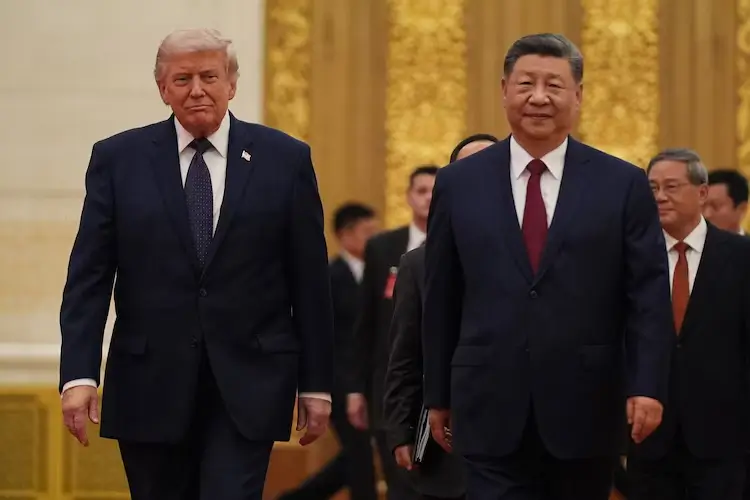
The Dow Jones Industrial Average dropped sharply as President Donald Trump wrapped up a two-day summit with Chinese President Xi Jinping in Beijing, leaving global markets spooked by a glaring lack of concrete agreements. Trump walked away from the high-stakes diplomatic meetings claiming immense progress on trade and global stability. But Wall Street didn’t buy the official optimism. Traders immediately dumped equities amid deep uncertainty over what the two leaders actually signed behind closed doors.
For all the grand handshakes inside the Great Hall of the People, the structural frictions between Washington and Beijing haven’t budged an inch. Xi pushed back aggressively on any notion of Taiwanese independence, drawing a firm red line under Beijing’s core territorial claim. The two sides left the negotiating table without a single major deal on paper. They couldn’t find common ground on curbing Iran’s nuclear ambitions, nor did they finalise the bilateral trade packages Trump had previously promised his domestic base.
So what did this high-profile meeting actually achieve? Trump framed the visit as a sweeping victory, telling reporters he had succeeded in settling “problems others couldn’t” during his face-to-face sessions with the Chinese leader. He didn’t offer any specifics or binding documents to back up that sweeping declaration. The administration’s failure to produce a joint statement speaks much louder than the presidential rhetoric.
Xi played a much longer, quieter game. The Chinese president used the two-day summit strictly to reinforce his government’s absolute refusal to compromise on Taiwan. Beijing views the island as a breakaway province, and Xi ensured they’ve maintained maximum diplomatic leverage by refusing any concessions. He won’t yield on territorial sovereignty, and the American delegation couldn’t force a shift in that fundamental posture.
That rigid stance guarantees the geopolitical temperature won’t drop anytime soon.
And the financial fallout was immediate and brutal. The total absence of fresh trade pacts or binding diplomatic frameworks sent a cold shock through the trading floors. Investors had priced in the expectation of at least a superficial bilateral agreement to stabilise tariffs, but the summit didn’t deliver a single compromise. The sharp decline in the Dow reflects a broader institutional anxiety that this superpower rivalry isn’t just continuing—it’s actively calcifying into a permanent standoff.
You can’t sell invisible progress to institutional investors. When the closing bell rang, the sheer volume of sell-offs laid bare the market’s complete lack of faith in the summit’s vague outcomes. Traders hate a vacuum, and Trump’s failure to detail exactly how he solved these historical problems hasn’t calmed anyone’s nerves. They’re looking closely at the macroeconomic data, and that data shows absolutely zero movement on the tariffs, sanctions, and export controls currently choking international supply chains. The vague promise of stability doesn’t pay dividends.
The failure to secure Chinese cooperation on Iran represents another massive diplomatic miss. Washington desperately needs Beijing to exert economic pressure on Tehran, yet the summit concluded without any framework to address Middle Eastern instability. Chinese diplomats haven’t shown any willingness to jeopardize their energy security to do Washington a favour. Trump couldn’t leverage American economic might to crack that specific alliance.
Even the promised trade stability evaporated entirely under closer scrutiny. Corporate leaders and agricultural lobbyists spent weeks anticipating a breakthrough that would lower barriers for American exports and ease restrictions on technology manufacturing. They didn’t get it. Instead, the Beijing summit functioned as little more than a high-budget photo opportunity, completely devoid of the granular, tedious policy work required to actually untangle the world’s two largest economies. The structural barriers remain exactly where they’ve always been.
Regional allies across the Indo-Pacific watched the proceedings with deep apprehension. Japan, South Korea, and the Philippines rely on American diplomatic weight to counter Beijing’s growing maritime assertiveness. They haven’t seen any evidence this summit restrained China’s regional ambitions. Trump’s vague assurances of stability don’t offer much comfort to nations staring down Chinese naval vessels in disputed waters.
This isn’t just a missed opportunity for bilateral relations. It is a stark indicator that the era of grand diplomatic bargains between these two powers has likely ended entirely. The structural divide on technology, human rights, and regional security hasn’t narrowed at all over the last forty-eight hours.
While the American delegation packs its bags with claims of renewed stability, the tangible results simply don’t support the official narrative. The severe flashpoints of Taiwan and Iran remain entirely unresolved. Both nations are retreating to their respective corners, preparing for the next phase of economic attrition, and they aren’t hiding it.
Ultimately, two days of closed-door diplomacy in the Chinese capital changed nothing on the ground. The posturing didn’t translate into policy. And it’s the global markets paying the immediate price.