N. Chandrasekaran will step down in February 2027 after Tata Trusts refused to back a third term over Air India’s staggering financial bleed.
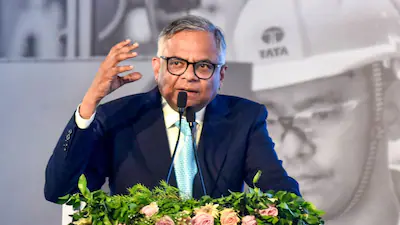
MUMBAI, August 12 — The architect of Tata’s modern empire is walking away. N. Chandrasekaran announced on Wednesday he won’t seek a third term as chairman of Tata Sons, pulling the pin on a simmering boardroom standoff with the conglomerate’s powerful charity arm. He told the board he will leave when his current term expires in February 2027 because he lacks the explicit backing of Tata Trusts. The resignation abruptly ends a nearly decade-long tenure that transformed India’s largest business house. The news wiped out boardroom stability and triggered an immediate 4% stock slide across top listed entities like TCS and Tata Motors.
The fallout didn’t happen overnight.
Chandrasekaran and Tata Trusts Chairman Noel Tata clashed repeatedly over the past six months. Tata Trusts controls 66% of Tata Sons, giving Noel Tata absolute veto power over executive appointments. According to senior directors cited by The Indian Express, the charity arm’s trustees informally decided against renominating Chandrasekaran ahead of a crucial August 13 trust meeting. The opposition killed a previously unanimous recommendation from the nomination committee to hand the 63-year-old executive another five-year extension.
Why would the majority shareholders force out the executive who multiplied the group’s profits fivefold?
The answer lies in the massive financial bleed happening outside the public markets. Noel Tata zeroed in on the staggering losses draining out of the group’s unlisted ventures. Air India’s losses more than doubled to Rs 22,238 crore in FY26, up from Rs 10,859 crore the previous year. The airline’s revenue shrank from Rs 78,636 crore to Rs 71,870 crore during the same period. Tata Digital burned another Rs 4,974 crore. Chandrasekaran poured billions into fleet expansions, aircraft orders, and tech infrastructure to resurrect the former state carrier, but the Trusts ran out of patience waiting for a financial turnaround.
And the bleeding wasn’t the only battleground.
The two camps fundamentally disagreed on whether Tata Sons should launch a public listing. The Reserve Bank of India classifies Tata Sons as an upper-layer non-banking financial company, mandating a public listing unless the company restructures its debt. Chandrasekaran refused to give Noel Tata a permanent commitment that the holding company would remain private forever. That ideological deadlock paralyzed the board. When directors met on February 24 earlier this year, Noel Tata demanded strict conditions for any leadership extension. Four directors stood ready to push the vote through, but Chandrasekaran tabled the decision, hoping for a consensus that never materialized.
Six months of executive limbo proved too much. In his statement on Wednesday, Chandrasekaran made it clear that a massive institution executing critical strategic projects can’t operate under a cloud of leadership uncertainty. Pointing to the massive investments locked up in semiconductors and aviation, he formally asked the board to find a successor quickly so the transition won’t derail the group’s momentum.
The market reaction was brutal and immediate.
Shares of Tata Consultancy Services, the group’s unquestioned cash cow, dropped over 4% to Rs 2,322 by Wednesday afternoon. Tata Motors Passenger Vehicles matched the plunge, while Tata Consumer Products and Tata Power shed roughly 2% each. Investors hate vacuums, and Chandrasekaran’s exit creates a massive one just days before the conglomerate’s highly anticipated August 18 Annual General Meeting.
The AGM itself operates under severe legal complications. The Maharashtra charity commissioner recently suspended the Sir Ratan Tata Trust (SRTT), a key shareholder, from making decisions pending an inquiry into alleged regulatory violations. Legal experts like Ruchi Khatlawala, a partner at Little & Co, told The Economic Times that if the AGM lacks a quorum, the company enters uncharted legal territory regarding director reappointments. Noel Tata, Darius Khambata, and Jehangir Jehangir are scrambling to secure permission from the charity commissioner to vote on August 18. Without their votes, the entire governance structure of Tata Sons hangs in the balance.
Chandrasekaran’s departure signals a profound shift for India’s corporate landscape. He took control of Tata Sons in 2017 during the explosive fallout from Cyrus Mistry’s unceremonious ouster. As the first non-Parsi professional to run the holding company since its founding, Chandrasekaran dragged the 150-year-old institution out of traditional manufacturing and into the future. He expanded the footprint into semiconductors, battery cell manufacturing, and digital retail. He pushed aggregate revenue from Rs 7.89 lakh crore in FY20 to Rs 16.24 lakh crore in FY26. Total profits skyrocketed from Rs 32,000 crore to Rs 1.71 lakh crore under his watch.
But high-growth ambition requires deep pockets. Tata Trusts clearly decided the price of aviation glory simply didn’t justify the risk to their philanthropic dividend. The charitable trusts rely on the dividends generated by Tata Sons to fund their hospitals, universities, and social programs across the country. Every rupee lost to Air India’s operational inefficiencies represents a rupee pulled away from those philanthropic commitments.
So the family closed ranks and reasserted its traditional authority over the corporate board. Noel Tata, the half-brother of the late Ratan Tata, quietly consolidated his influence over the trusts since taking over. He favoured giving Chandrasekaran only a two-year executive term to align with the group’s strict retirement age of 65, rather than another full five-year mandate.
The search for a new chairman begins immediately. Tata Group insiders told reporters the board will look both inside and outside the conglomerate for a replacement. They have until February 2027 to find an executive capable of managing $180 billion in assets while simultaneously keeping the powerful family trusts satisfied. It’s an impossible tightrope walk that Chandrasekaran managed for nearly a decade before the crosswinds finally knocked him off.
The next chairman inherits a sprawling, modernized conglomerate heavily burdened by unfinished aviation integrations and aggressive digital expansion plans. The Tata family successfully reclaimed absolute control over their legacy, but they’ve just lost their most effective operator in a generation.
The House of Tata belongs to Noel now.