
Three days into a joint U.S.-Israel bombing campaign that killed Iran’s Supreme Leader, Hezbollah has joined the war — and Trump won’t rule out ground troops.
By Rootsalert Global Desk
The War Just Got Bigger
The Middle East didn’t just escalate Monday. It detonated.
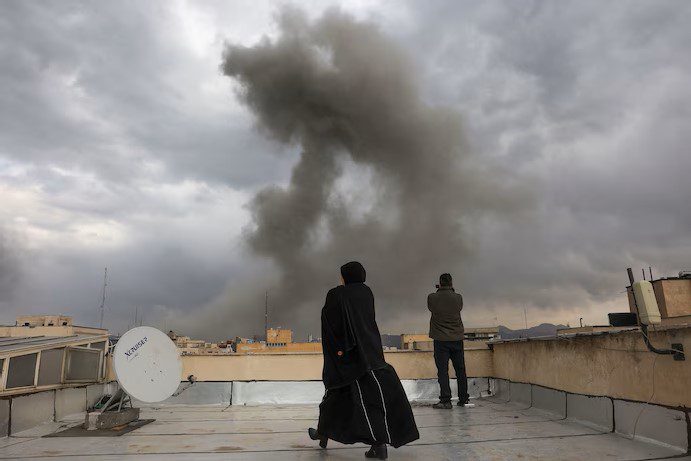
On Day Three of a joint U.S.-Israeli military campaign dubbed “Operation Epic Fury,” Hezbollah opened a new front by launching rockets and drones from southern Lebanon into northern Israel — a direct act of retaliation for the killing of Iranian Supreme Leader Ali Khamenei Wikipedia, whose death sent shockwaves through every capital in the region. Israel answered fast and hard. Israeli jets bombed Beirut at 3 a.m. local time, issuing evacuation orders to civilians across 50 villages in southern Lebanon and the Beqaa Valley.
Lebanon’s Health Ministry reported at least 31 people killed and 149 injured in the Israeli strikes, with roughly two-thirds of the dead in the country’s south.
So much for a contained operation.
President Donald Trump, speaking from the White House East Room Monday, said the U.S. military projects the operation in Iran could take four to five weeks — but has “the capability to go far longer than that.” He didn’t blink. He didn’t hedge. And when asked about ground troops, he didn’t rule them out.
Six American service members have now been killed since the campaign began February 28.Trump said he would “avenge” their deaths. “Sadly, there will likely be more before it ends,” Trump told reporters.
What nobody in the administration seemed eager to discuss: Pentagon briefers acknowledged to congressional staff that Iran was not planning to strike U.S. forces unless Israel attacked first — directly undercutting the White House’s “imminent threat” justification for launching the strikes.
Secretary of State Marco Rubio tried to hold the line. “We knew that if Iran was attacked — and we believed they would be attacked — that they would immediately come after us,” Rubio told reporters on Capitol Hill. He argued the Trump administration had gone in early to reduce American casualties. Whether that logic survives six body bags is another question.
The human cost inside Iran is climbing. Iran’s Red Crescent Society reported at least 555 people killed by the U.S.-Israeli campaign, with strikes hitting more than 130 cities across the country. A girls’ elementary school was hit in attacks on Minab. Twenty civilians were killed in Tehran’s Niloofar Square on March 2 alone.
Iran’s military, meanwhile, didn’t absorb the punishment quietly. The Islamic Revolutionary Guard Corps launched attacks on 27 bases across the Middle East where U.S. troops are deployed, as well as Israeli military targets in Tel Aviv. The UAE’s Ministry of Defence said its forces intercepted 165 ballistic missiles, two cruise missiles, and 541 Iranian drones since the conflict began. Dubai’s Burj Al Arab was targeted. So were international airports in Abu Dhabi and Dubai, Jebel Ali Port, Bahrain’s 5th Fleet headquarters, and the Al Udeid air base in Qatar.
The Gulf, in other words, is not a spectator.
The U.S. State Department urged Americans in more than a dozen countries — including Bahrain, Israel, Iraq, Kuwait, Lebanon, Jordan, Saudi Arabia, the UAE, and Yemen — to “depart now.” Tens of thousands of travelers remain stranded across the region with most airspace still closed.
Back in Lebanon, the Lebanese government called an emergency cabinet meeting and tried to assert control. Prime Minister Nawaf Salam announced a total ban on all Hezbollah military activities, demanding the group surrender its weapons to the state. Wikipedia Hezbollah’s Secretary-General Naim Qassem made clear he wasn’t listening — and Israel made clear it was already hunting him. Early reports suggested Israeli strikes in Beirut were targeting both Qassem and Hezbollah parliament member Mohammad Raad, whose body was reportedly being searched for in the rubble.
Inside Iran, the power vacuum left by Khamenei’s killing deepened. Security chief Ali Larijani announced a temporary leadership council would be established and warned that any “secessionist groups” attempting to capitalize on the chaos would face a harsh response. Iran’s foreign ministry, meanwhile, acknowledged the military had “lost control over several units” operating on old standing orders.
That’s not stability. That’s a country in freefall — with nuclear infrastructure still in the equation and no succession plan in place after 35 years of one man’s rule.
Britain isn’t in the fight, but it isn’t untouched. Prime Minister Keir Starmer confirmed the UK allowed the U.S. to use British military bases for operations against Iran, and Iranian-linked drones struck a British base in Cyprus. Starmer insisted London learned the lessons of Iraq. Whether the region gives him time to prove that is far from certain.
What comes next is anyone’s guess — and that’s precisely the problem. With Hezbollah now openly at war with Israel, Iran in political chaos, six Americans dead, and a U.S. president who won’t close the door on boots on the ground, the next 48 hours could define the next decade.