
Reporters Without Borders places India in the “very serious” category, citing the government’s aggressive use of the UAPA, defamation suits, and internet shutdowns to paralyze journalism.
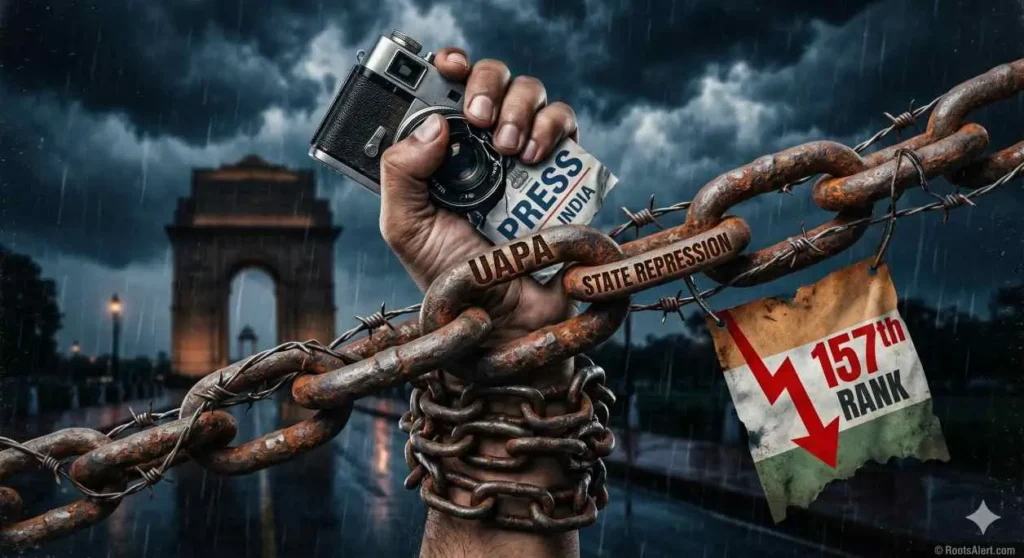
NEW DELHI, May 3 — India now ranks 157th out of 180 countries in the 2026 World Press Freedom Index. Reporters Without Borders (RSF) released the data today, delivering a brutal reality check to the world’s largest democracy on World Press Freedom Day. The country didn’t just slip; it plummeted six spots from its 151st ranking last year.
The numbers present a stark and undeniable indictment of the current media landscape. Pakistan sits at 153. Sri Lanka holds the 134th spot. It’s a bitter pill for New Delhi’s political establishment, but the data is absolute: both neighbouring nations, despite their own severe internal crises, currently outpace India in basic press liberties. So, how does a democratic superpower fall behind its regional peers? The RSF report points straight to a calculated, systematic crackdown by the state apparatus designed to silence critical voices.
The index formally categorises India’s press environment as a “very serious” threat to those working within it. Authorities aren’t hiding their methods or making apologies for their heavy-handed approach. The government increasingly weaponises the Unlawful Activities (Prevention) Act (UAPA) — a stringent anti-terror law originally meant to combat serious national security threats — against reporters who dare to challenge the official narrative. They pair this extreme legal maneuvering with a rapid surge in criminal defamation suits and sweeping national security charges. The strategy isn’t just about securing convictions in court; it’s about forcing reporters into permanent financial, emotional, and professional paralysis.
The legal process itself becomes the punishment. When a journalist is hit with a UAPA charge, securing bail becomes nearly impossible. Reporters are left languishing in jail for years without trial, their lives upended and their sources terrified into silence. The chilling effect this has on the broader journalistic community is exactly what the state intends.
And the assault doesn’t stop at the courthouse doors. The state’s persistent reliance on internet shutdowns keeps India in a bleak global spotlight. When the government cuts the digital cord in volatile regions, it’s not a temporary glitch; it’s a deliberate act of censorship. Reporters can’t file their stories, local sources can’t speak out safely, and the wider public remains entirely in the dark about the realities on the ground. It’s a highly effective tool for suffocating the truth before it ever reaches a printing press or a broadcast tower.
Newsrooms from Raipur to Delhi aren’t just compromised; they’re under active siege. The pressure from political elites often trickles down to media owners, resulting in self-censorship becoming the unwritten rule for survival. Independent journalists, particularly those reporting from smaller towns and conflict zones, face the brunt of this hostility. Without the backing of large corporate networks, they are easy targets for local strongmen and corrupt officials.
Reporters don’t just battle state-sponsored legal harassment; they face lethal, unchecked violence on the ground. The RSF data confirms that two to three journalists die in India every single year simply because they refuse to stop reporting. These aren’t accidents; they are targeted killings, often linked to investigations involving local mafias, illegal mining, or political corruption. This consistent death toll, coupled with a near-total lack of state protection and abysmal conviction rates for the perpetrators, solidifies the country’s reputation as one of the most dangerous places on earth for media professionals.
Looking globally, the contrast couldn’t be sharper. Norway dominates the top of the board, securing the number one position for a tenth consecutive year. They’re followed closely by the Netherlands, Estonia, Denmark, and Sweden, where press protections actually hold weight against the state, and journalists can hold power to account without fearing for their freedom or their lives.
At the other end of the spectrum, it’s a predictable lineup of authoritarian regimes. China occupies the 178th slot, while North Korea sits practically at rock bottom at 179. These are nations where the press operates entirely as an arm of the state.
India hasn’t reached those authoritarian depths yet.
But the state’s tightening grip, the weaponisation of laws, and the persistent violence against reporters show exactly where the country is heading.


Leave a Reply