Amit Shah got two chief ministers into one room. But the question that has kept Chhattisgarh and Odisha apart for a decade is simpler, and harder: who gets the water when the rain stops?
RAIPUR 03 October : A day after Union Home Minister Amit Shah brought the chief ministers of Chhattisgarh and Odisha to the same table in New Delhi, the long-running Mahanadi water dispute appears closer to a settlement than at any point in the last decade. Whether it will hold, however, depends on a question that neither government has yet answered in public: how much water will actually flow downstream when the monsoon is over.
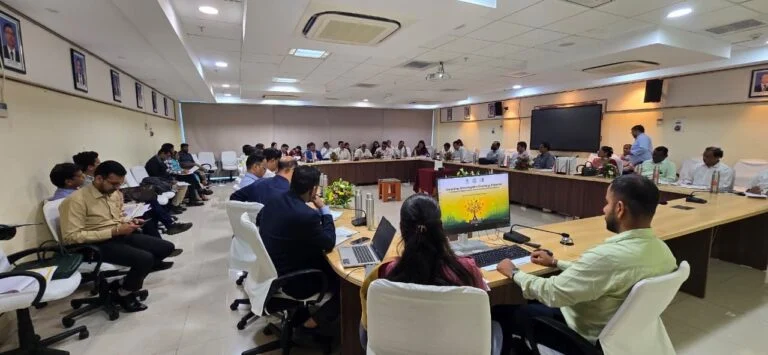
Shah chaired the meeting on Thursday with Chhattisgarh Chief Minister Vishnu Deo Sai and his Odisha counterpart, Mohan Charan Majhi. Both BJP-led states have reportedly agreed to accept the decision of the Central Water Commission on the matter. Speaking before the meeting, Sai acknowledged that the two states had been at odds over the river for many years.
The meeting capped a series of talks over the past few months. Senior officials of both states, including chief secretaries and water resources secretaries, met in New Delhi on August 31, and Majhi had chaired a high-level review in Bhubaneswar on July 24. Odisha BJP president Manmohan Samal said on Friday that he expected the issue to be resolved soon, and a related report in a regional outlet quoted Majhi as saying a final framework could be ready within three months.
The dispute itself goes back to 2016. That year, the Odisha government submitted a complaint to the Centre under Section 3 of the Inter-State River Water Disputes Act, 1956, seeking a tribunal to adjudicate the matter. Odisha, the lower riparian state, has long objected to the barrages that Chhattisgarh built on the upper reaches of the river. Reports from the earlier phase of the dispute named six of them, at Kalma, Saradi, Basantpur, Mirauni, Sheorinarayan and Samoda.
Chhattisgarh has consistently maintained that the river carries more than enough water. At an earlier round of talks, then Chief Minister Raman Singh argued that the flow reaching Odisha’s Hirakud reservoir was enough to fill it five times over. Odisha countered that construction upstream would affect drinking water and irrigation downstream. In the run-up to this week’s meeting, Odisha Revenue Minister Suresh Pujari pointed out that Chhattisgarh had already built barrages on the Mahanadi by the time the present Odisha government took office.
What gives the dispute its sharpness is the pattern of the river’s flow. Around 90 per cent of the Mahanadi’s water is said to flow during the monsoon months, and the river sustains over 30 million people across the two states. In July and August, there is little to quarrel over. The contest begins in the lean months, when the river thins out and barrages upstream decide how much reaches the fields and towns below. Earlier discussions had touched on this, including a proposal to install a Central Water Commission gauge station at the point where the river enters Odisha.
Neither state has made public what formula, if any, was discussed on Thursday. Several points will determine whether the settlement is credible: whether the framework fixes a guaranteed dry-season flow or merely divides annual totals, who will measure the flow and whether the data will be public, and whether the operation of the existing barrages will be tied to release rules.
The political context is also unusual. With the same party in power in Raipur, Bhubaneswar and New Delhi, a negotiated outcome is easier to reach than it would have been when the two states were ruled by rival parties. That also leaves less room for the kind of open contestation that usually keeps such agreements honest, which makes the terms and their transparency more important.
There is a further gap that the talks have not addressed. The negotiations so far have involved governments and technical bodies. The villagers, farmers and fishing families who live along the river, including those inside Chhattisgarh near the barrages, have not been part of the conversation.
If the three-month timeline holds, a framework could be on the table by early January. RootsAlert will continue to follow the talks and report on what the final arrangement says about water in the dry season.
Discover more from Rootsalert
Subscribe to get the latest posts sent to your email.